Charming & Immersive Platform Game …….

Upon the Super NES’s debut, with its vibrant colors and expansive sprites, developers found themselves in a new era – not just of games but of potential franchises. The market welcomed new characters, often mandated to come “with attitude,” offering developers the chance to establish enduring slices of the gaming pie.
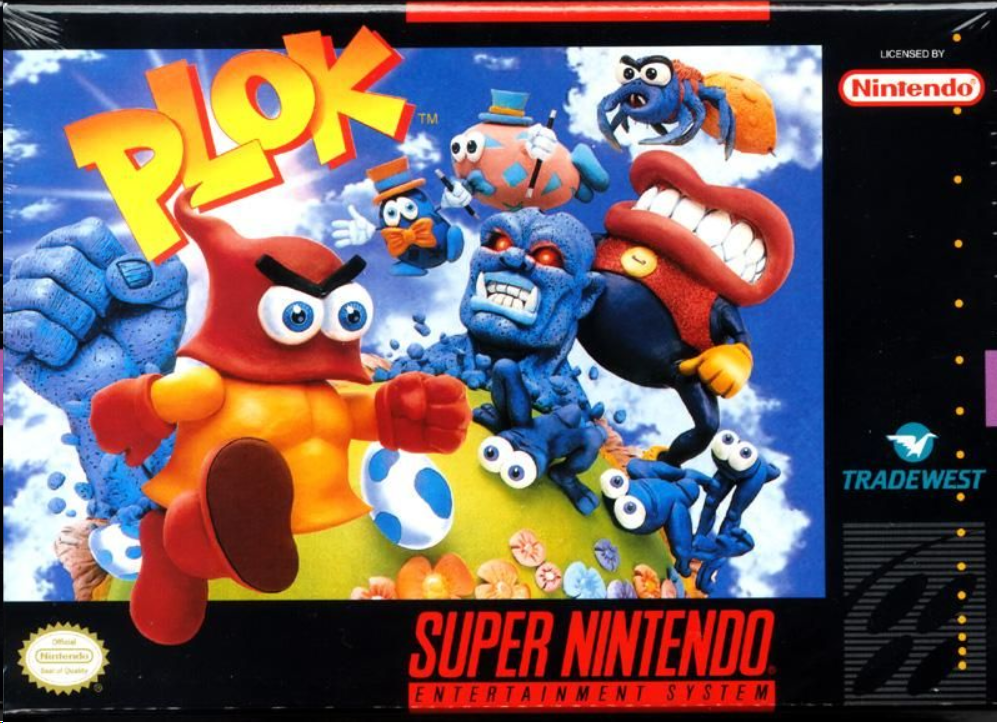
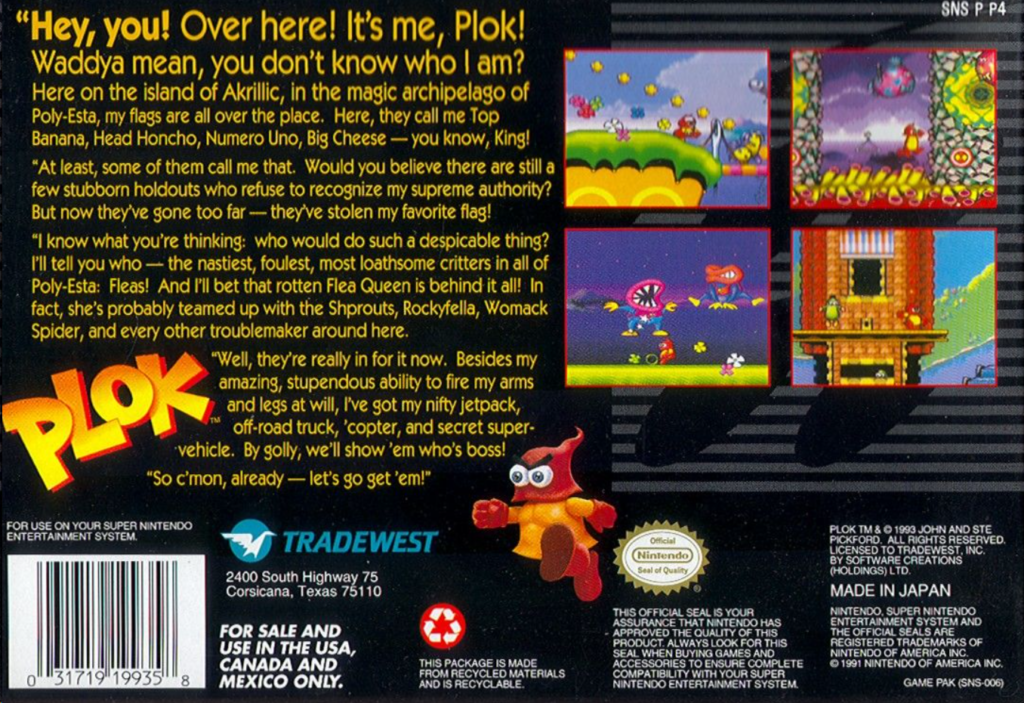
Looking at the Plok box today might suggest a game attempting a formulaic approach. Angry eyebrows are obligatory on the quirky cartoon hero, and the teaser text on the back, adopting the hero’s voice, recites a list of antagonist names that seems market-tested. While it’s not uncommon for a company to target all the hotspots of its demographic, such signs sometimes hint at a lazily designed game.
However, a single flip of the power switch dispels any concerns about Plok falling into that category. A splash screen appears with the hero playing the harmonica, and the title song’s lively introduction unexpectedly transforms into a rocking guitar solo. (While the Mega Man X games simulate heavy metal with their guitar sounds, Plok opts for upbeat blues rock.) Instantly, it becomes evident that both care and joy were invested in crafting the in-game universe.

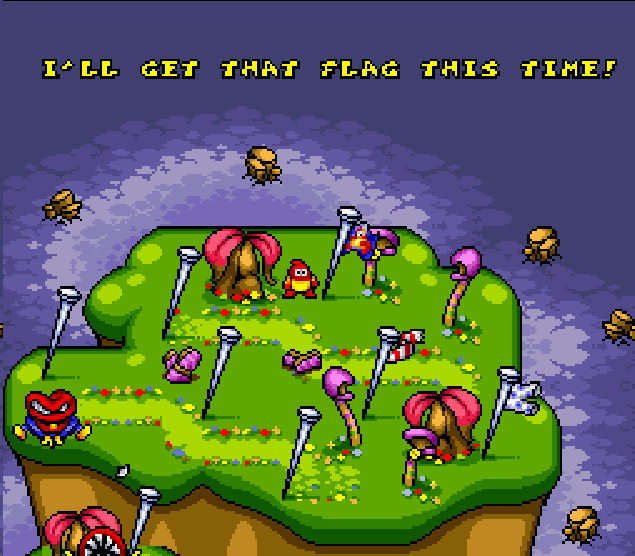
Plok’s mission is simple – he jumps, shoots, dodges enemies, and navigates from the left to the right side of the screen (at least, for now) across multiple levels. The primary hook to the gameplay is that Plok can only shoot as many projectiles as he has remaining limbs. With each shot, an arm or leg detaches and, if they miss, they drift back slowly to you. Meanwhile, enemies keep firing, and platforms continue to float, adding an element of strategy. Although the level design might not demand this yet (apart from mastering the feature), situations will arise where every shot must count. Firing off all your limbs too hastily leaves you guiding a weaponless, bouncing head (more on that later).
What makes this system great is that every aspect of Plok’s visual design – the colorful Claymation with peculiar staggered joints – serves a gameplay purpose. Whether the developers conceived a gimmicky cartoon hero first and then designed the gameplay or vice versa doesn’t matter. The interplay between design and interaction is omnipresent. This is the key distinction between a lasting game like Plok and, for example, Bubsy (not to single out the latter).
In comparison to the concise structures and expansive environments of 16-bit platforming pioneer Super Mario World or the sleek design of console powerhouse Super Metroid, Plok magnifies almost every element. The hero’s sprite is sizable, the enemies are substantial, their projectiles move swiftly, and the available space often feels brief and broad. Even the slightest enemy inflicts significant damage to Plok’s health bar, contributing to an initial impression of a somewhat cramped and challenging world, especially since the game dispenses with any kid gloves almost immediately.
Fortunately, the controls are precise, and the hit detection is intuitive. Plok can execute both short and high jumps with ease, providing players with a sense of confidence in a character who typically lacks power-ups.
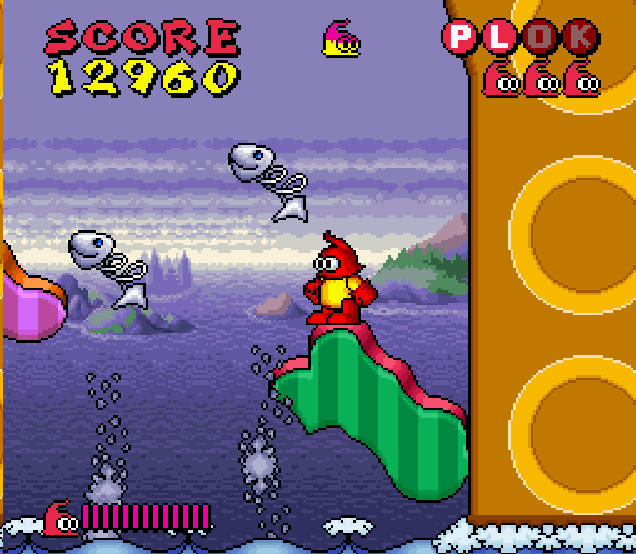
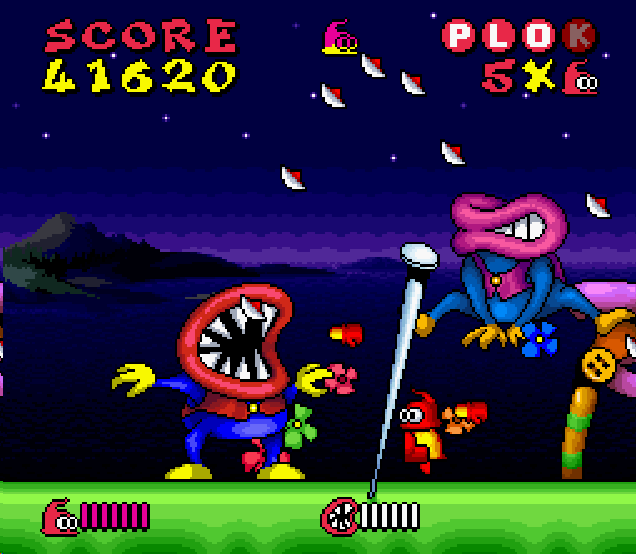
Plok’s diverse combat moves showcase the impressive graphical work in this game. Beyond simple ducking, Plok can gracefully move backward and forward while crouched, with a sprite that smoothly animates a crab-walk. This relatively uncommon move in a platformer is executed with such attention to detail that it becomes enjoyable to watch and rewarding when used to navigate through tight spaces.
It’s a good thing that this game can be picked up quickly because it seems designed to challenge you continuously and reset your progress frequently. There is no save or password feature, offering infinite restarts as long as the Super NES remains on, allowing you to continue after clearing precisely two bosses (there are a total of six boss fights, along with seven challenging levels between the penultimate and final boss). Continues can be earned at a rate of one per every four stages without dying (not necessarily consecutive), and extra lives are awarded as you collect seashells throughout the levels. While it may seem ruthless, these survival elements are integral to what makes the game enjoyable despite its steep difficulty.
In today’s gaming landscape, it might be considered almost heretical for a game that frequently challenges and shows little regard for your progress to be enjoyable. Admittedly, Plok may not appeal to everyone; even with decades of platformer experience, it managed to test my patience a few times. However, the game possesses certain qualities that make it enjoyable from the first stage to the final boss, regardless of the number of times you may face defeat.
One notable aspect is the captivating and often distinctive design of the levels and boss encounters. The initial boss battle exemplifies the Super NES’s capabilities by pitting Plok against two enormous adversaries who move at impressively fast speeds without causing any system lag. Like much of the game, winning on the first attempt seems nearly impossible, but as you grasp the enemies’ rhythm, it becomes a gratifying accomplishment. Another boss, Rockyfella, introduces a whac-a-mole gimmick, while the Penkinos fight defies easy descriptions: you must launch Plok’s limbs at a switch and time it so a massive spike net opens at the right moment to knock down one of the four menacing balloon pixies overhead. Such unique elements set this game apart.
The stage designs are also well-crafted, featuring secret power-up costumes that Plok can temporarily adopt, along with other concealed enhancements. Given the bonus lives and continues system that rewards collecting items and minimizing damage, the levels offer considerable short-term replay value—whether exploring hidden areas or confronting new enemy types unprepared during previous attempts.
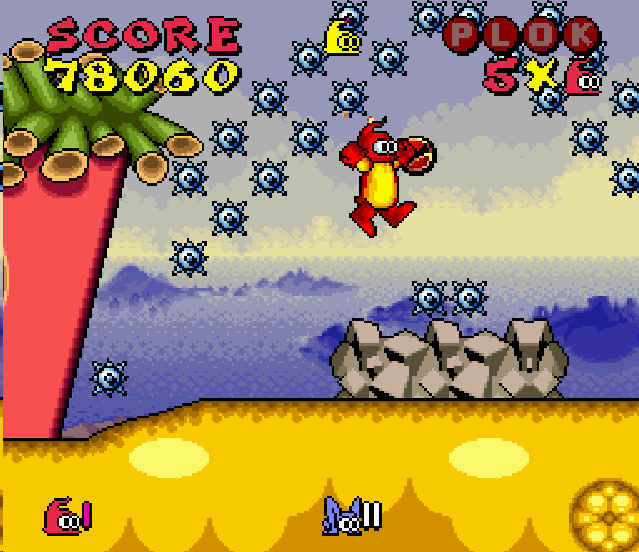

This is particularly evident in the Akrillic levels, the core segments between the initial boss battle and the “Bowser’s Lava World”-esque Fleapit. These stages are more open-ended, requiring players to locate an average of 10 to 20 Flea enemies, with the last one yielding Plok’s flag for that level. Different approaches can be attempted, offering varied ways to handle enemies and obstacles along the way.
Occasional puzzle elements demand Plok to temporarily sacrifice some of his limbs, which act as keys triggering level-altering switches scattered throughout. With fewer limbs, you have fewer bullets before briefly becoming a powerless bouncing head. The strategic tradeoff is clear: backtrack to find your switch-fired limbs and explore the level now, or risk proceeding with limited firepower?
The game encourages mastery of controlling a limb-compromised Plok, even mandating it for half a stage at one point. Fortunately, his bouncing head form is easy to control and predict. While enemies may pose a challenge in this form, it always feels like something you can overcome with a bit more practice. This skill becomes crucial for success in the final battle!
Apart from its exceptional world design, Plok stands out in the humor department, possibly doing for 16-bit platformers what Earthbound achieves for RPGs. The storyline, which essentially casts Plok as a self-proclaimed, slightly vain island governor against scheming vandals, is delivered with just the right touch of tongue-in-cheek humor. One of Plok’s power-up costumes allows him to shoot boxing gloves, complete with a 16-bit rendition of the Rocky theme music playing while he sports a helmet and a beat-up Rocky Balboa facial expression.
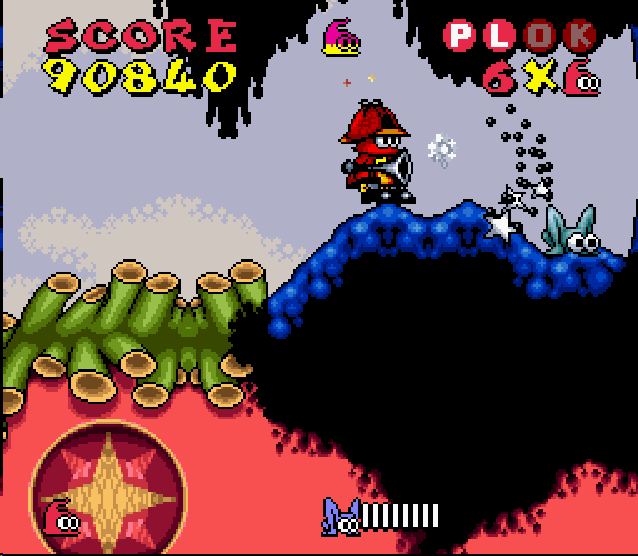

Most notably, the extended gameplay flashback featuring Plok’s grandfather stands out, providing a delightful simulation of old-timey Hollywood with villains sporting twirly mustaches. This segment captures the essence of self-contained genre humor, akin to the styles of South Park or Homestar Runner, making it a worthwhile section of the game on its own.
Lastly, and arguably most crucial in my assessment, is the music. Plok’s small but exceptional soundtrack demonstrates a mastery of the Super NES soundchip. It maintains an upbeat atmosphere, preventing the repetition of stages from becoming monotonous. The tropical level, for instance, remains engaging due to the late electric guitar introduced at the 1:40 mark of its song. Plok seamlessly combines level locations with musical composition, showcasing a genius that foreshadows the success of the Donkey Kong Country games.
An excellent illustration of this synergy is the Gohome Caverns theme. The basic melody progresses through three instruments: first, a whistle simulating wind passing through a cave, followed by a xylophone, evoking a rockier image reminiscent of Donkey Kong Country. Finally, it is overlaid with a toned-down version of the main Plok theme. The elements of the song complement the visuals of the level, injecting energy into a challenging, repetitive stage. Other tracks also anticipate the prowess of SNES soundtracks to come, with hints of Super Mario RPG in the bridge of the boss battle song and echoes of Tactics Ogre’s “Fog of Phantom” in the spooky level theme.
While Plok excels in many aspects, it’s important to acknowledge its primary weakness – repetition. The unavoidable nature of revisiting levels may turn some players away, especially during slower-paced stages like the Forest and Crag levels. The scarcity of secrets in the mid-to-late game feels like a missed opportunity, particularly when starting from scratch becomes a more laborious task. Despite these flaws, Plok stands as an example of how a video game can achieve remarkable success through simple yet effective design choices.
BREAKDOWN:
GRAPHICS: 84%
MUSIC/SFX: 88%
PLAYABLITY: 81%
OVERALL: 82%

Platform: Super Nintendo
Genre: Action-Platformer-2D
Developer/ Publisher: Software Creations / Tradewest
Release: 1993