A typical 80s 2D Brawler……….
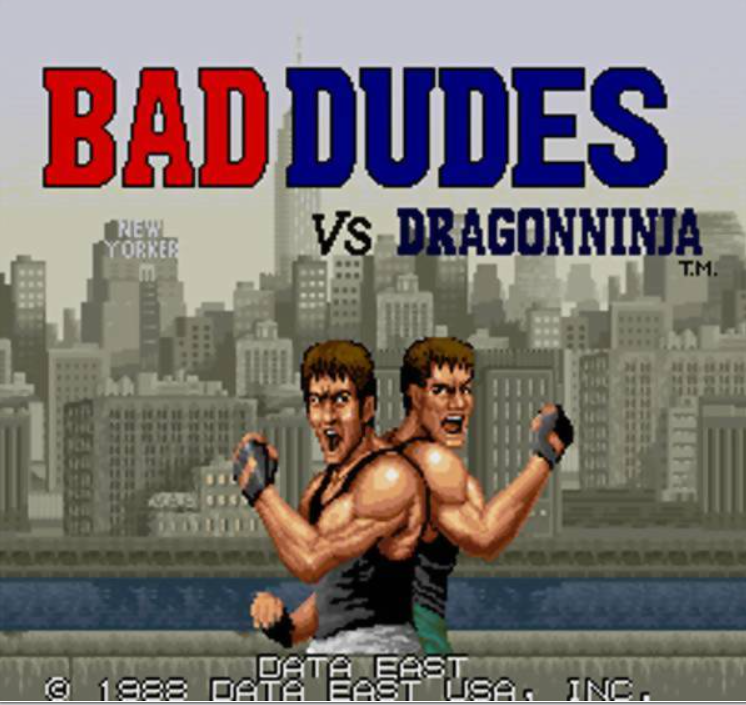
You know how you can watch a movie knowing absolutely nothing about it and still instantly place it in a specific era? That’s exactly the energy Bad Dudes vs. Dragon Ninja—hereafter referred to simply as Bad Dudes—radiates from every pixel. Whenever I need an example of the ’80s’ straight-faced indulgence in absurd premises and macho excess, Bad Dudes is always near the top of the list.
After picking up the Data East Arcade Classics compilation on Wii, I finally had access to the arcade original—best known today through its NES port. Since the emulation faithfully reproduces the arcade cabinet’s programming, it serves perfectly well as the basis for this review.
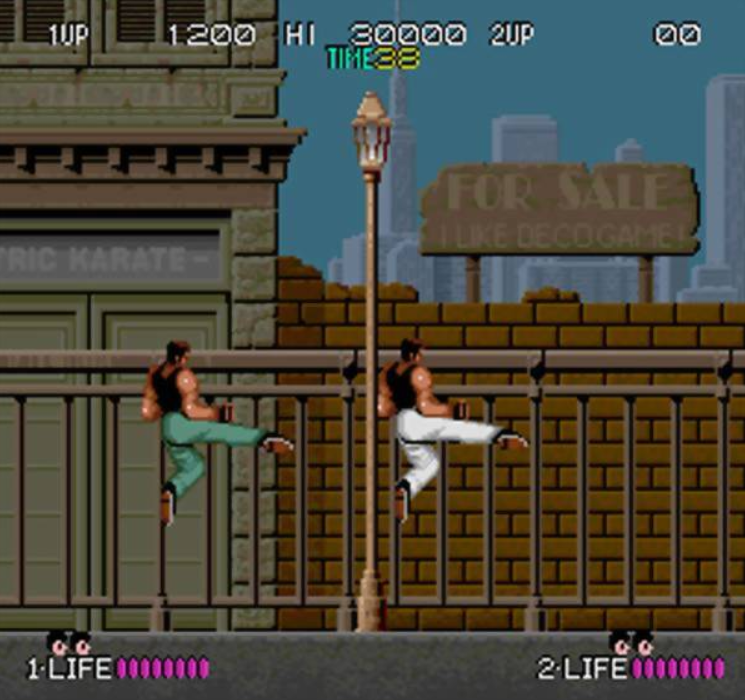
Story
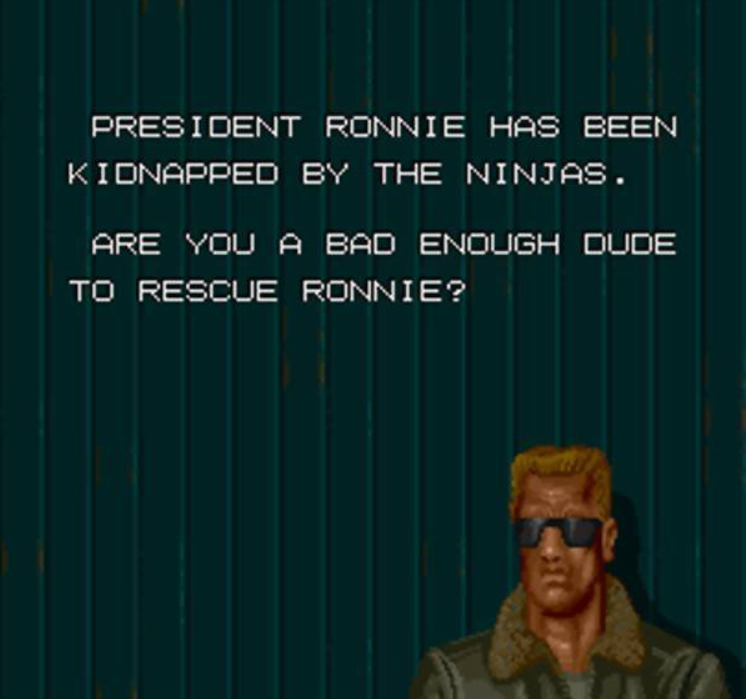
The plot of Bad Dudes belongs in the same “so serious it becomes hilarious” category as Commando. Many games and films try to manufacture laughs by parodying clichés or exaggerating archetypes, but few are as entertaining as those that earnestly commit to utter nonsense.
The setup is gloriously unhinged: in the late ’80s, ninja-related crime has spiraled so wildly out of control that even the executive branch isn’t safe. President Ronald “Ronnie” Reagan has been kidnapped by Japanese assassins. With the Secret Service presumably incapacitated by clouds of ninja smoke, a special forces operative turns to the only remaining option—recruiting two civilian street fighters to rescue the leader of the free world.
How does he persuade them? Money? Political influence? Not a chance. Instead, he questions their masculinity—specifically, whether they’re “bad” enough for the job. And in a decade defined by Power Gloves, bulging muscles, and unapologetic alpha-male posturing, that’s all it takes.
Thus, Blade and Striker hit the streets in tank tops, sweatpants, and Converse sneakers, ready to dismantle an army of ninjas. If the premise wasn’t already clear enough, each stage ends with the duo striking a pose and proudly declaring, “I’m bad!” Subtlety was not invited.
Graphics
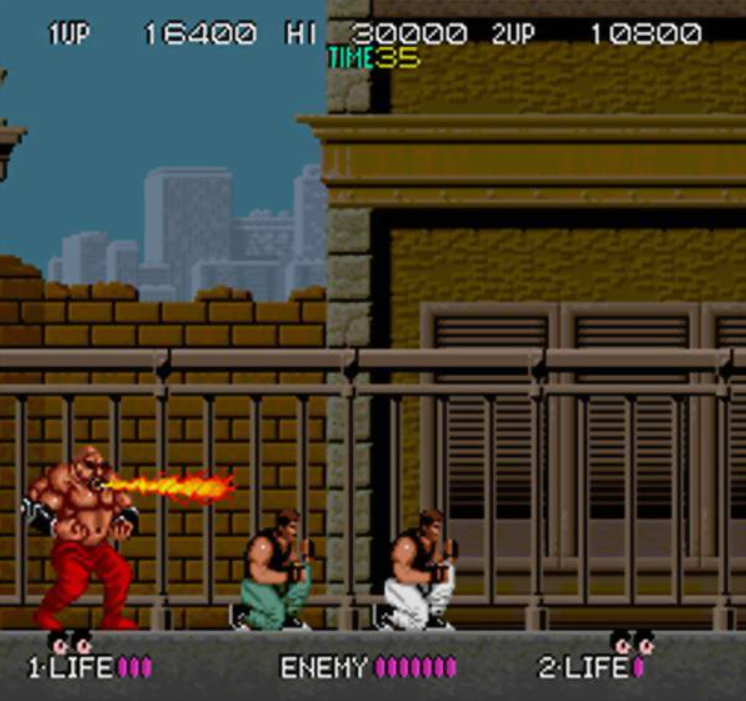
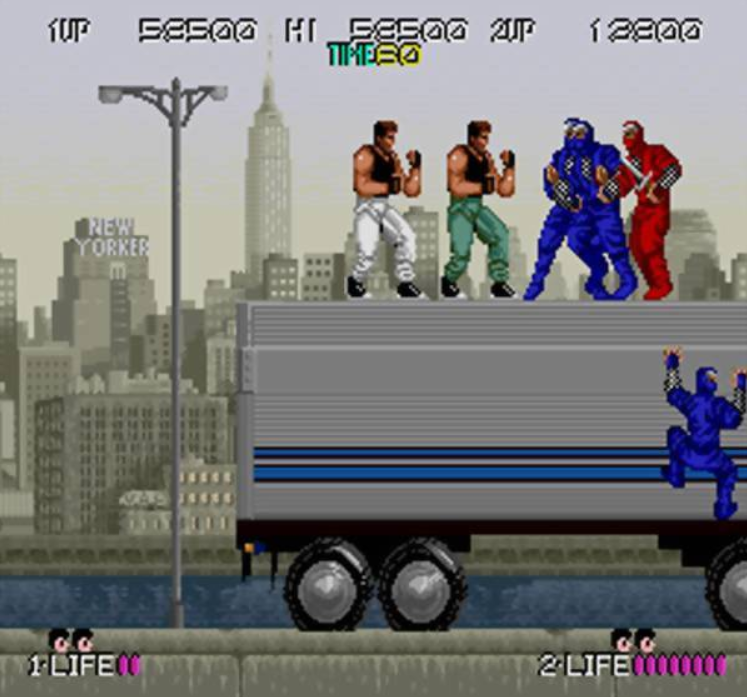
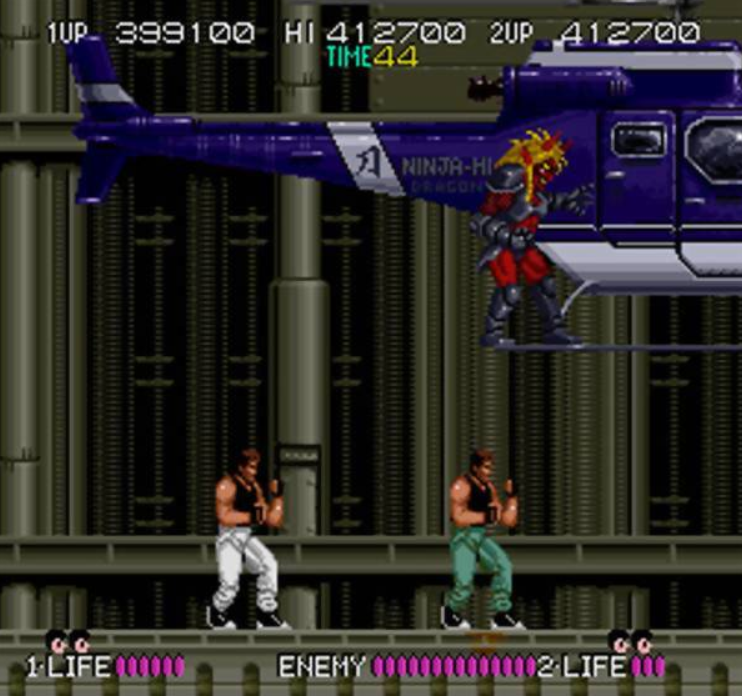
Visually, Bad Dudes is solid for its time, if not exceptional. You face an assortment of ninjas—naturally clad in historically accurate green, blue, and red outfits—alongside post-apocalyptic thugs, attack dogs, and even Karnov from Data East’s own game of the same name.
There are a few creative touches, such as a ninja who splits into multiple clones that attack independently while the original hangs back. Animation quality is inconsistent, though; the nunchaku, for example, barely animate when swung, which is a noticeable letdown.

Sound
The music and sound effects are respectable for a 1988 arcade release, though later brawlers like Final Fight would soon raise the bar. Still, the limited voice samples—especially the triumphant “I’m bad!”—are iconic and endlessly amusing.
Control
While the game runs smoothly without technical hiccups, the controls can be finicky. Transitioning between vertical tiers isn’t as responsive as it should be, and landing hits can feel awkward.
The biggest issue is the lack of proper collision boundaries. Enemies can overlap your character, meaning that when you’re surrounded, you often take unavoidable damage just trying to regain control of the space.
Gameplay
Combat unfolds on a single plane with occasional upper and lower tiers that allow you to reposition and break up enemy mobs. Most of the action is hand-to-hand, though you can briefly wield weapons like swords or nunchaku to increase damage.
Enemies attack from both sides, some leaping or throwing shuriken, forcing constant awareness. The move set is basic—punches, kicks, and jump-kicks—with no desperation or crowd-clearing moves. While not brutally difficult, a single misstep can quickly lead to being overwhelmed.
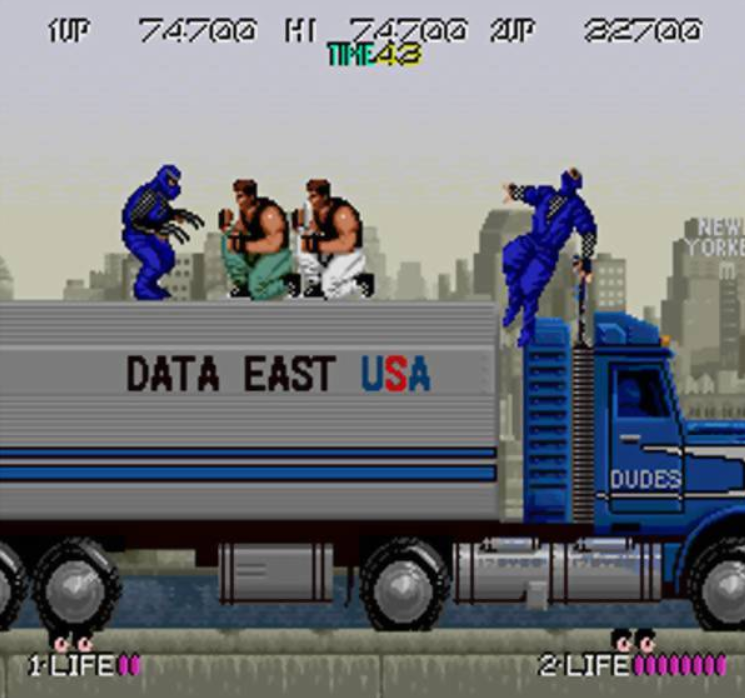
Boss encounters are varied and require different strategies, though the final stage repeats earlier bosses back-to-back. Level design occasionally shines, such as a standout sequence brawling atop a moving semi while ninjas leap from passing cars. The final showdown—fighting the ninja leader on a helicopter’s landing skids while dogs roam below—is visually memorable, if mechanically underwhelming.
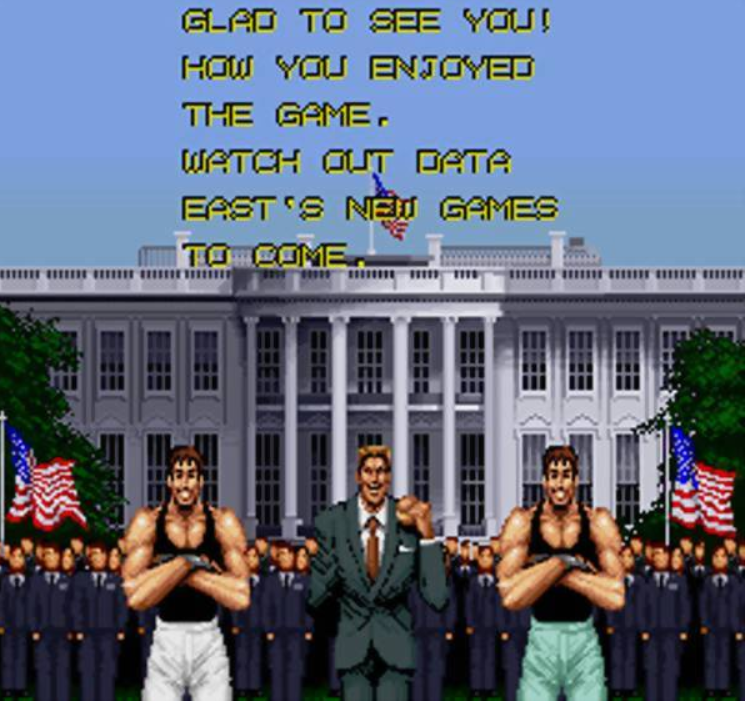
Two-player co-op, while standard today, was less common at the time and significantly enhances the experience. Overall, Bad Dudes stands as a solid but unspectacular beat ’em up from the transitional era between Renegade and Final Fight, remembered far more for its premise than its mechanics.
Replay Value
With identical characters, a single ending, and no branching paths, Bad Dudes offers little replay incentive from a mechanical standpoint. Its enduring appeal lies almost entirely in its camp value—the kind of game you boot up to share laughs with friends.
Overall
Purely as a game, Bad Dudes doesn’t stand out in the crowded field of 2D brawlers, even during the genre’s formative years. However, its cultural staying power is undeniable. Unlike many contemporaries, its legacy extends beyond a single meme-worthy intro.
The ’80s produced an abundance of absurd, hyper-macho action entertainment, and Bad Dudes vs. Dragon Ninja captures that spirit perfectly in arcade form. The game is available today—alongside its spiritual sequel Crude Buster (Two Crude Dudes)—as part of the Data East Arcade Classics collection for Nintendo Wii.
BREAKDOWN:
GRAPHICS: 79%
MUSIC/SFX: 77%
PLAYABLITY: 71%
OVERALL: 74%

Platform: Arcade
Genre: Action-Beat-em-up-2D
Developer/ Publisher: Data East
Release: May 1988
Franchises: Bad Dudes