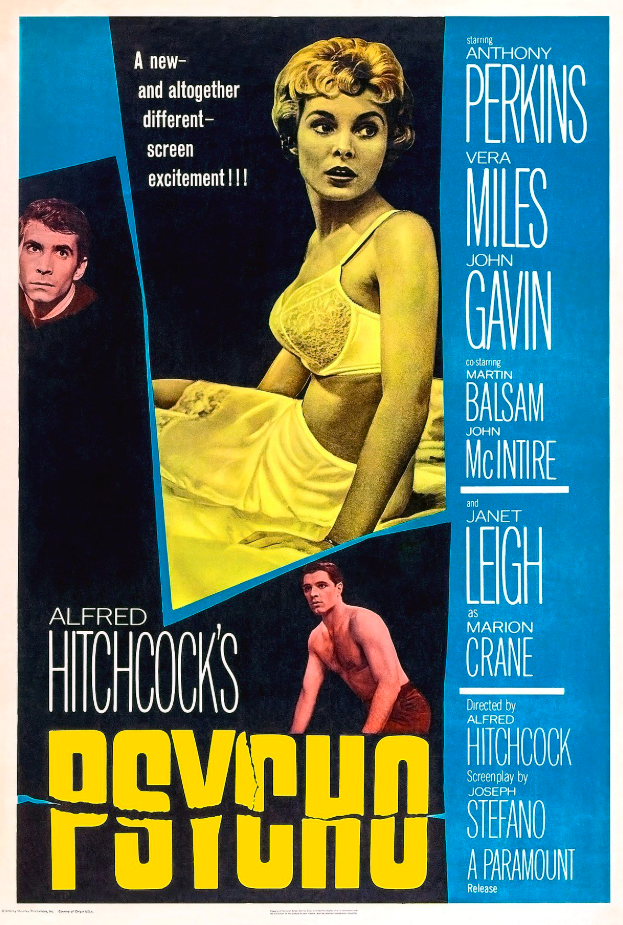
Alfred Hitchcock once told François Truffaut that Psycho “belongs to filmmakers, to you and me.” From the outset, Hitchcock deliberately set out to make the film resemble a cheap exploitation picture. Rather than using his usual high-budget feature crew—fresh off North by Northwest—he employed the team from his television series. He shot in black and white, allowed long stretches without dialogue, and worked with a modest $800,000 budget, even by 1960 standards. The Bates Motel and looming house were constructed on Universal’s back lot. In its raw, visceral impact, Psycho has far more in common with gritty noir quickies like Detour than with the polished elegance of Rear Window or Vertigo.
And yet, no other Hitchcock film left a deeper mark. “I was directing the viewers,” Hitchcock told Truffaut. “You might say I was playing them, like an organ.” For audiences at the time, Psycho was unprecedented in its shocks. Advertising warned viewers not to reveal its secrets, and no one could have predicted what lay ahead: the murder of Marion Crane (Janet Leigh)—the apparent heroine—barely a third of the way into the film, or the truth about Norman Bates’s mother. Hitchcock even marketed the film like a William Castle-style exploitation thriller, insisting audiences arrive on time: latecomers would otherwise wait in vain for a star who was already dead.
Those surprises are now common knowledge, yet Psycho remains profoundly unsettling. This endurance is due largely to Hitchcock’s mastery in areas that are easy to overlook: the careful construction of Marion Crane’s story and the deeply unsettling relationship between Marion and Norman Bates (Anthony Perkins). Hitchcock treats both elements as if they will anchor the entire film, investing them with complete seriousness and emotional weight.
The setup revolves around a familiar Hitchcock theme: the guilt of an ordinary person caught in wrongdoing. Marion steals $40,000, but she is no hardened criminal. We first meet her in a tawdry hotel room, sharing a stolen afternoon with her divorced lover, Sam Loomis (John Gavin). He cannot marry her because of financial obligations, forcing their relationship into secrecy. The stolen money comes from a crude, leering real estate client who implies that Marion herself could be bought. Her crime, then, is motivated by love, and her victim is repellent—a moral framing that invites our sympathy.
This storyline alone could easily sustain a full Hitchcock thriller, and it never feels like a narrative trick. As Marion flees Phoenix for Sam’s hometown of Fairvale, California, Hitchcock introduces another recurring obsession: paranoia about the police. A highway patrolman wakes her from a roadside nap and questions her, seeming almost able to see through her lies and into the envelope of stolen cash. Even after she trades her car, she spots the same officer watching her from across the street, arms folded, gaze unwavering. For first-time viewers, this appears to be the spine of the film.
Exhausted, frightened, and perhaps already remorseful, Marion drives on through a violent rainstorm before stopping at the Bates Motel. Her brief, fateful encounter with Norman Bates follows—and once again Hitchcock carefully convinces us that this relationship will define the rest of the movie.
Their extended conversation in Norman’s parlor is crucial. Surrounded by predatory stuffed birds, Marion overhears Norman’s mother berating him and gently suggests he need not remain trapped in this decaying motel, bypassed by the new highway. She shows him compassion, and in doing so begins to reassess her own choices. Norman responds with shy warmth, but beneath it lies fear—fear of intimacy, of change, of his own feelings. That fear seals Marion’s fate.
When Norman spies on Marion, Hitchcock noted that audiences typically read it as voyeurism rather than a prelude to murder. Truffaut observed that the film’s opening—Marion in her underwear—primes the audience for this interpretation. Nothing prepares us for what comes next.
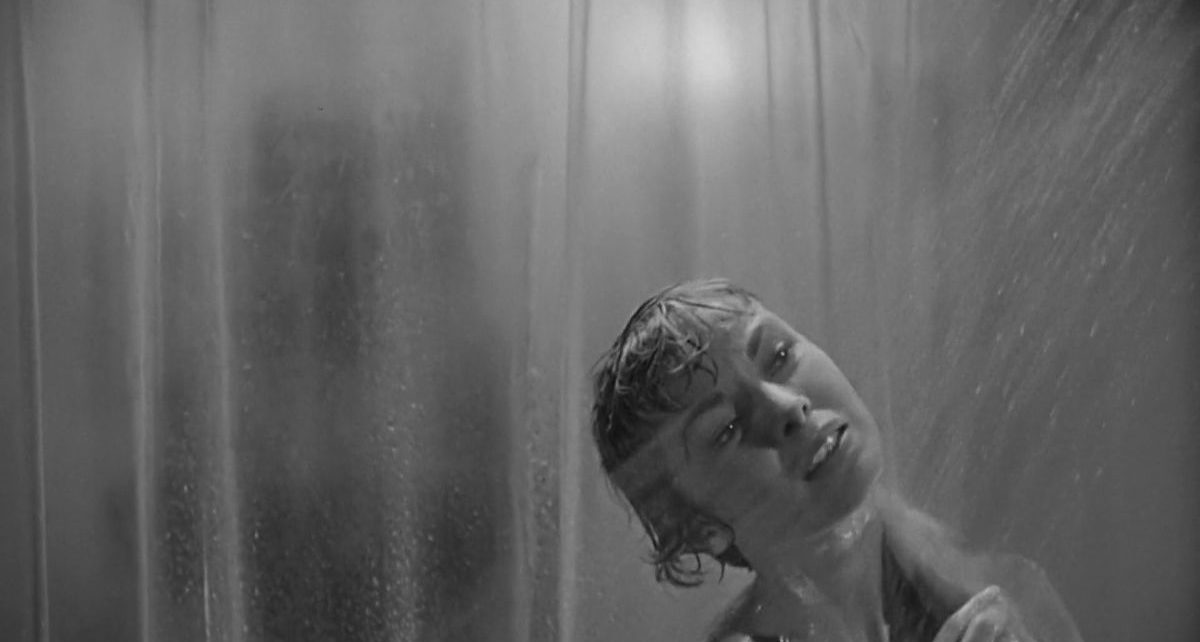
Viewed today, the shower scene remains remarkable for what it does not show. The knife never penetrates flesh. There are no visible wounds, no torrents of blood. Hitchcock chose black and white precisely because he believed color would be unbearable. Bernard Herrmann’s shrieking strings replace explicit violence, and the scene ends not with gore but with imagery: blood and water spiraling down the drain, dissolving into a close-up of Marion’s lifeless eye. It remains cinema’s most effective murder scene, proof that suggestion outweighs explicit detail.
Anthony Perkins delivers a defining performance as Norman Bates. He subtly conveys something deeply wrong beneath Norman’s boyish charm—his nervous gestures, awkward smiles, and evasive stammering when conversation turns personal. At first, he earns both Marion’s sympathy and ours.
After Marion’s death, Hitchcock performs one of his boldest manipulations: he transfers our identification to Norman. As Norman cleans the bathroom with meticulous care, we find ourselves sharing his dread—not because we condone murder, but because we recognize his terror of discovery. This shift culminates in the unforgettable image of Marion’s car sinking into the swamp. When it hesitates before disappearing, we realize, uncomfortably, that we want it to sink as much as Norman does.
By the time Sam Loomis returns with Marion’s sister Lila (Vera Miles), the film has already given us a new protagonist. This substitution is among Hitchcock’s most audacious narrative sleights of hand. The remaining acts deliver effective melodrama and two major shocks: the murder of the private investigator Arbogast (Martin Balsam) and the revelation of Norman’s secret.
Yet one final surprise remains—though not an entirely welcome one. After the mystery is resolved, Hitchcock abruptly undercuts the tension with a long-winded psychiatric explanation delivered by a doctor (Simon Oakland). The scene is oddly flat, even comical, and feels painfully out of place.
Were I bold enough to reedit the film, I would keep only the psychiatrist’s essential line: “Norman Bates no longer exists. He only half existed to begin with. And now, the other half has taken over, probably for all time.” Everything else would go, cutting directly to Norman wrapped in a blanket as his mother’s voice speaks. That, I believe, would leave Psycho nearly flawless. No convincing defense of the psychiatric exposition has ever emerged, and even Truffaut discreetly sidesteps it.
What ultimately makes Psycho immortal—while so many films fade as we exit the theater—is its direct connection to our deepest fears: the fear of committing an impulsive crime, the fear of police scrutiny, the fear of becoming a victim of madness, and, perhaps most unsettling of all, the fear of disappointing our mothers.