An extremely rare arcade game – and a pretty good one at that….

Fuuki, a relatively modest company known primarily for their adorable puzzle games, took a leap into the 2D fighting genre with Asura Blade: Sword of Destiny, marking their inaugural venture in this competitive field. Surprisingly, their foray into the genre proved to be more than satisfactory
Story
In the realm of Asura Blade: Sword of Destiny, a unique blend of a futuristic and medieval world unfolds. While envisioning such a concept may require a touch of imagination, it sets the stage for an intriguing setting. However, it’s important to note that apart from the character and stage names, the rest of the game is presented solely in Japanese, making it difficult to fully comprehend the intricacies of the story.
GamePlay
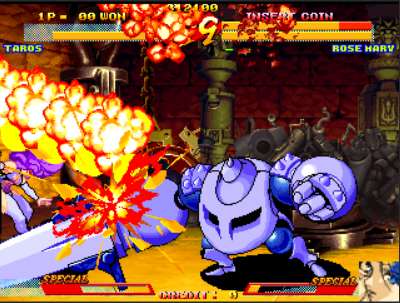
The gameplay of Asura Blade: Sword of Destiny closely resembles that of Guilty Gear, with several similarities and a few variations. As a primarily weapon-based fighter, you have the option to fight bare-fisted or with your chosen weapon. At the start of each round, you begin armed, but by pressing A.B.C, you can throw your weapon at your opponent, similar to the mechanics in Samurai Shodown. If you wish to fight armed again, you must retrieve your weapon.
Unlike some other fighting games, Asura Blade lacks an “Aerial Launcher or Dust” move. Instead, it introduces a “Bash Attack” that can either slam your opponent to the ground or bounce them off the corner wall, allowing for an ES move or an impressive combo. While this may not sound groundbreaking, mastering the controls will enable you to execute wicked combos that may impress your friends or online opponents. The combo system in Asura Blade resembles SNK’s Real Bout Fatal Fury, featuring “Chain-Special” combos that involve starting with a light attack, followed by a medium attack, and often followed by a Bash Attack and an ES attack.
Another unique element in Asura Blade is the “Push Back” mechanic. When your opponent relentlessly attacks you, the Push Back move knocks them away, giving you a chance to reassess your strategy. The gameplay of Asura Blade leans towards a fast-paced experience with a simple yet combo-friendly system. Despite techniques like the Bash Attack and Push Back, the gameplay lacks significant depth compared to titles like Killer Instinct 2.
In contrast to certain Capcom fighters, the ES special moves in Asura Blade are quite powerful, dealing substantial damage similar to some of the game’s supers. As a result, the supers may seem somewhat underutilized, as they require a full energy bar compared to the ES moves that only need a specific amount of energy. Overall, the play mechanics in Asura Blade are decent and solid for a three-button fighter, offering a satisfying experience without overly flashy or intricate techniques.
Controls
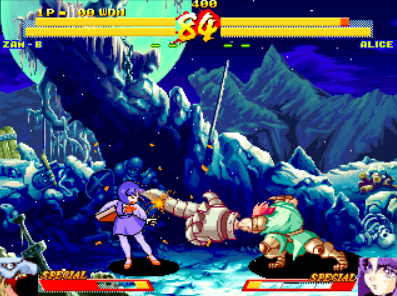
Asura Blade features a straightforward control scheme revolving around three buttons: Light, Medium, and Strong attacks. The controls are intuitive and highly responsive, making it easy to execute special attacks and perform combos with precision.
Graphics
The backgrounds in Asura Blade are creatively designed, featuring subtle animations and up to four layers of parallax scrolling. Some backgrounds even incorporate warping floor scrolling reminiscent of Street Fighter 2, adding depth to the visuals. Most of the backgrounds are stunning, such as the captivating Float Castle stage where you battle in a shallow lake with its reflection shimmering on the water’s surface. However, one aspect that may disappoint some players is the reuse of backgrounds for certain characters, like Rosemary/Taros and Curfue/Goat/Alice. Considering the game only features 10 characters (including bosses), it would have been nice to see a few more unique backgrounds included.
The character designs in Asura Blade have a distinct SNK-inspired aesthetic that exudes charm. They possess a rough yet appealing hand-drawn look, with vibrant colors and smooth animations that fall slightly below Night Warriors but surpass Guilty Gear on the PlayStation. The characters’ move sets consist of standard 2D fighter techniques like anti-air attacks and projectiles, with the ES special moves being the standout feature. Additionally, the facial expressions displayed when being hit add a touch of humor to the game’s lighthearted and less serious tone. Special effects are present throughout, including flashy flashes during super and ES moves, as well as flame effects when characters sustain damage, all of which are decently executed.
Characters
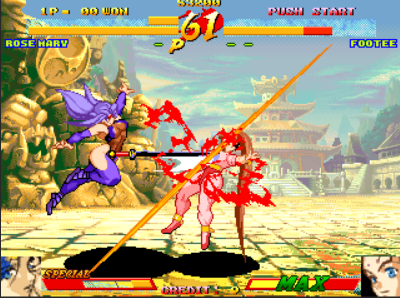
The cast of characters in Asura Blade, including Goat, Yashou, Alice, Rosemary, Taros, Lightning, Zam-B, Footee, Curfue, and the final boss S-Geist, is an eclectic and lively group. Their designs draw inspiration from both Night Warriors and Guilty Gear, but while they possess their own distinct personalities, they lack the same level of flair, particularly when compared to the vibrant cast of Night Warriors. For instance, Rosemary and her demon sword showcase a unique design, but upon closer examination, she resembles nothing more than a female iteration of Donovan from Night Warriors. The more I contemplate the characters, the more they seem unoriginal.
It’s true that many fighting game characters often adhere to certain stereotypes, such as grapplers, martial artists, or mutants. It appears that most fighting games released follow a predetermined DNA chart, with developers incorporating small tweaks and additions to create what essentially feels like a new version of older games, rather than offering something truly different. This pattern becomes apparent when comparing Asura Blade to Sega’s EC-CftDS or other fighters in the genre. It raises the question of whether these games are truly innovating or merely presenting a familiar formula with a fresh appearance.
Sound/FX
The sound effects in Asura Blade are generally satisfactory, although they tend to be a bit soft. For instance, when two swords collide, the resulting sound is barely audible, lacking the impact one would expect. While most of the sound effects are decent, there is room for improvement in terms of selection.
On the other hand, the voices in the game are great and effectively bring the characters to life. Each character’s voice adds depth and personality, enhancing the overall experience. Additionally, the music in Asura Blade is good and complements the backgrounds and certain characters effectively. The soundtrack successfully captures the atmosphere and mood of the game, contributing to the overall enjoyment.
Overall
Asura Blade, while enjoyable, doesn’t bring anything groundbreaking to the table. Its release came shortly after Atlus’ Guilty Gear for the PlayStation, and it had a limited presence in arcades. At the time, Capcom’s VS series garnered more attention due to its distinctive style and appeal, regardless of personal preferences. Although Asura Blade is not a bad game, it shines best when played with friends, providing a fun multiplayer experience. If you’re a fan of 2D fighters and have access to MAME, it’s worth giving Asura Blade a try without any major risks involved. Good luck trying to find the arcade original of this game as it is very rare.
BREAKDOWN:
GRAPHICS: 80%
MUSIC/SFX: 81%
PLAYABLITY: 80%
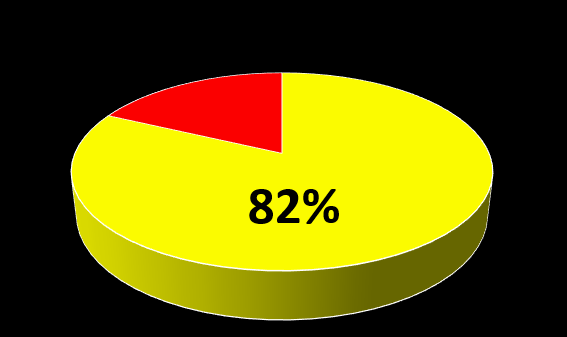
OVERALL: 82%
Platform: Arcade Games
Genre: Action-Fighting-2D
Developer/Publisher: Fuuki
Release: 1998