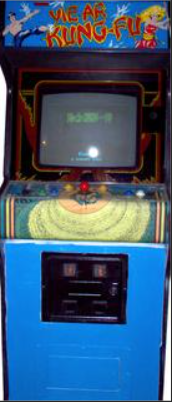
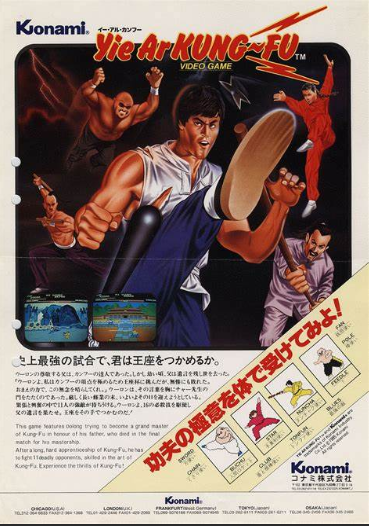
One of the original fighter games, and a great one at that ………
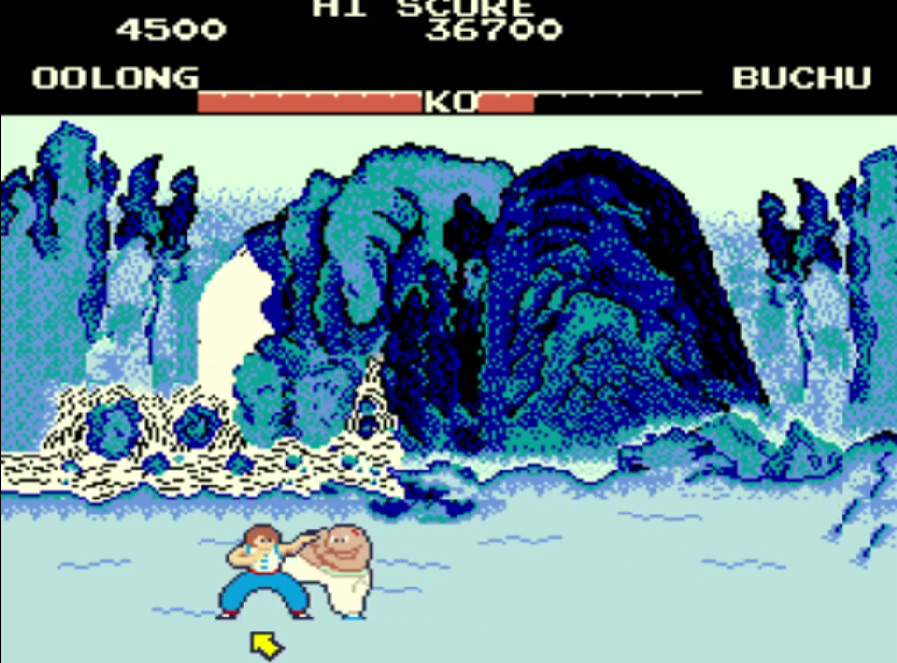
Among the prominent Japanese arcade game manufacturers, each had their own renowned and long-standing fighting game series. Capcom had Street Fighter, SNK had King of Fighters, Sega had Virtua Fighter, and Namco had Tekken, all of which became significant symbols of status and profit in the 1990s. In contrast, Konami sent only a few quickly forgotten one-off titles into the competition, such as Dragoon Might, Deadly Arts, Rakuga Kids, or Teenage Mutant Ninja Turtles: Tournament Fighters. However, long before these competitors, Konami had already made its mark with Yie Ar Kung-Fu.
Yie Ar Kung-Fu, the most popular fighting game of the 1980s, plays quite differently from what is expected in a modern fighting game. Instead of a complex control scheme, there are only two buttons next to the directional joystick: one for punches and one for kicks. Nonetheless, the protagonist, Oolong (yes, like the tea), possesses a wide range of impressive martial arts techniques. By combining different joystick directions with button inputs, players can execute 16 distinct maneuvers. Each move consists of just one frame of animation, but skilled players can fluently string them together, creating impressive sequences of attacks. Every successful hit earns varying points, and when opponents are struck, they are briefly stunned, leaving them vulnerable to follow-up strikes. However, Oolong himself is more likely to find himself on the receiving end of rapid beatings, as the game requires precise timing and specific directions for his attacks to connect, which may not always feel intuitive. Unfortunately, Oolong’s defensive capabilities are lacking; attempting to block by holding the joystick upward and backward proves to be ineffective. His main means of evasion and agile movement around the arena is through jumping, reminiscent of a frog’s movements.
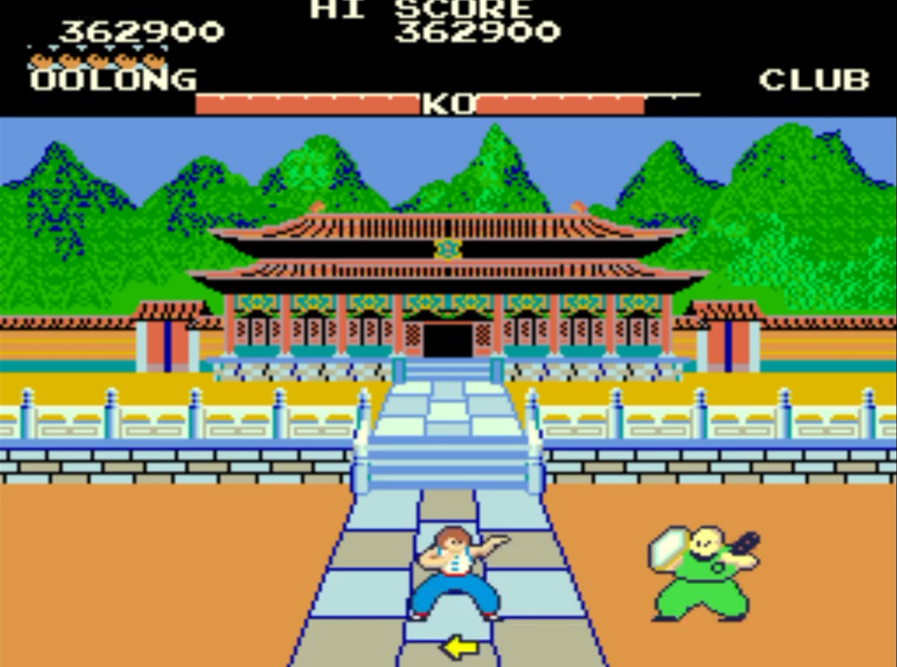
While Yie Ar Kung-Fu drew inspiration from Data East’s Karate Champ in terms of its mechanics, its true innovations lay in a different realm. Unlike the generic karate protagonists found in most fighting games of the time, Yie Ar Kung-Fu introduced a vibrant and diverse cast of characters straight out of a lively 1970s Hong Kong martial arts film. Each character possessed their own unique characteristics and abilities. The duels were accompanied by stereotypical “Chinese music” tunes, enhancing the game’s thematic atmosphere.
In the game, players always assume the role of Oolong, driven by a quest for revenge after his father’s death at the hands of the tournament champion in the final battle. Unlike modern fighting games with character select screens, Yie Ar Kung-Fu does not provide such options. Furthermore, the privilege of selecting characters is limited to human players, while the CPU opponents remain fixed as generic karate fighters in other games.
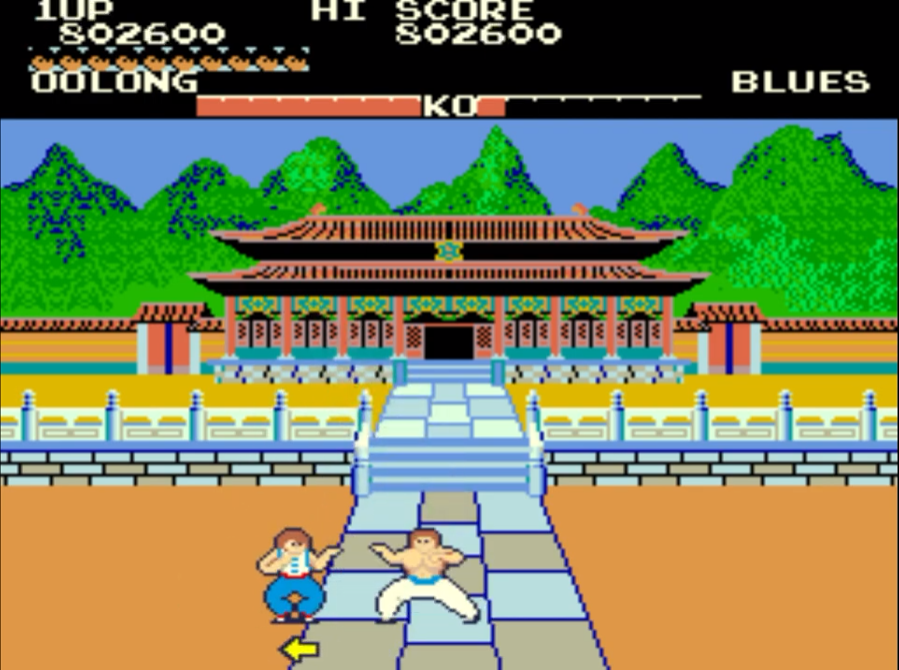
The opponents in Yie Ar Kung-Fu are divided into two tiers. In the “Hot Fighting History,” Oolong must face the initial five challengers against the backdrop of a picturesque waterfall. Upon defeating them, he advances to the “Masterhand History” at a Buddhist temple, where six more formidable enemies await. Many of these adversaries prefer unorthodox combat styles and are named after their weapons. For instance, Pole uses his stick to block most attacks, Chain can strike from a distance, and Club remains shielded and vulnerable only to low or preemptive strikes. Star and Fan, the first-ever female characters in a fighting game, rely on projectile attacks, which Oolong can intercept with well-timed counterattacks. Notably, Yie Ar Kung-Fu deviates from the norm of classic fighting games by omitting formal bonus rounds. However, the encounter with Feedle partially filled that void as he charges at the player with an army of clones, each falling to a single hit.
Yie Ar Kung-Fu’s distinct character roster and challenging battles set it apart from its contemporaries, offering a unique and engaging fighting game experience with a touch of martial arts film nostalgia.



Yie Ar Kung-Fu, much like its predecessors, prioritizes strategic gameplay over intricate combo systems. It emphasizes the importance of learning each opponent’s AI patterns and exploiting their weaknesses, rather than relying solely on controller dexterity. While swift reflexes remain crucial due to the game’s fast pace, understanding an opponent’s vulnerability can make a fight significantly easier. However, the final adversary in Yie Ar Kung-Fu exhibits a serious case of SNK boss syndrome, reminiscent of a time when Shin Nihon Kikaku (SNK) focused primarily on mediocre 2D shooters. Blues (Bruce?) proves to be a formidable opponent, effortlessly chaining devastating leg-based combos that can swiftly bring Oolong to his knees.
Although Yie Ar Kung-Fu’s gameplay has been surpassed by titles like Street Fighter and its numerous successors, its impact on the look and feel of Japanese fighting games endured for years to come. Playing Yie Ar Kung-Fu reveals the origins of various character archetypes and design choices found in later games. For instance, one can understand why Billy Kane from Fatal Fury confidently wields his distinctive stick without disqualification, encounter the first shirtless fat guy who attacks with head-first dives (clearly an inspiration for E. Honda from Street Fighter II), and even come across a fan-throwing woman in a seductive red dress, whose design bears a striking resemblance to SNK’s Mai Shiranui. Furthermore, achieving a perfect round in Yie Ar Kung-Fu is rewarded with a voice sample that expresses gratitude with the phrase “xie xie” (Chinese for “thanks”).
One drawback of Yie Ar Kung-Fu is its limited replay value due to the absence of character selection. Players are restricted to controlling Oolong, engaging in one-on-one battles against a series of opponents. Two players can take turns participating in the fights. However, each successive fighter presents a greater challenge than the previous one, offering a genuine test of skill and adding to the game’s overall difficulty.
Overall
Yie Ar Kung-Fu can be regarded as an excellent fighting game for its time. Its gameplay mechanics strike a balance, being accessible enough for newcomers to enjoy while providing a satisfying challenge for seasoned players. So, fasten your belt and prepare yourself for some intense rear-kicking action!
BREAKDOWN:
GRAPHICS: 80%
MUSIC/SFX: 77%
PLAYABILITY: 86%
OVERALL: 79%

Platform: Arcade Games
Genre: Action-Fighting-2D
Developer/Publisher: Konami
Release: 1985