

Still the Greatest 3D Platformer ……..

In 1996, Nintendo EAD unveiled their groundbreaking project—a fully 3D Mario game. During its development, the game underwent numerous changes and experiments. Upon release, it generated an unprecedented level of hype. While hardcore fans had mixed reactions and some remained uncertain, the majority of people recognized it as an exceptional game. I wholeheartedly agree with this sentiment. In light of the game’s significance, I feel compelled to review this scintillating game and give it the absolute maximum score it can acheive.
Let me start by emphasizing the sheer beauty of the graphics. This isn’t merely a generic 3D platformer; it’s Mario himself, in full 3D glory! When I first laid eyes on the visuals, I was absolutely mesmerized. It was the summer of 1997, and my sister and I were deliberating over which new gaming system to purchase. I was leaning towards a Saturn (at the time, unaware of its shortcomings, but enticed by Virtua Fighter 2), while my sister favored a Playstation. However, everything changed when we witnessed someone playing Mario 64 at a store. The sheer graphical prowess and the realization that our beloved mascot had embraced 3D compelled us to choose the Nintendo 64. It was an unquestionably wise decision.
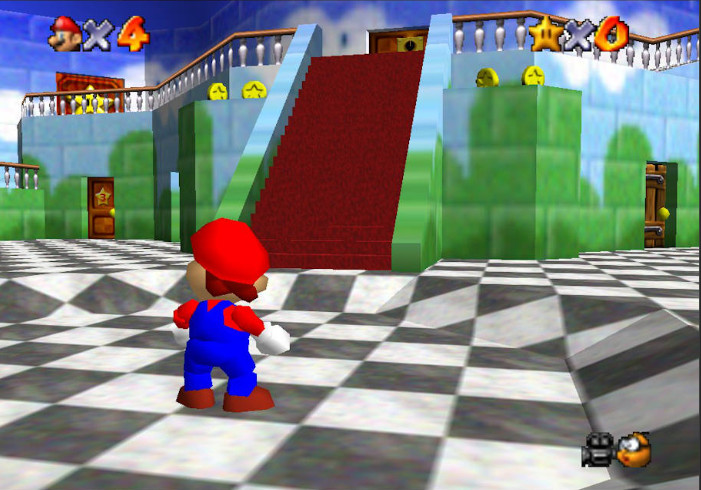
Now, let’s delve into the technical aspects. For its time, the game’s graphics far surpassed anything previously seen. The polygon counts on Mario, Peach, Toad, and Bowser were simply mind-boggling. Their level of detail was astonishing. The entire game world was meticulously crafted and exuded a remarkable level of artistry. This is where the game truly shines. Not only do we witness our cherished characters rendered in glorious 3D, surpassing all expectations of the time, but we also encounter colossal figures like Bowser or the Eel that occupy the entire screen—magnificent in their scale and even more visually stunning. The N64 demonstrated its graphical prowess through these elements. Additionally, certain characters were rendered rather than relying solely on polygons. While this may be considered a memory-saving technique, it actually enhanced their appearance. This approach was selectively employed, mainly for characters with curved shapes like the bomb-ombs or for the trees in specific instances. I must admit that even when resorting to these minor shortcuts, the level of detail is so subtle that it goes virtually unnoticed.

Now, let’s discuss the incredible world you get to explore. When you first lay eyes on it, prepare to be awestruck. The scale of the worlds in this game is simply mind-blowing—they are enormous! And not only are they vast, but they also look stunning. Each world is meticulously designed, and there are a whopping 15 of them! Let’s face it: if the PSX or the Saturn had attempted something like this upon their initial release, they would have struggled to handle it. It’s difficult to articulate why the visuals are so impressive. Perhaps it’s because we had never seen anything quite like it before. Maybe it’s because in the past, when we had large worlds, they often appeared excessively blocky, even for that era. But now, we have these expansive, breathtaking worlds to explore, and they look better than anything we’ve seen before!
Moving on to the camera angles, you are in control. Well, to be precise, it’s the Lakitu brother who follows you, but you have the power to manipulate the camera. This feature allows you to observe these colossal worlds without obstruction, which is undoubtedly a major advantage. Rarely does the camera become problematic, and even when it does, it’s usually a simple matter of readjusting Mario’s position. Thanks to the excellent camera system, most of the time, you’ll find yourself standing in awe of the game’s gorgeous backgrounds, thinking, “Wow.” The camera work is commendable, and it undoubtedly deserves a perfect score in the graphics department.

The control in this game is not just excellent—it’s superb. It surpasses that of Spyro or Crash, without a doubt. I was genuinely impressed by it. As mentioned earlier, you have complete control over the camera angles. Using the “C” buttons, you can manipulate the camera to achieve different perspectives of the world. The shoulder buttons allow you to zoom in or out, enabling you to focus on Mario up close or make him appear as a tiny dot on the screen. The camera implementation was a stroke of brilliance and was necessary to accommodate the game’s full 3D environment.
When it comes to controlling Mario himself, the experience is entirely different from what we were accustomed to. In the past, it was all about running, jumping, landing, and defeating enemies. Now, it’s about running, jumping, flipping, bouncing, punching, and annihilating foes. Mario has become an acrobat of sorts, and this newfound agility adds a whole new layer of fun to the game. Moreover, Mario has acquired a plethora of new moves. Gone are the days of a single jump; now he can execute regular jumps, double jumps, flips, punches, kicks, punch-kick combos, backward flips, butt-stomps, long jumps, and many other intricate combinations, like a double jump flip butt-stomp combo!
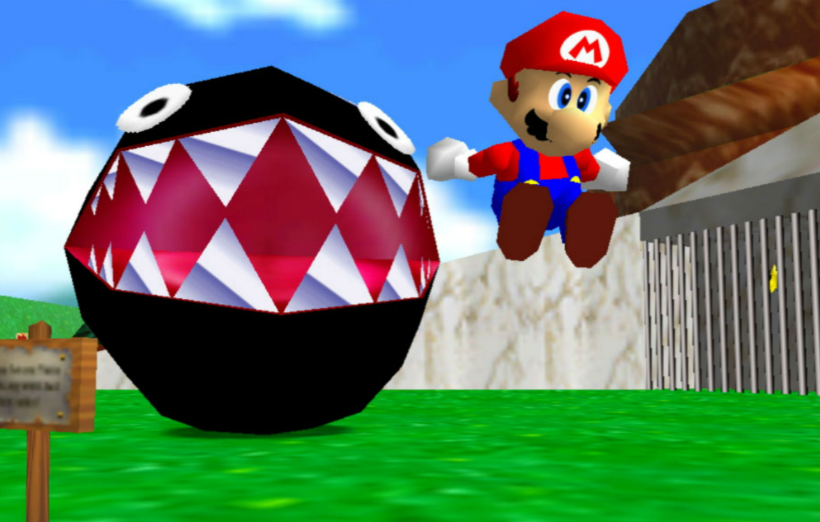
However, if it were just these moves, the control would not be much better than Crash’s. What truly sets it apart is the fact that this is a fully 3D experience. Gone are the linear paths that Mario used to follow. Now, he can explore the worlds in any way he desires. The controls have been meticulously crafted with this freedom of exploration in mind. Alongside the movable camera, Mario’s athletic abilities, and the multitude of combos you can string together, it’s evident that the control scheme was designed for both exploration and, more importantly, to have an absolute blast.
Now, let’s delve into the heart and soul of the game—the gameplay. It’s so incredibly enjoyable that it’s hard to believe. Seriously, I cannot express how much fun this game is. It’s an absolute blast to run around, jumping, punching, kicking enemies, collecting coins, and progressing through the levels. It’s almost addictive! When I first tried it, I couldn’t fathom how they managed to make it so much fun in a 3D setting.

However, fun factor alone isn’t all that a game needs. It also needs depth, and this game certainly delivers. Firstly, there are no longer any predefined paths. You jump into a world, and it becomes your world. You have the freedom to do whatever you want. You can search for stars, interact with the monsters, or simply explore to your heart’s content. Exploration is the core element of this game. It’s evident that Miyamoto took inspiration from the Zelda games when transitioning Mario into the 3D realm. Mario is no longer solely focused on combat. The objective now is to explore. Unlike other Mario games or even Crash, you don’t just reach a portal at the end of the level. You can only exit the world if you have achieved something significant, such as obtaining a star or meeting your demise.
I was utterly amazed by the extent of exploration in this game. I was also surprised at how quickly I became accustomed to it and grew to love it. To progress in the game, you must find stars, and to do so, you must thoroughly search your surroundings and fulfill specific mission objectives. You can’t simply reach the end of a level and declare, “I’m done! On to the next!” No, that’s not how it works. Shame on you for even thinking it could be that simple. To discover the stars, you must scour every nook and cranny, explore every visible area, and investigate any suspicious-looking spots. You’ll engage in boss battles, play mini-games, and even hunt for specific coins.

Let me tell you, the astonishment you feel when you first try it is unparalleled. I spent the first 20 minutes outside the castle, and you might wonder why someone would choose to wander outside when faced with a magnificent four-story castle. Well, it’s because this game is crafted so masterfully that even exploring the exterior is immensely enjoyable. Most of my time outside the castle was spent leaping around, laughing, and marveling at the fact that my beloved plumber had become an acrobat. I climbed trees, swam in the water, and reveled in the greatness of it all, even though I hadn’t yet entered any proper levels.
Once you finally enter the first level, prepare to be amazed. After being awestruck by its sheer size, you’ll find yourself wondering how long it will take to conquer it. But then, something dawns on you. This isn’t just a three-dimensional plane—it’s a living, breathing world. You can interact with the pink bomb-ombs and listen to what they have to say. You can observe the goombas and witness how they interact with the environment. You can simply sit back and watch the world unfold, as there’s no time limit dictating how long you can spend within it. It’s your world, and you can do whatever you please.
When you finally get there, you’ll be pleasantly surprised by what you can do. Unlike the 2D games, if Mario reaches a certain level, he isn’t confined to that location for life. You run towards a wall, just to see what happens. You perform a double jump purely out of curiosity, and lo and behold—Mario latches onto a ledge, allowing you to climb up and explore an entirely new section of the world. It’s fantastic because while exploration is necessary to complete the game, you can make significant progress by defeating bosses or winning mini-games alone. The maximum number of stars you need to explore any level except the final one is 30. If you manage to obtain 30 stars, the entire castle opens up to you, and you won’t have to explore further if you choose not to.
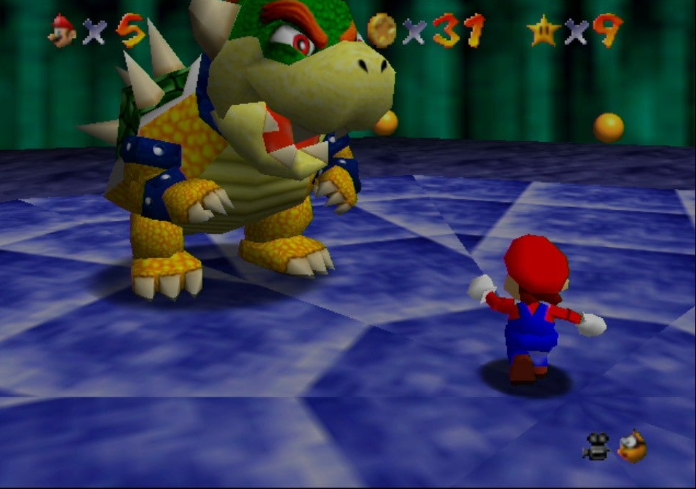
In summary, the gameplay is unbelievably enjoyable, offering a level of fun and addictiveness that is hard to match. It goes beyond surface-level entertainment and provides depth through exploration. The game’s transition to a 3D environment opens up a world of possibilities, allowing you to immerse yourself in a living, breathing universe where the boundaries are limited only by your curiosity.
Anyway, now that I’ve rambled on about the gameplay (which, let’s be honest, you can already tell deserves a perfect score), let’s talk about the sound. In short, it’s excellent. Mario finally has a voice, and surprisingly, it sounds really good! Yes, it’s an Italian accent that might be seen as somewhat stereotypical, but considering the game’s cartoony nature, it fits perfectly. The sound effects for the monsters and characters are all very well done, showcasing the developers’ attention to detail.

The music in Super Mario 64 is nothing short of exceptional. Not only are there completely new and cool tunes, but there are also remixed versions of classic tracks, and they sound fantastic. While the instruments used could have been more orchestral, similar to those in Zelda, they still deserve a perfect score. I must mention how much I adore the credits theme—it’s wonderfully quirky and cool, yet it suits the game perfectly. Kudos to Koji Kondo for his great work!
Finally, let’s discuss replay value. Don’t expect it to be lacking just because previous Mario games didn’t offer much in that regard. You couldn’t be more wrong; in fact, Super Mario 64 has one of the highest levels of replay value ever seen. With a total of 120 stars to collect, there’s plenty to keep you engaged. And if, by some miraculous feat, you manage to collect all 120 stars, there’s still more to discover. You can revisit the old mini-games, such as the race with Koopa or the sliding Penguin race. Only this time, the Penguin is much larger and faster, adding an extra challenge. Even after collecting all the stars, I still find myself revisiting old levels just to explore. No matter how many times you play it, this game never loses its magic.
Super Mario 64 is the perfect game when you need something stimulating and challenging that is also easy to grasp. It appeals to players of all ages—from a 3-year-old who can enjoy its simplicity to the smartest person in the world who can appreciate its depth and intelligence. Beyond being just a game, it feels like an immersive experience where you genuinely inhabit these enchanting worlds, making it truly yours to control.
To sum it up, this game is flawless. Its graphics were top-notch, the gameplay revolutionized the industry at the time, the music was superb, and it offered an abundance of replay value. Even those who may not find playing as Mario particularly enjoyable can’t deny the greatness of this game. It’s evident that Nintendo poured tremendous effort into its development. Shigeru Miyamoto deserves congratulations and gratitude for creating a remarkable game that will forever leave a lasting impression.
BREAKDOWN:
GRAPHICS: 95%
MUSIC/SFX: 96%
PLAYABILITY: 98%
OVERALL: 97%

Platform: Nintendo 64
Genre: Action-Platformer-3D
Developer/Publisher: Nintendo
Release: 1996
Franchises: Mario

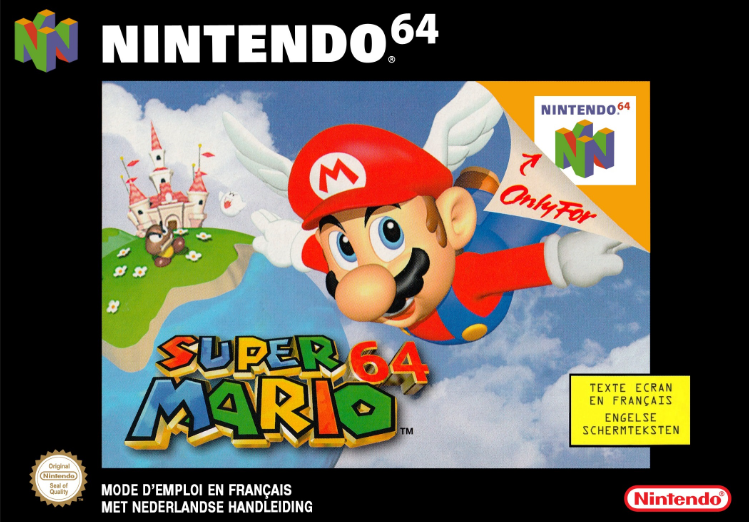

Absolutely one of the best games ever made – totally agree with your review and subsequent scoring.