Classic Shoot em up , one of the first of it’s kind…….

Operation Wolf, a classic old-school shooting gallery game, made its arcade debut in 1987 under Taito’s banner. It adheres to a straightforward style with a clear objective: eliminate as many terrorists in an enemy stronghold as possible. While it may seem simple, strategy and caution are vital for success. As a child, this game, along with its outstanding sequel, Operation Thunderbolt, marked some of my earliest memories of arcade gaming. These classics have also made their way to home consoles, with the original arcade versions available as part of the Taito Legends compilation for PC, PS2, and Xbox. Even today, you can occasionally stumble upon Operation Wolf in arcades and entertainment venues, where games of its ilk still find their place among the classics.
Operation Wolf is arguably one of the pioneering and most iconic arcade shooter games. In this single-player game, you step into the shoes of Green Beret soldier Roy Adams, tasked with infiltrating an enemy military base. Your mission: eliminate as many terrorists as possible while also rescuing multiple hostages. However, you must exercise caution not to harm too many innocent hostages, as this could jeopardize your mission. The game is enriched with between-level cutscenes and text, offering players an evolving storyline as they progress. It follows the classic narrative of a heroic soldier facing off against an entire enemy force, a tried-and-true theme.
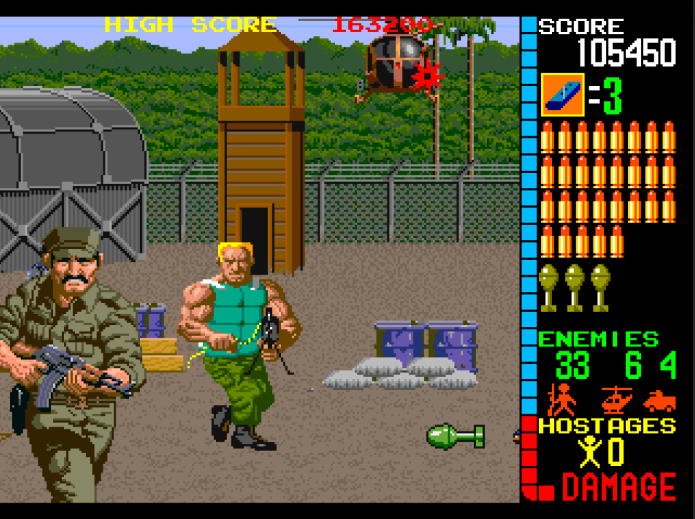
The game consists of six primary action stages that follow a similar pattern. From the very beginning, you’ll be engaged in intense battles against successive waves of enemy terrorists and vehicles, some of which lurk in the distance, while others charge directly at you. As is customary for a quality arcade game, early stages provide an accessible learning curve, with difficulty gradually increasing as you advance. The need to safeguard the lives of hostages adds an extra layer of challenge, requiring precise aiming and ensuring that no terrorists or threats are nearby when hostages attempt their escape by running to the edge of the screen.
Your life is indicated by a standard meter that fills in red as you sustain damage from enemy fire. It blinks, accompanied by a warning sound, as you approach the brink of defeat. Ammunition, displayed as bullets and rockets on the side of the screen, also demands your attention. Running out of ammo results in a game over, rendering you defenseless and susceptible to capture. Fortunately, you can replenish your ammunition by shooting wild animals that occasionally appear on-screen, including hogs and chickens—yes, you read that correctly. You shoot hogs and chickens to obtain ammo.
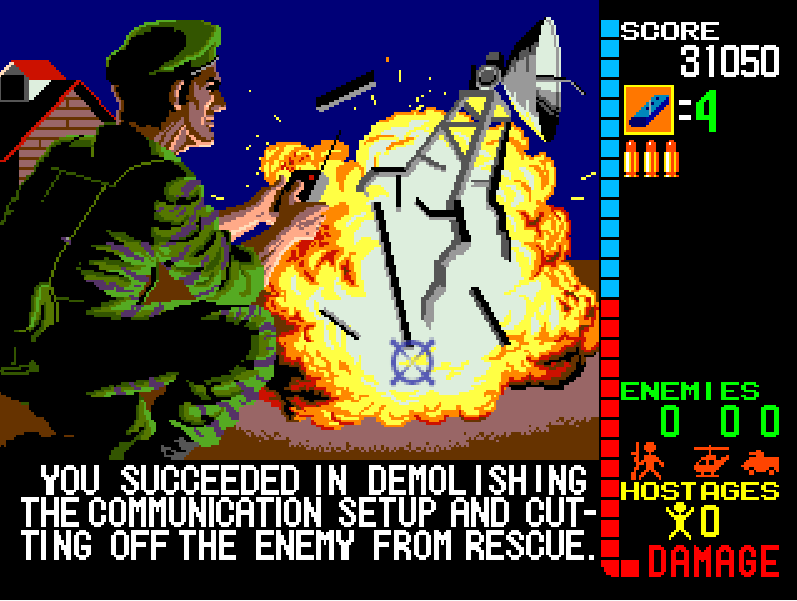
The game employs a first-person perspective with a horizontal scrolling camera. Enemies come in various forms, including terrorists on foot and a range of vehicles such as combat jeeps, airplanes, helicopters, speedboats, and tanks. The original arcade cabinet even features a gun controller shaped like a lifelike metal Uzi. Pulling the trigger fires bullets, while a button on the side launches rockets, capable of wiping out large groups of enemies in one area. Controls are responsive and intuitive, with the gun controller easily aimed by tilting it slightly up, down, or side to side. The trigger and button responses are instantaneous, offering an immersive and engaging gameplay experience.

The outcome and the ending you achieve in the game depend on the number of enemies you defeat and the hostages you rescue by the game’s conclusion. This can present significant challenges in later stages, and there may be moments when you need to retry a stage if there are too many civilian casualties. For newcomers, the game is fairly forgiving in the initial levels, but as you progress further, you might find yourself investing a fair amount of change to continue your quest if you aim to reach the end.
Regarding the game’s visuals and audio, Operation Wolf doesn’t emphasize background music. While the title screen and cutscene themes are decent, they don’t particularly stand out. As you’re immersed in gunning down enemies, the predominant sound effects include the rapid gunfire and the characteristic ‘Uuh-oough!’ death cry of defeated terrorists as your bullets find their mark. Hostages will repeatedly cry out for help as they seek safety, so be prepared to hear these familiar sound effects frequently during gameplay.
Considering the game’s age, which is now over a quarter of a century old, the graphics hold up reasonably well. Most of the levels and elements are adequately detailed, and the game surprisingly boasts vibrant and colorful visuals. Notably, enemies are often dressed in darker, more subdued colors like green and gray to make them easily distinguishable from hostages, who typically wear the traditional red, white, and blue colors. It may strike you as odd to see a skateboarder clad in a white vest and jeans casually skateboarding through a war zone while tanks and gunboats wreak havoc! The designs of enemies and vehicles are not particularly captivating, but Operation Wolf effectively conveys a military war-zone atmosphere and maintains an overall appealing presentation.

As mentioned, if you’re playing the original arcade cabinet and aiming for the best ending, you should be prepared to spend a significant amount of money. The game offers a substantial challenge but strikes a balance that is not overly punishing for newcomers, while still providing experienced players with a substantial test during subsequent playthroughs. With a total of six stages, Operation Wolf boasts an ideal length for an arcade shooter. It guides you through diverse environments, from jungles to hangars and airports, and each level is not excessively long. Your primary focus will be staying vigilant for the next wave of adversaries and ensuring the safety of the hostages. Moreover, the stand-up cabinet design prevents you from standing in one place for too long and experiencing discomfort in your legs.
Operation Wolf offers replay value and is the type of game that can entice you to return for additional attempts if you didn’t manage to complete it on your initial playthrough or if you’re seeking to achieve a high score. It’s not an overly lengthy game, making it an excellent choice for a quick, straightforward shooting experience that also requires strategic thinking and caution at various points. The game has been ported to several home consoles, with the Nintendo Entertainment System version being a notable and enjoyable one. Nevertheless, the original arcade version remains the ideal way to experience the game, and by acquiring Taito Legends, you gain access to this title and several other classic Taito arcade games, all in their unaltered, original form for home enjoyment, without the need for coin-operated machines.
In conclusion, Operation Wolf, while showing its age as a shooter and falling slightly short of its follow-up Operation Thunderbolt, still stands as a defining shooter from the late 1980s. It continues to provide an enjoyable gaming experience, rivaling many newer titles in the same genre. While finding an original arcade machine may be a challenge these days, if you’re fortunate enough to locate one, it’s well worth your time to give it a try for a classic shooting action adventure!
BREAKDOWN:
GRAPHICS: 82%
MUSIC/SFX: 78%
PLAYABILITY: 89%
OVERALL: 86%

Platform: Arcade
Genre: Action-Shooter-Light Gun
Developer/Publisher: Taito
Release: 1987
Franchises: Operation Wolf