In the latter part of 1986, the renowned arcade developer Konami made a strategic move into the 8-bit home computer market by deciding to release conversions of its own games. Previously, they had licensed their popular coin-op hits like Hyper Sports, Mikie, and Green Beret to established publishers such as Ocean and Imagine. Gamers, impressed by the quality of Imagine’s ports of these titles, eagerly anticipated Konami’s direct involvement, assuming that with full access to the arcade resources, they would excel even further.
The initial release, however, shattered these expectations. Konami’s first offering was a dismal Spectrum port of the acclaimed coin-op game Jail Break. Despite impressive graphics, the game lacked fundamental features like eight-way movement, let alone more sophisticated elements like three-dimensional collision detection (where obstacles could block your character’s path even above his head), or gameplay resembling the original.
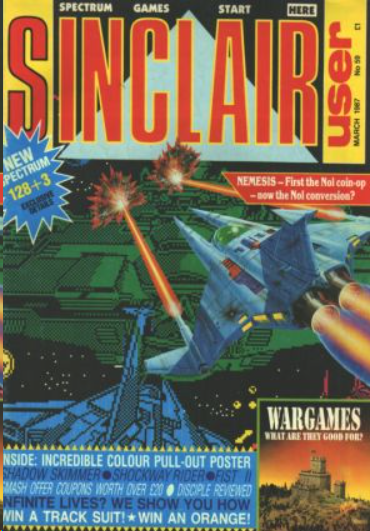
Nevertheless, in the still-innocent gaming landscape of 1987, enthusiasts remained hopeful for Konami’s next release: Nemesis, a groundbreaking scrolling shooter that introduced the concept of selectable power-ups in arcade gaming. When Sinclair User published the first review of the game, it seemed like the wait and optimism were about to pay off.

In 1987, receiving a five-star review from Sinclair User (SU) wasn’t necessarily cause for celebration. After all, the abysmal Jailbreak had also garnered a perfect score, despite a dismal 47% rating from Crash magazine. SU had a reputation for overly generous reviews and a lack of expertise when it came to assessing arcade-to-Spectrum game ports. However, in a stroke of unexpected foresight, SU twice drew connections between Nemesis and Konami’s earlier arcade hit, Scramble, long before Konami officially acknowledged Scramble as the precursor to the Nemesis (also known as Gradius) series.
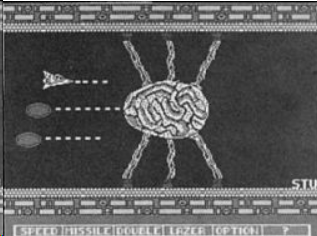
While few gamers relied solely on SU’s review scores, what truly sold Nemesis to readers were its screenshots. Displaying a visually stunning rendition of the game, seemingly the pinnacle of what the Spectrum could achieve, the screenshots depicted detailed graphics faithful to the arcade original, vibrant with colour and action. All the distinctive features of the coin-op appeared intact, further supported by the review text. Unfortunately, those who trusted SU’s word (and images) were in for a rude awakening.

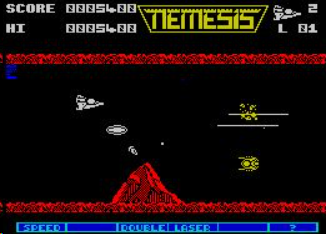
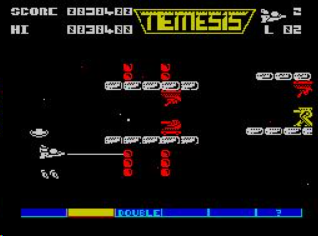
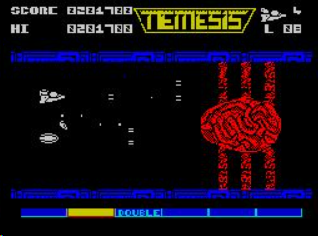
The screenshots above starkly reveal the grim disparity between the promised Nemesis experience and the harsh reality on the Spectrum. Sinclair User’s portrayal hardly resembles the true pixelated landscape: the iconic mountains reduced to mere bumps, the defining tree line erased, and the depiction of two vibrant “Options” satellites firing blue lasers, along with a power-up bar suggesting more options, contrast sharply with the feeble reality of a single white Option emitting a weak laser. Additionally, various non-existent enemy types and a significantly reduced play area, limiting the ship’s movement, further exacerbate the disappointment.
Yet, these cosmetic discrepancies are just the tip of the iceberg. Despite not being inherently terrible, the game’s gameplay holds numerous flaws that betray Sinclair User’s endorsement of an “excellent conversion.” Issues such as obscured shots due to explosions, unreliable collision detection, ineffective double shots firing at odd angles instead of the intended 45 degrees, erratic speed fluctuations, and the surprising ability to collide with the floor or ceiling without consequence diverge significantly from the arcade original. Thus, scepticism regarding the accuracy of Sinclair User’s review is well-founded.
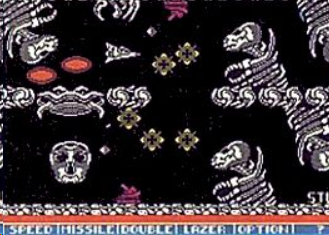

The decline in quality persists into later levels, as evidenced by the Level 5 screenshots above. Observant readers might have noticed a recurring detail in most of the magazine’s images: the letters “STU” in the bottom right-hand corner. These initials denote the signature of Nemesis’ graphics artist, Stuart Ruecroft. An interesting coincidence, isn’t it?
At this juncture, sceptics might cynically conclude, “It’s obvious— the writer simply evaluated the game based on press-release screenshots and blurbs, just as Official Xbox Magazine did with Headhunter Redemption. Typical lazy journalism.” However, the reality appears to be stranger than fiction. How do we ascertain this? Enter Jon Riglar’s Zap Chat.
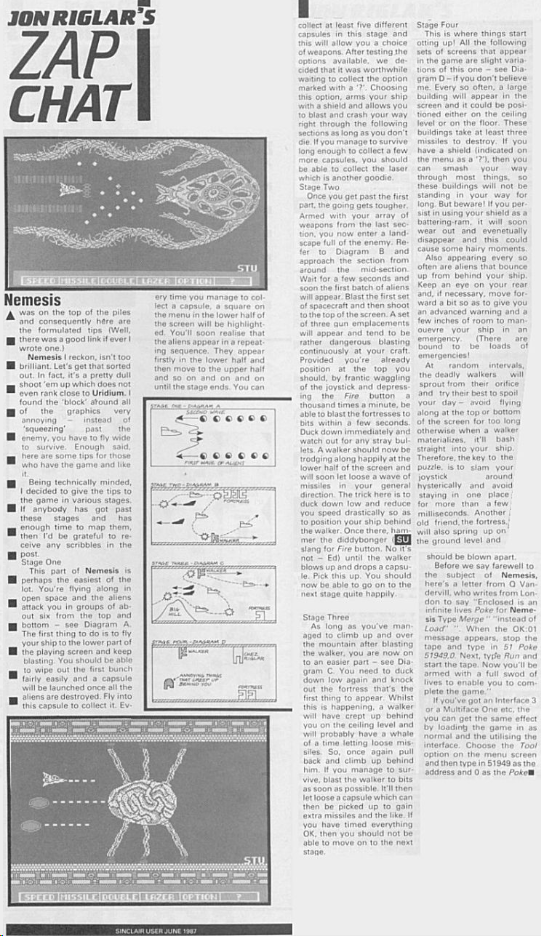
Zap Chat served as Sinclair User’s tips section, and a few months after the review, it dedicated a substantial portion of its pages to providing tips for Nemesis. However, the tone of the section diverged significantly from the glowing praise of the review. The host of the tips section started with a disclaimer, distancing themselves from the overly positive assessment:
“I have to say, Nemesis isn’t all that great. Let’s be clear about that. Frankly, it’s a rather uninspiring shoot-’em-up that doesn’t even come close to matching Uridium.” (Uridium being the benchmark for horizontally-scrolling shooters on the Spectrum at that time.)
Despite this initial disclaimer, the subsequent page contained a surprising array of tips that either showcased remarkable creativity, demonstrated clueless rambling, or hinted at the existence of a vastly superior version of Nemesis reviewed by Sinclair User—one that differed greatly from the version players actually experienced. The tips were accompanied by screenshots bearing the “STU” signature again, depicting bosses from Level 7 and Level 8 of the game. However, the text of the tips, published three months after the review, strongly suggested that the tips writer struggled to progress beyond Level 1.
Remarkably, Sinclair User had dedicated approximately 1,200 words of tips to the seemingly straightforward task of advancing beyond the first level of a game that had already been available for weeks. Extensive paragraphs and diagrams were employed to elucidate strategies for navigating sections of the game lasting mere seconds and featuring only one enemy, which could be dispatched with a single shot. Despite the excessive level of detail provided, the tips writer managed to make embarrassingly inaccurate statements—the initial waves of enemies were erroneously described as attacking “in groups of about six”, when, in reality, they appeared in waves of precisely five. While one could argue that five is “about six”, one would expect greater precision from tips that purported to offer a meticulously detailed, moment-by-moment breakdown of enemy encounters.
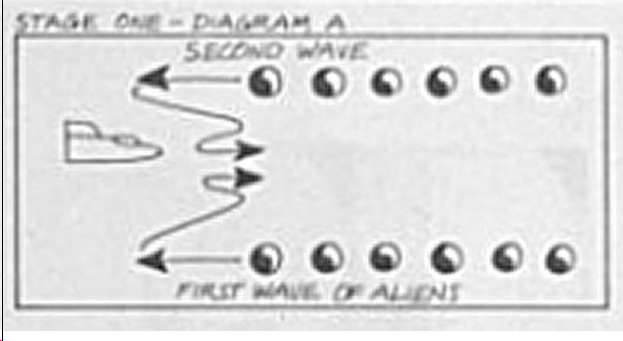
In a bizarre twist, the tips-section writer proceeded to claim that after the final section of Level 1, “All the subsequent sets of screens that appear in the game are slight variations of this one.” This assertion is so profoundly divorced from reality that one can only wonder what the writer intended to convey. (Despite its flaws, the Spectrum version of Nemesis remains faithful to the original by offering distinct and varied levels.)
So, why dedicate such significant magazine space to a game with such glaringly poor “tips” for its initial stage, long after its release, when most potential buyers had already made their purchases weeks ago and were unlikely to require 1,200 words of guidance for the first five seconds of Level 1? (News of Nemesis’ subpar quality spread rapidly, resulting in dismal sales after the first month. It debuted at No. 9 on the charts and disappeared from the Top 20 the following month. Curiously, observe the picture below left from the issue of Sinclair User containing the review—there’s something peculiar about the image they used to depict the game’s brief stint on the charts three issues later.)
Moreover, if the tipster had only progressed through the first level, where did the screenshots of Levels 7 and 8 originate? And why, three months after the review, were they still sourced from an obviously fabricated version that could easily be identified as such by every reader who had ever seen the game? The mystery deepens.

The Nemesis Mystery in Sinclair User leaves few plausible explanations. After careful consideration, one possibility emerges as the most reasonable: there may indeed have been another, superior version of Nemesis for the Spectrum. The alternative—that SU reviewed a game solely based on wildly unrepresentative mock-up screenshots, simply to secure the review a month ahead of Crash (and three ahead of YS)—seems too absurd to be true.
As demonstrated by the five-star review of Jailbreak, SU didn’t need to resort to fake screenshots to award high scores to poor games. Thus, their logical motivation would have been to secure the first review of a major publisher’s debut releases. It’s worth noting that SU reviewed Nemesis and Jailbreak in the same issue, with other Spectrum magazines reviewing Jailbreak well before Nemesis. It’s conceivable that SU used unfinished code, only to be blindsided when a different version was released to stores during the interim period. Naturally, SU faced a dilemma: stick to their version of events or risk a scandal by admitting what they had done.
SU chose to stand by their initial assessment steadfastly. When they reviewed the budget re-release of Nemesis three and a half years later, the reviewer dedicated nearly the entire page to criticizing the graphics. However, they still concluded that the game was “brilliant” and awarded it an 81% score. Notably, all the screenshots featured Level 1 but were from the genuine version of the game.
This theory could also provide an explanation for the peculiar tips coverage. If SU possessed a superior version of Nemesis, it might have been a beta version that couldn’t accommodate all the levels or graphics due to memory constraints or a similar issue, thereby explaining why it wasn’t released. However, had SU based their tips on this version, the levels would have been misplaced. Level 1 is the only stage where the released Spectrum port closely resembles the layout of the coin-op version. Therefore, it’s plausible that in our hypothetical superior version, Level 1 would have been more or less the same, making it “safe” to provide playing tips without revealing the discrepancies in the questionable review.
This theory gains some support from the review in Your Sinclair, which is rather lackluster (credited to the enigmatic “Tommy Nash,” though the picture accompanying the byline is actually that of the magazine’s publisher, Kevin Cox, sporting dark glasses), and awards the game an overly generous 8 out of 10 score. (Your Sinclair’s reviews were never quite on par with the magazine’s writing standards, either ethically or critically—a fact often overlooked in the rosy glow of nostalgia. In contrast, Crash, known for its candidness, gave Nemesis a more sobering 48%.)
However, the Your Sinclair piece begins by noting that Nemesis has finally arrived “after countless reprogrammings,” supposedly undertaken in an effort to cram the game into the limited memory of the Spectrum. (This is somewhat peculiar in itself, considering that the 128K version of the machine was well established by this time. Nevertheless, the burdensome multiloads that characterized the twilight years of the Spectrum were still not widely embraced, and excluding the 48K market in 1987—when it still comprised the majority of Spectrum owners—would have been imprudent.)
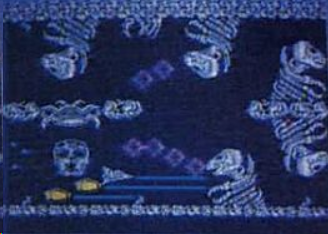
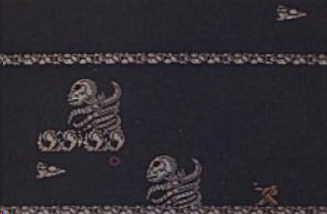
Even more intriguingly, the screenshots above are sourced from the previews featured in Your Sinclair (YS) and Crash magazines. The YS preview, published a month prior to Sinclair User’s (SU) review, displays a picture strikingly similar to SU’s Level 5 shot, although not identical, thus further refuting the theory that SU reviewed the game solely from press-release materials. Meanwhile, Crash’s preview, released the month following Sinclair User’s review, showcases a game that falls somewhere between the two, correcting the “LAZER” misspelling seen in SU’s version but featuring clearly unfinished graphics, such as the absence of the title logo and score information at the top, which align more closely with the final released version. Notably, the Crash preview concludes with a noteworthy disclaimer:
“The Nemesis that we received from Konami’s representative was the latest working version available. However, it is still incomplete, and the game has yet to be approved by Konami… until this approval is given, any ‘reviews’ which you may read are premature – and probably inaccurate!”
Even more intriguingly, the month following the appearance of SU’s tips section, the magazine’s letters page printed a letter seemingly out of context from Konami’s “Nemesis Management Co. Ltd.” The letter, resembling a phone message addressing an unheard inquiry, claims that only one minor change—removing the second Option for speed reasons—was made to the game between the magazine’s preview and the release. It also expresses dismay that the programmers have seemingly vanished, their whereabouts unknown to Konami. (Interestingly, these programmers later resurfaced to develop Jackal, Konami’s final self-published Spectrum game. However, none of the named programmers in the Jackal development team lists Nemesis in their individual credits on World Of Spectrum.)
The evidence suggesting that Sinclair User reviewed a more polished beta version, rather than simply basing their review on fabricated screenshots to secure exclusivity, appears reasonably compelling. Whether this was a result of innocent coincidence or deliberate intent (the latter being more probable), Sinclair User’s actions remain highly reprehensible. They must have been fully aware that the images they showcased bore little resemblance to the actual game their readers would purchase, particularly when they continued to feature them months after the game’s release. Coupled with the carefully vague wording of the review, this was likely to mislead readers into squandering their money on a misrepresented product. (Moreover, priced at £7.95, Nemesis was among the most expensive titles available for the Spectrum at the time.)
However, as previously mentioned, any reader who relied solely on a Sinclair User review to make purchasing decisions would have been ill-advised. Therefore, let the buyer beware.
More crucially, though, the question remains: where is the genuine, superior version of Nemesis?