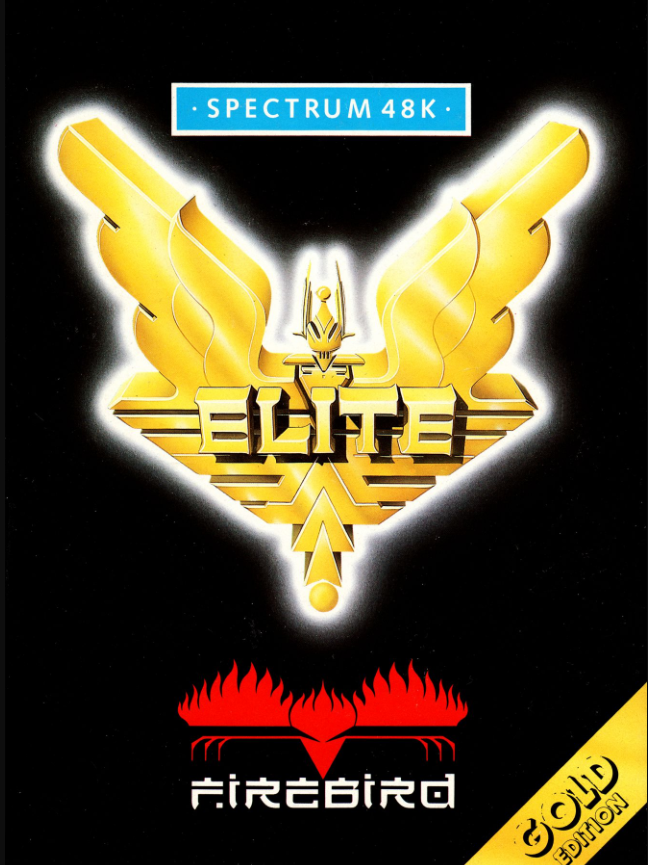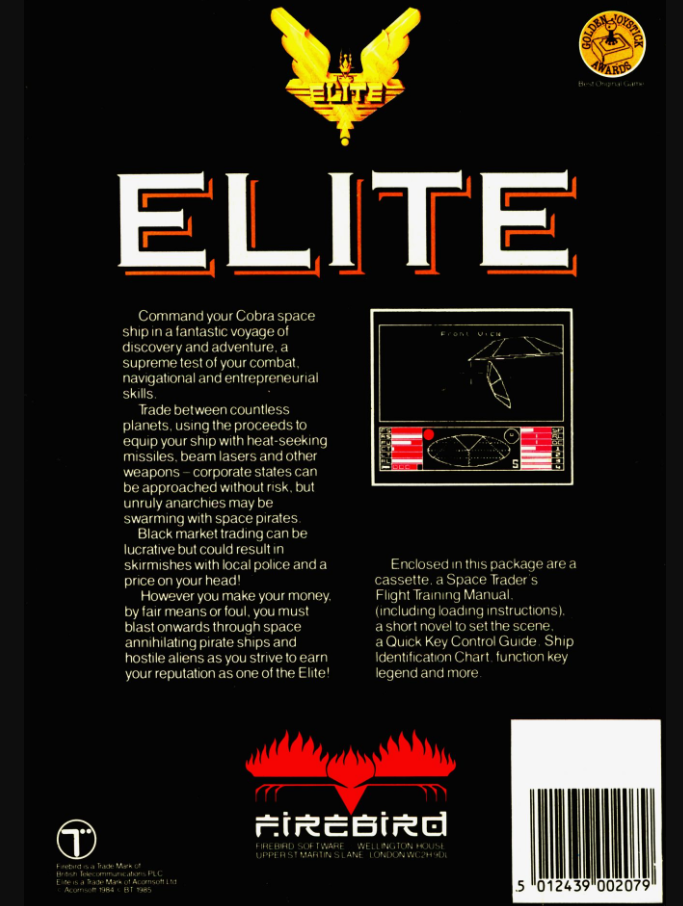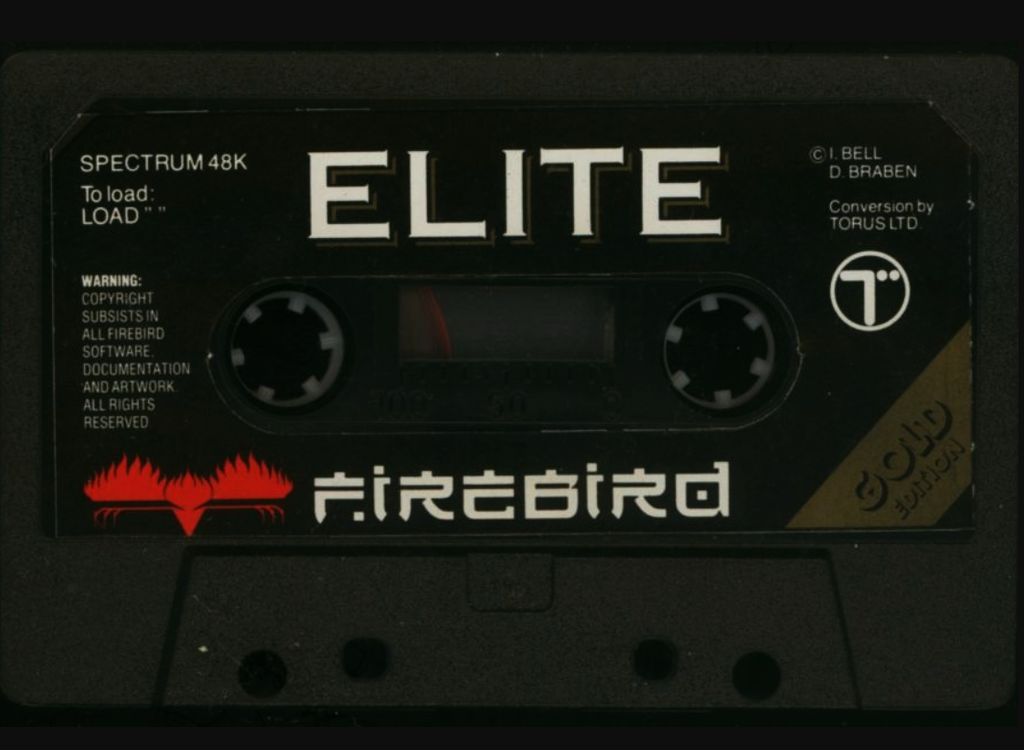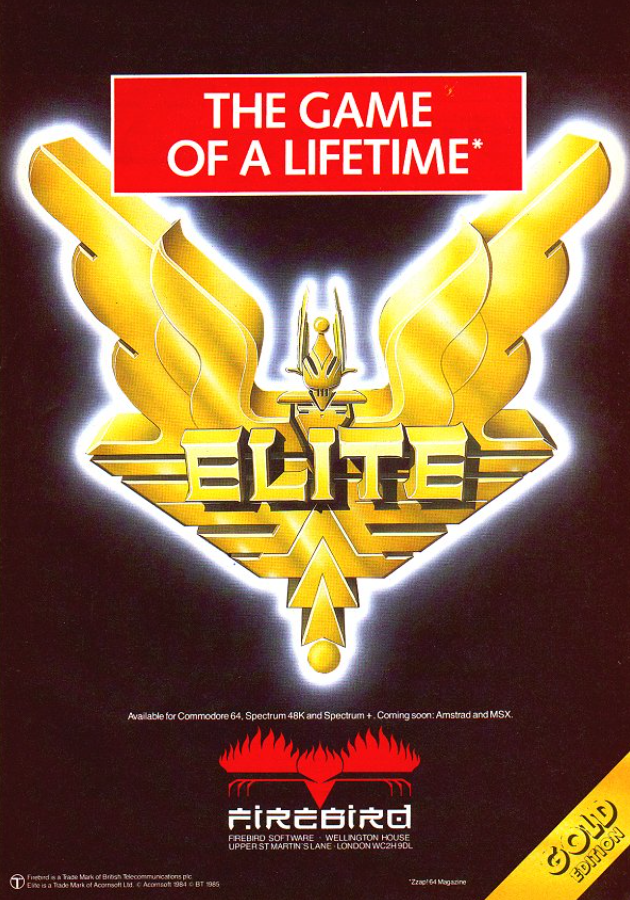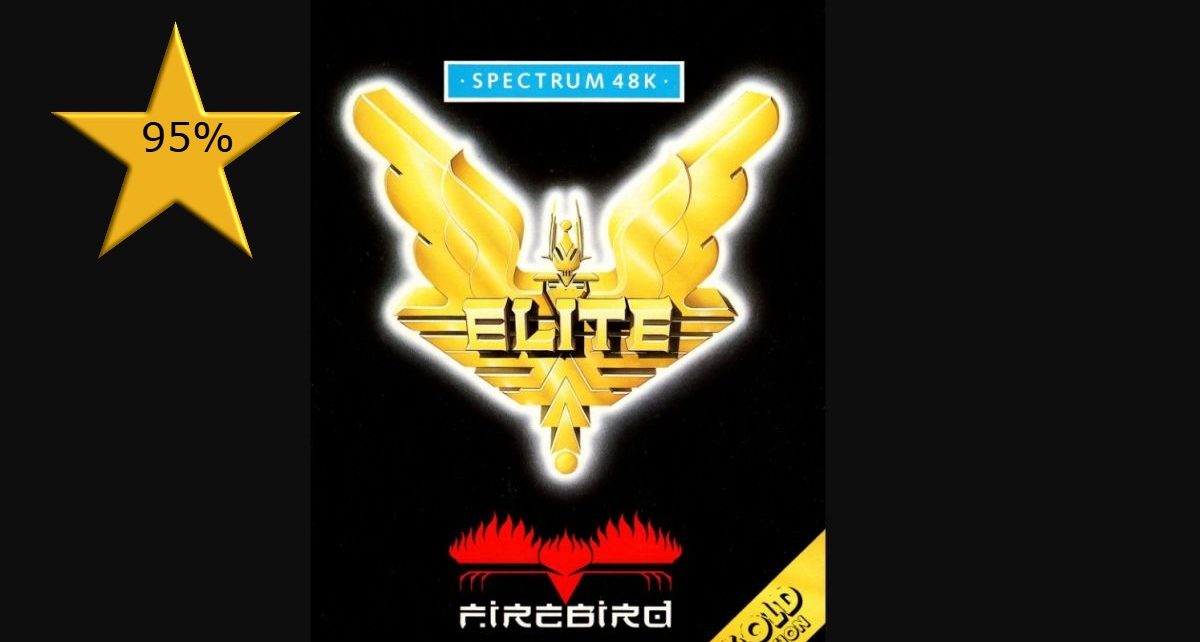
About as good as you can get on the Speccy , a rudimentary openworld and, boy, does it succeed……..

Platform: ZX Spectrum 48K / 128K
Genre: Space trading, combat and exploration
Developer: Torus (Spectrum conversion)
Original release: 1985
Publisher: Firebird Software
Review score: 95%
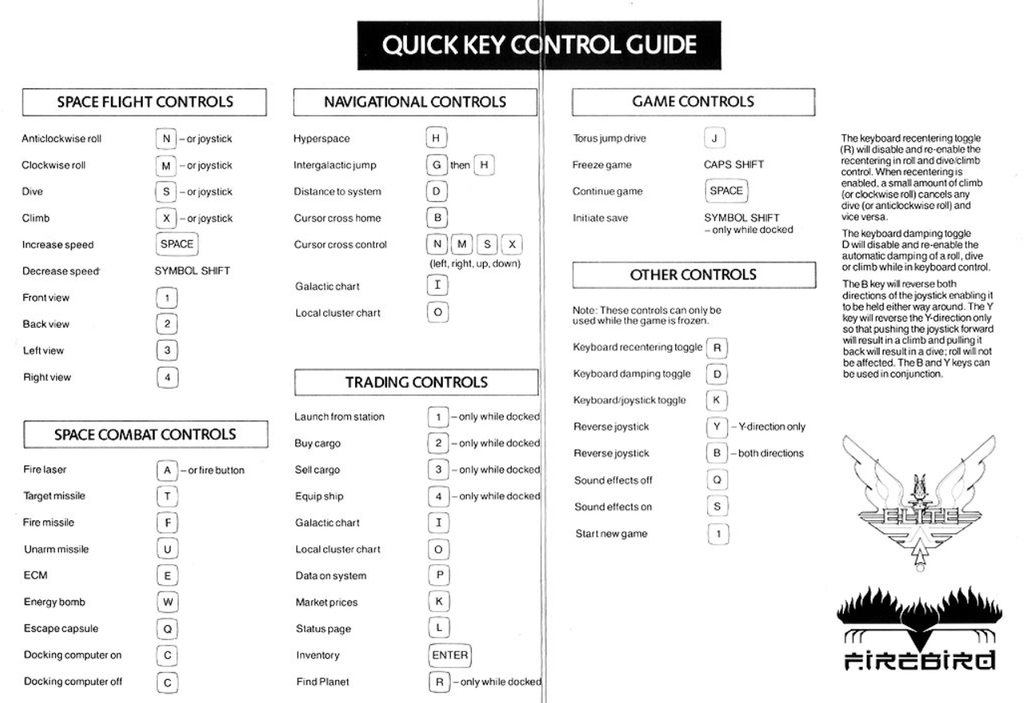
Elite was a tiny bit before my time as a Speccy lover and it was only a few years after that I got to play it and realised what the hype was all about, the best I can do here is give it an intro it so richly deserves. There are games that entertain you, games that challenge you, and games that fundamentally change the way you think about what a videogame can be. Elite belongs firmly in that third category. Even today, loading it onto a ZX Spectrum feels less like booting up an old computer game and more like opening a window into an entire universe. In an age of open-world games boasting hundreds of square miles of meticulously crafted landscapes, Elite achieves something arguably more impressive. It creates a vast galaxy from an astonishingly small amount of code, leaving the player free to explore, trade, fight, flee, mine and ultimately carve out their own destiny.
For its time, its brilliance remains undeniable. It is ambitious, unconventional, occasionally frustrating and utterly captivating. Few Spectrum games offer such a powerful sense of freedom.
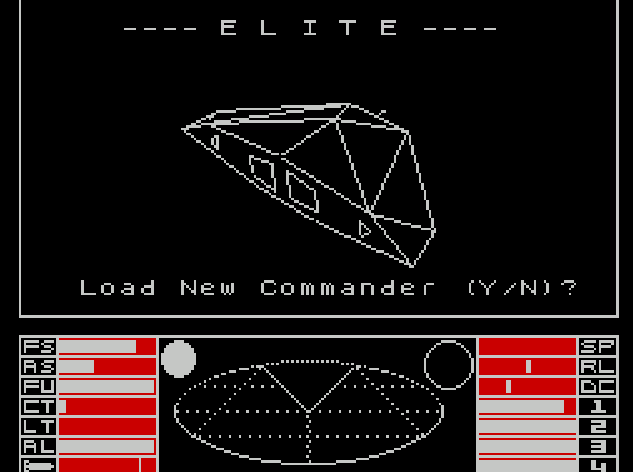
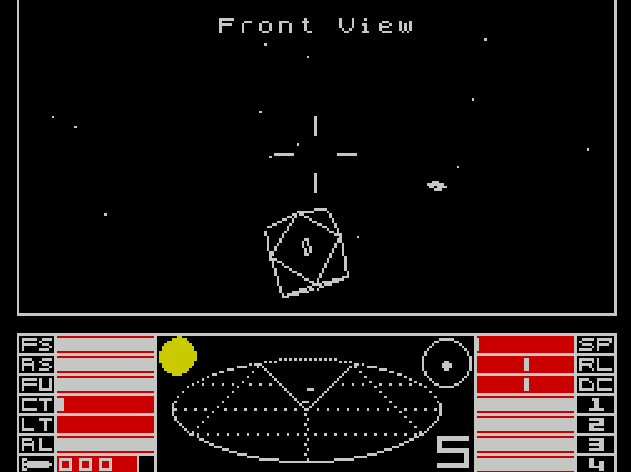
Welcome to the galaxy
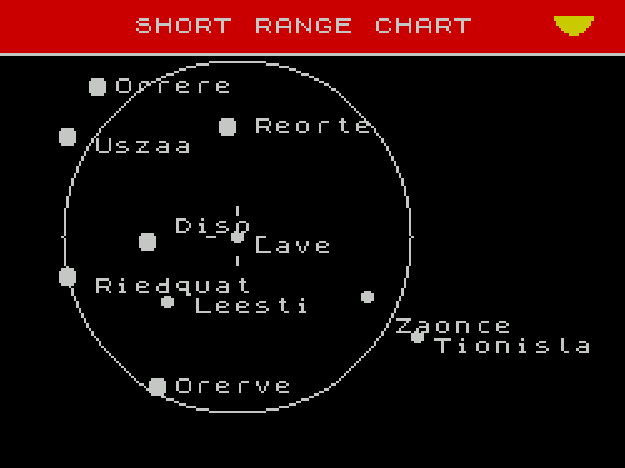
You begin with a Cobra Mk III spacecraft, a modest amount of cash, basic equipment and absolutely no guarantee of survival. Your starting point is the planet Lave, and from there the galaxy is yours to explore. There is no lengthy introduction, no scripted sequence explaining your destiny and no friendly guide holding your hand. You are given the controls, a manual, a universe and the expectation that you’ll work things out. That sense of independence is central to Elite’s appeal.
You can become a merchant, travelling between planets in search of profitable commodities. You can become a bounty hunter, seeking out criminals and hostile ships. Alternatively, you can embrace piracy, attacking innocent traders and accepting the consequences of your increasingly questionable reputation. The game doesn’t insist that you follow one particular path. It simply reacts to your choices.
That freedom feels remarkably modern. The absence of a rigid storyline allows the player to invent their own adventures, and the resulting experiences can be far more memorable than anything a scripted campaign might offer. One journey might involve a lucrative trading opportunity. Another might end in a desperate escape from pirates. Occasionally, you’ll encounter something strange enough to make you wonder whether the galaxy is quite as predictable as you thought.
And that’s when Elite becomes magical.
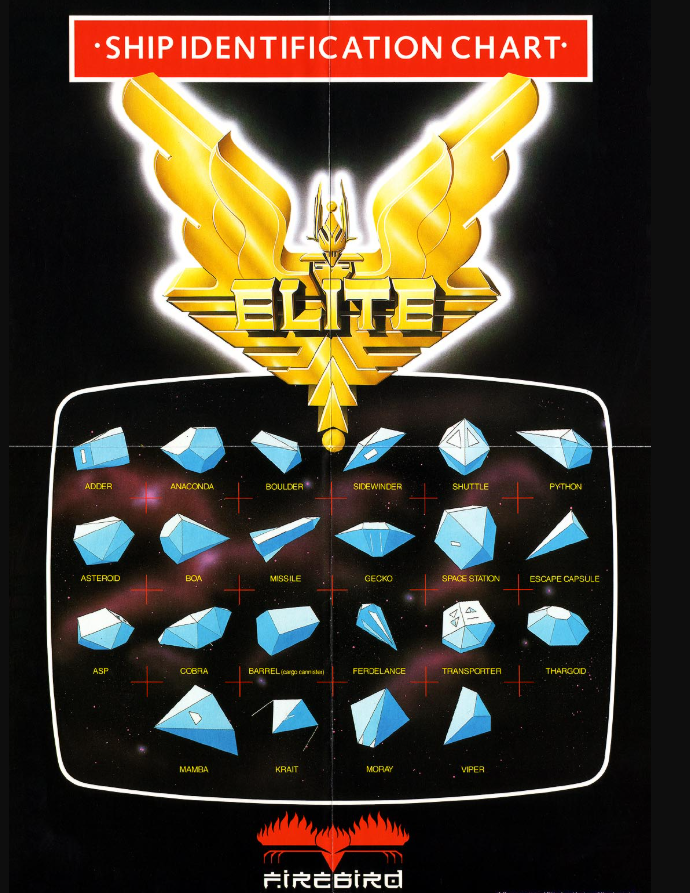
Gameplay: a universe of possibilities
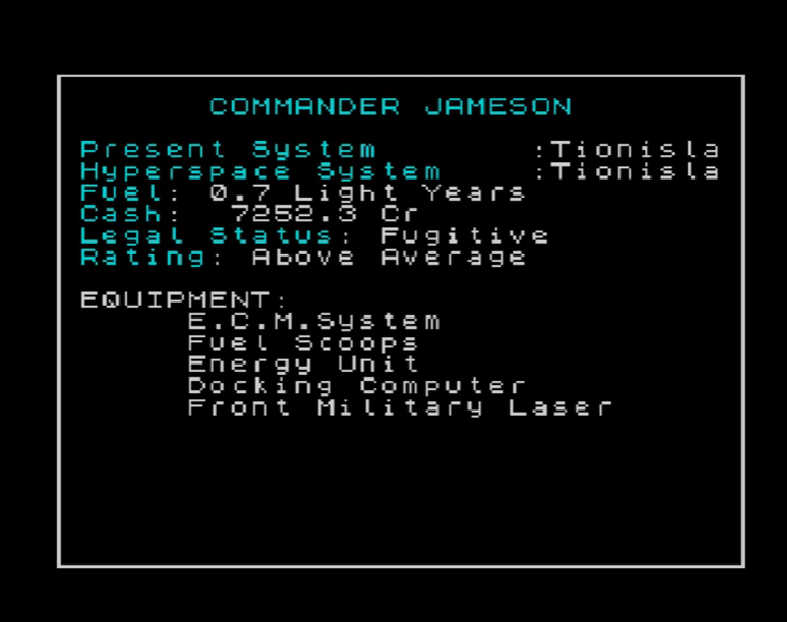
At its heart, Elite combines several genres into one remarkably cohesive experience. Trading, space combat, exploration, navigation and ship upgrades all feed into one another, creating a gameplay loop that is wonderfully addictive. The trading system is simple to understand but offers plenty of opportunity for experimentation. Each planet has its own economy, and prices vary depending on local conditions. Buy goods cheaply, transport them to another system, sell at a profit and gradually build your fortune. That money can then be invested in better equipment. More powerful lasers, shields, energy units, missiles and other upgrades make your Cobra increasingly capable of surviving hostile encounters. The progression feels genuinely earned. You’re not filling an experience bar or unlocking abilities because a menu says you’ve reached level five. You’re becoming a better pilot, a wealthier trader and a more capable combatant through your own decisions.
Space combat is exhilarating, although initially rather bewildering. Ships approach from different directions, your instruments provide vital information, and understanding how to manoeuvre effectively takes time. The first encounters can feel chaotic, particularly when several enemies decide that your little spacecraft looks like an easy target. But once the controls begin to click, combat becomes enormously satisfying. Tracking an enemy, lining up your weapons and watching its wireframe structure explode into fragments provides a surprisingly visceral thrill. The balance between risk and reward is excellent. Dangerous systems can offer lucrative opportunities, but travelling through them without sufficient equipment can be disastrous. You gradually develop an instinct for when to take chances and when to make a sensible hyperspace jump somewhere safer.
It’s this freedom to make meaningful decisions that gives Elite its remarkable longevity.
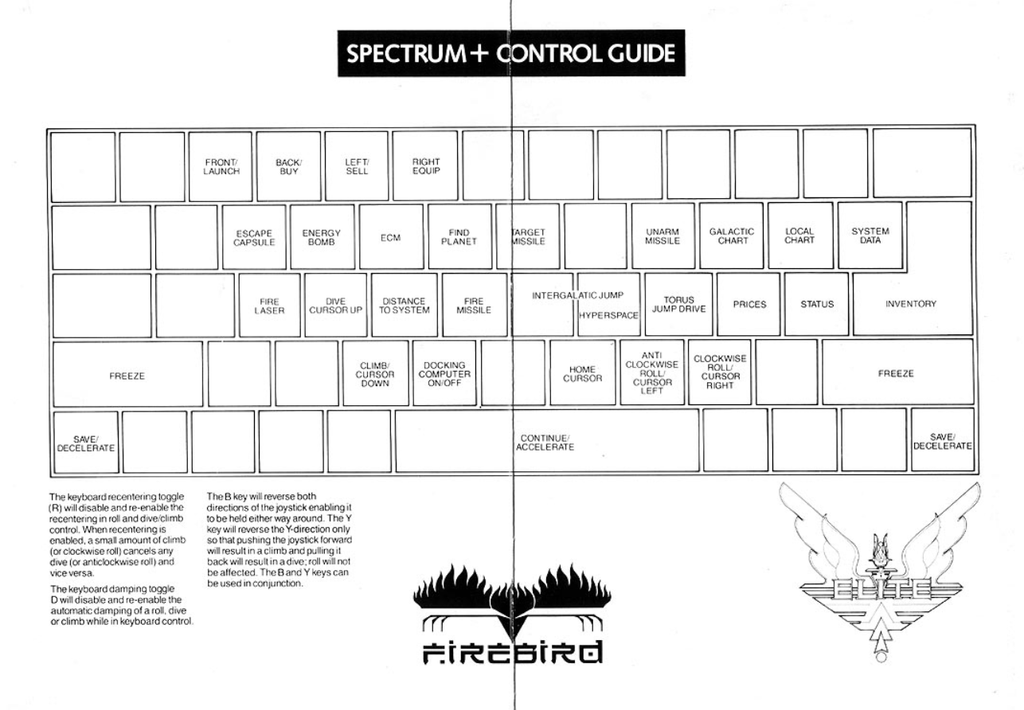
Graphics: wireframe wonders
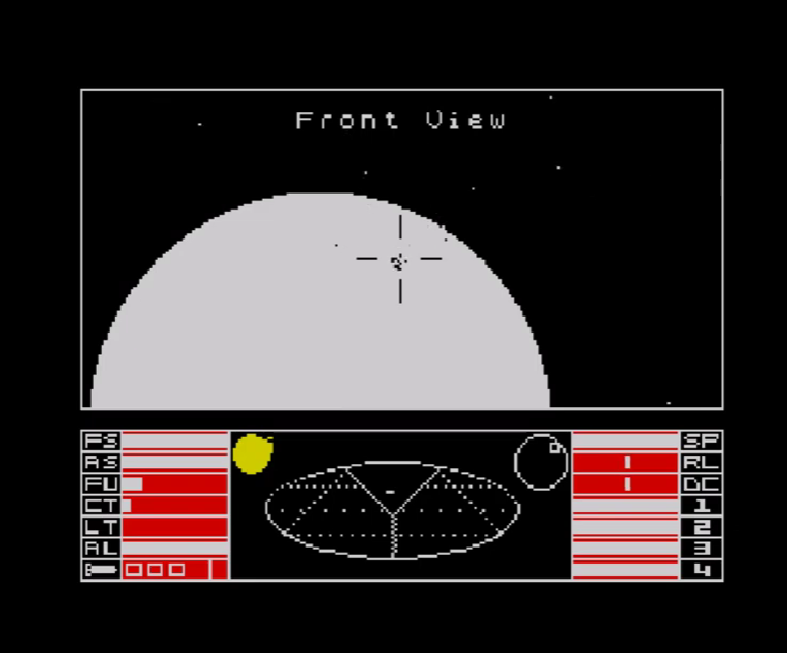
Let’s be honest: by modern standards, the visuals are primitive. Ships are constructed from simple wireframe polygons, planets are represented by basic geometric shapes, and the surrounding space is largely empty. Yet judging Elite purely on its visual complexity would be a profound mistake. The achievement is not simply that the Spectrum can display three-dimensional objects. It’s that those objects move convincingly through a navigable environment, creating a genuine sense of depth, distance and spatial awareness. Enemy ships rotate, approach and retreat. Space stations loom ahead, their rotating structures demanding careful manoeuvring. Planets grow larger as you approach, giving the impression that you’re travelling through an actual solar system rather than moving between static screens. The simplicity of the graphics also leaves plenty to the imagination. A distant blip on the radar might be a harmless trader, a police vessel or a pirate preparing to attack. The sparse presentation creates atmosphere in a way that more elaborate graphics sometimes struggle to achieve. The Spectrum version is particularly impressive considering the compromises involved. It captures the essential mechanics and sense of scale without losing the identity of the original game.
Sound: functional, not spectacular
The audio is probably Elite’s least impressive department. The Spectrum’s sound effects are limited, and the game doesn’t offer a sweeping orchestral soundtrack to accompany your travels. However, the lack of music isn’t necessarily a disadvantage. Space feels appropriately lonely, and the restrained sound design leaves you concentrating on your instruments, the radar and the unfolding action. The occasional sound effect provides useful feedback without overwhelming the experience. It’s an understated approach that suits the game’s atmosphere.
A richer soundtrack might have been welcome, but it would hardly have been essential to the experience.
Docking: the ultimate test of patience
If there’s one aspect of Elite that has become legendary for all the wrong reasons, it’s docking.
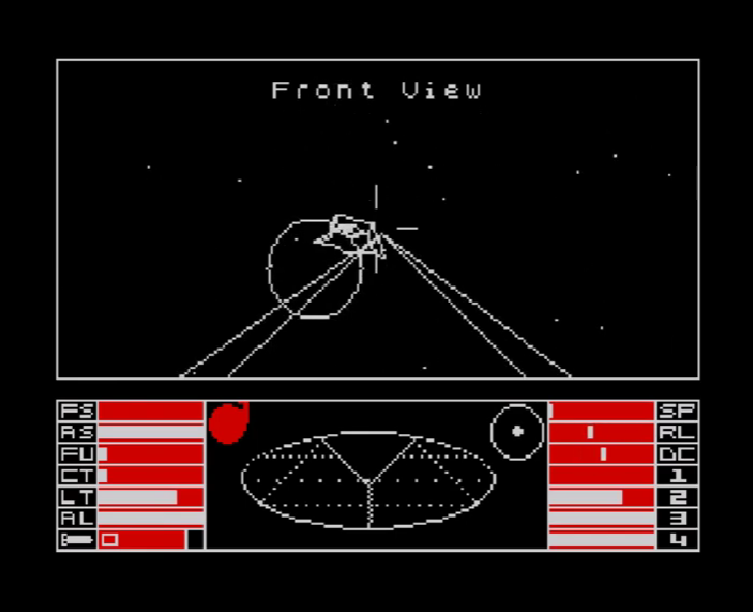
Returning to a space station with a cargo hold full of valuable goods should be a moment of triumph. Instead, it can become a nerve-wracking exercise in spatial awareness, patience and sheer stubbornness. The station rotates, its entrance is relatively small, and your ship needs to be positioned and aligned correctly to enter safely. Get it wrong and you may find yourself bouncing off the structure, losing precious time or, in the worst circumstances, destroying your ship and everything you’ve worked for.
There is a docking computer available, but acquiring one requires money that a new pilot may not have. Learning to dock manually is therefore an important early milestone. And when you finally glide through the entrance successfully, the relief is tremendous.It’s an unconventional mechanic, certainly, and modern players may find it unnecessarily demanding. But it contributes enormously to the sense that you’re piloting a real spacecraft. Stations aren’t simply menus with a picture attached; they’re physical destinations that require you to navigate.
The game asks you to learn a skill, and the satisfaction of mastering it is one of its most memorable rewards.
Longevity: almost limitless ambition
The scale of Elite is astonishing. Eight galaxies, each containing hundreds of systems, provide an enormous playground for exploration. The worlds differ in economic conditions, technology levels and political stability, giving you reasons to travel beyond your immediate surroundings. The procedural generation is a clever solution to the limitations of the Spectrum, allowing the game to create an extraordinary sense of scale without requiring vast amounts of storage. Some planets and systems inevitably begin to feel familiar after extended play, but the sheer number of destinations makes repetition less of a problem than it might otherwise be. The progression towards the coveted Elite combat rating provides an additional long-term goal, while the various missions and encounters offer occasional surprises along the way. Importantly, you don’t need to reach Elite status to enjoy the game. You can spend hours simply trading, exploring unfamiliar systems or upgrading your spacecraft. Your personal objectives are every bit as valid as the game’s ultimate achievement. That flexibility makes it remarkably easy to revisit decades later. There’s no pressure to remember a complicated storyline or complete a specific sequence of missions. You can simply load it, launch into space and see where the next journey takes you.
A few rough edges
Elite isn’t perfect. Its learning curve can be steep, and the manual is practically essential for understanding the controls, navigation and trading systems. The initial experience can be intimidating, particularly if you don’t know what to prioritise. Combat may feel awkward until you’ve developed some familiarity with the ship’s movement, and the consequences of making mistakes can be severe. The Spectrum’s presentation also means that some encounters lack the visual clarity of more modern space simulators. And then there’s LensLok, the copy-protection system associated with the original release, which required a special optical device to decode an on-screen message. It was an infamous inconvenience, and some early copies reportedly suffered compatibility problems with the supplied device. These frustrations are worth acknowledging, but none fundamentally undermine the game itself. Once you’re past the initial learning curve, Elite becomes one of those rare experiences where the hours disappear without you noticing.
Verdict: still light-years ahead
Elite remains an extraordinary achievement. Its combination of trading, combat, exploration, progression and freedom creates an experience that feels genuinely expansive, even when played on a ZX Spectrum decades after its original release. The graphics are simple, the sound is modest and the learning curve can be unforgiving. Yet its ambition, depth and sheer sense of possibility more than compensate. What makes Elite truly special is that it doesn’t simply ask you to play a game. It asks you to inhabit a universe. You develop your own routines, discover your own profitable routes, encounter unexpected dangers and gradually build a reputation among the stars. Few games provide such a compelling feeling of personal adventure. For contemporary retro gamers, Elite is more than an important historical curiosity. It remains genuinely enjoyable, rewarding patience, curiosity and experimentation in equal measure.
It is a masterpiece of game design, an astonishing technical achievement and one of the most influential titles ever to grace the ZX Spectrum.
An essential classic. Even after all these years, the galaxy is waiting.
ELITE — 95%
Masterpiece · Essential
| Gameplay | 98% |
| Graphics | 94% |
| Sound | 82% |
| Longevity | 99% |
| Originality & ambition | 100% |
Final score: 95%
Historical context: The ZX Spectrum conversion appeared in 1985. Original magazine reviews praised its scope, with Crash awarding 92% and a Crash Smash, while Sinclair User awarded it 5/5.