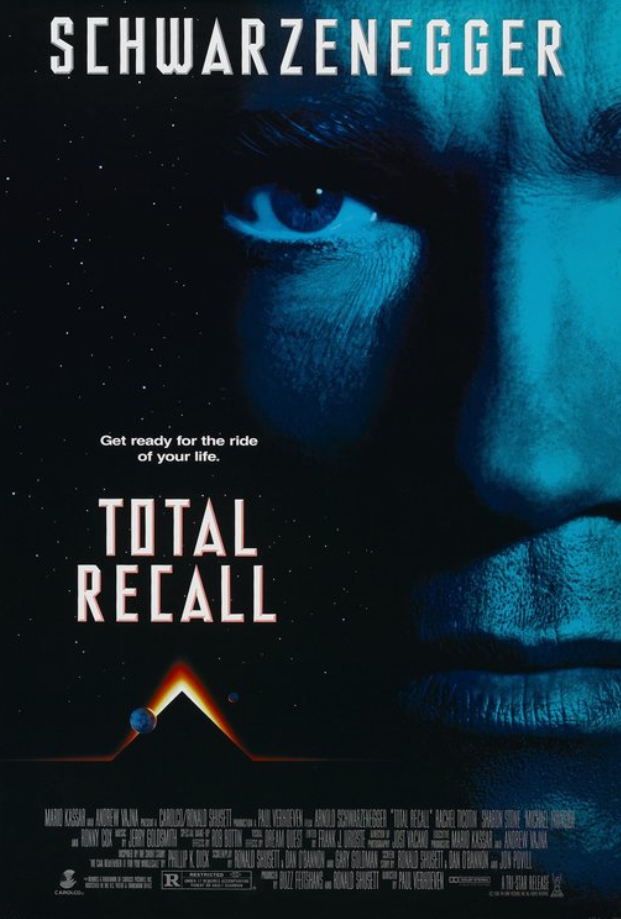
Some viewers may dismiss Arnold Schwarzenegger’s performance in Total Recall, assuming he’s simply flexing his muscles rather than acting. But that perception misses the mark — his portrayal is one of the key reasons the film works as well as it does. This time, he isn’t a superhuman action figure, though he certainly fights like one. Instead, Schwarzenegger plays a man trapped in a crisis of identity and perception, someone betrayed by the very nature of his reality. His confusion and vulnerability allow Total Recall to transcend the boundaries of a mere action spectacle, offering something more layered beneath the surface of its explosions and gunfire.
Of course, the film is still packed with action, violence, and dazzling special effects — nearly every frame features some kind of visual wizardry. At its release, Total Recall was one of the most visually ambitious sci-fi films ever made. The story, adapted from Philip K. Dick’s short story We Can Remember It for You Wholesale, explores an idea that’s as provocative now as it was then: What if your entire past — your memories, experiences, even your identity — could be fabricated? If your mind couldn’t tell the difference, would it even matter?
Schwarzenegger plays Douglas Quaid, an ordinary construction worker living a seemingly happy life with his wife (Sharon Stone) in a futuristic city. But Quaid is haunted by recurring dreams of Mars and an unfamiliar woman. Driven by curiosity, he visits Rekall — a company that implants artificial vacation memories directly into your brain. Quaid opts for the “secret agent” package, choosing Mars as his destination and customizing his fantasy to include a dark-haired, “athletic, sleazy, and demure” love interest.
But before the procedure is complete, something goes wrong. Quaid snaps violently out of the memory implantation process, claiming that his real identity has been uncovered. Suddenly, he’s on the run — hunted by government agents, betrayed by his wife, and unsure of what’s real. When he finally reaches Mars, he’s thrust into a revolution between the planet’s ruthless governor, Cohaagen (Ronny Cox), and a band of mutants fighting for freedom. Somewhere amid the chaos lies a buried alien reactor that could terraform Mars and change the planet’s destiny.
What makes Total Recall so compelling is that the audience, like Quaid, never quite knows what’s real. Is he truly a secret agent rediscovering his erased past, or is he still strapped into Rekall’s chair, lost in a vivid fantasy? A memorable scene toys with this ambiguity: a calm doctor and Quaid’s wife appear mid-adventure, urging him to take a pill to “wake up” — claiming that everything he’s experiencing is part of the implanted dream.
Director Paul Verhoeven (RoboCop, The Fourth Man) thrives in this psychological grey area, blending the hyper-violence and industrial grit of 1980s sci-fi with Dick’s fascination with fractured reality. Mars itself is brought to life through remarkable production design — a grimy, neon-lit hybrid of Times Square and a mining colony. Mutants, three-breasted dancers, and mercenaries populate this brutal, chaotic world, while Verhoeven’s lens lingers on grotesque yet imaginative details that make it feel alive.
Michael Ironside gives a fierce performance as Richter, Cohaagen’s enforcer, relentlessly pursuing Quaid through claustrophobic corridors and Martian tunnels. The action sequences are relentless and bloody, featuring the signature over-the-top violence that became Verhoeven’s trademark. Exploding heads, shattered glass domes, and frantic gunfights dominate the film’s pacing — yet beneath the carnage lies a deeper question: if reality is just a construct of memory, who decides what’s true?
The film’s science, of course, is pure pulp. The famous scenes where characters suffocate in Mars’s thin atmosphere, their eyes bulging grotesquely, are scientifically absurd — but gloriously cinematic. Similarly, the idea that an ancient alien reactor could instantly create a breathable atmosphere on Mars is nonsense, yet it’s exactly the kind of bold, fantastical storytelling that makes Total Recall unforgettable.
Verhoeven’s genius lies in making the absurd feel operatic. Beneath the explosions and one-liners, he injects irony and satire — a critique of corporate greed, authoritarianism, and the commodification of dreams. The movie’s future world feels less like a utopia and more like a polluted extension of 20th-century capitalism, where even your memories can be bought and sold.
Schwarzenegger anchors all of this chaos with surprising nuance. He manages to blend bewilderment, humor, and raw physical presence into a performance that makes Quaid both sympathetic and larger-than-life. His confusion and determination give the film an emotional core amid all the sci-fi spectacle. When he’s gasping for air on Mars or grappling with whether his memories are real, we believe him.
In the end, Total Recall is more than just a futuristic shoot-’em-up — it’s a mind-bending exploration of identity and reality, wrapped in one of the most entertaining packages science fiction cinema has ever produced. Whether Quaid wakes up at the end or not, the film leaves you questioning your own perceptions long after the credits roll.
Stylish, violent, funny, and philosophically rich, Total Recall stands as one of the great examples of 1990s sci-fi — a wild fusion of pulp energy and intellectual intrigue. And with Arnold Schwarzenegger at its center, the movie proves that even the biggest action star in the world can make you think while blowing everything to pieces.