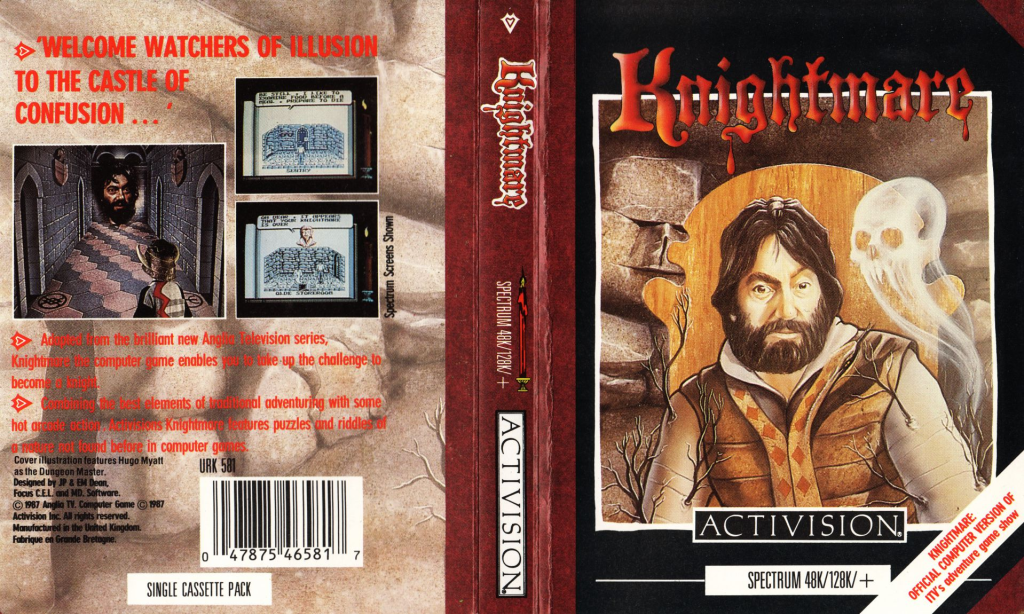
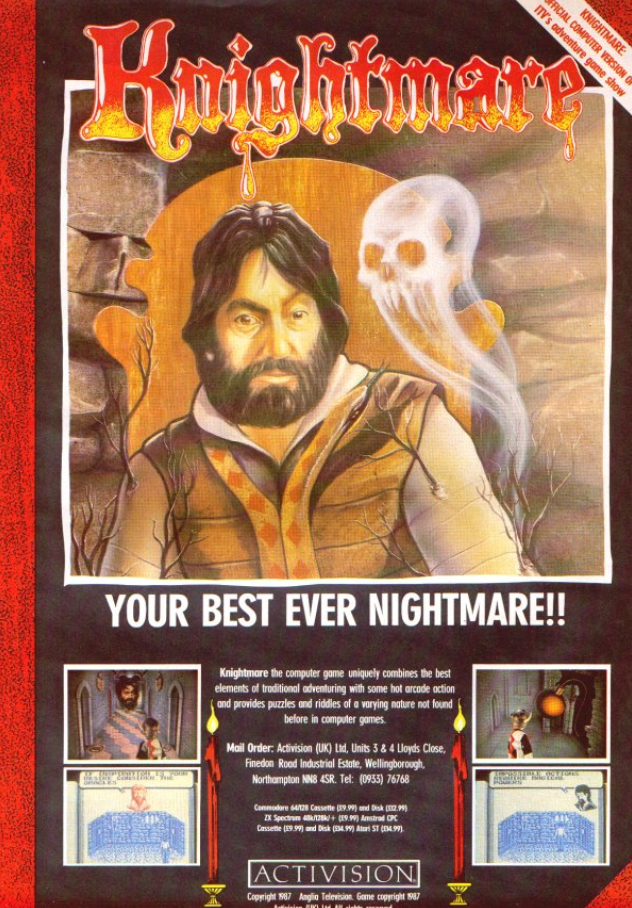
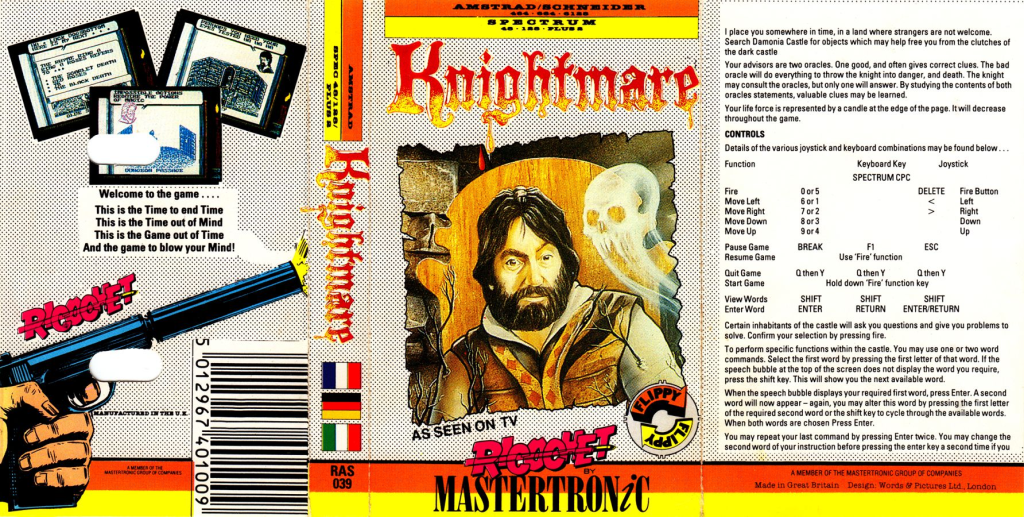
Decent puzzler adventure based on the excellent TV Show of the same name, Knightmare……

Just to give a little authentic background to this, I loved the TV show as a kid, for me it was amazing. And so when I knew I was getting the game, which happened to be the budget re-release at Christmas of 1988, I was delighted and excited. Funnily enough, it was a game that was in my stocking and as our stockings were placed on the base of our beds when we were young at around midnight on Christmas Eve, I got no sleep that night as I wanted to start cracking into the games I was due. (This was the year I also had Double Dragon for Christmas). I did suffer later as I remember feeling quite ill in the evening due to a night of no sleep and over indulgence at the Christmas table, c’est la vie. Anyway, enough of my ramblings, let’s crack on.
For those born a little later, Knightmare was a television programme involving a blue studio, cardboard dungeon walls, and one unfortunate soul rendered blind by an oversized helmet. This poor victim was guided by three excitable idiots and a bearded middle-aged man whose enthusiasm always felt just a little… concerning.
Yet Knightmare: The Game turns out to be something of a pleasant shock. It’s actually rather good. Very good, in fact.
You don’t need to have seen the TV show to enjoy it; the game stands perfectly well on its own. That said, fans of Anglia TV’s twenty-minute fantasy fix will be impressed by just how closely programmer Mev Dinc has captured the spirit of the original.
Knightmare is an adventure in the purest sense. You control the knight, guiding him through a grim fantasy world, solving puzzles and surviving dangers as you go. It’s difficult to compare directly with other games because its mechanics are refreshingly original, though there are hints of Fairlight and even Valhalla lurking beneath the surface.
As you explore, you’ll regularly encounter situations that refuse to be easily solved. At these moments—just like in the TV show—you can call upon the Oracles. Two godlike figures appear at the top of the screen, gazing down upon your predicament. One is good, the other evil, and both are eager to offer advice.


Naturally, the good Oracle often suggests doing absolutely nothing and getting nowhere, while the evil one actively tries to get you killed. Choosing who to trust becomes an art in itself. The trick is to walk a very fine line and steal just enough wisdom from each.
Visually, Knightmare is a delight.
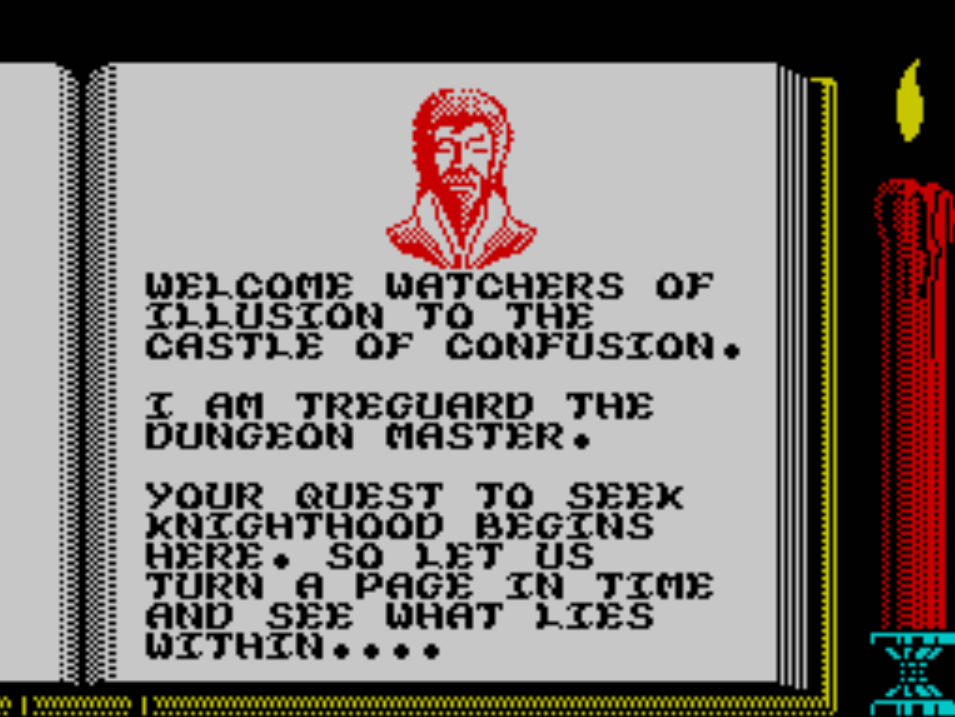
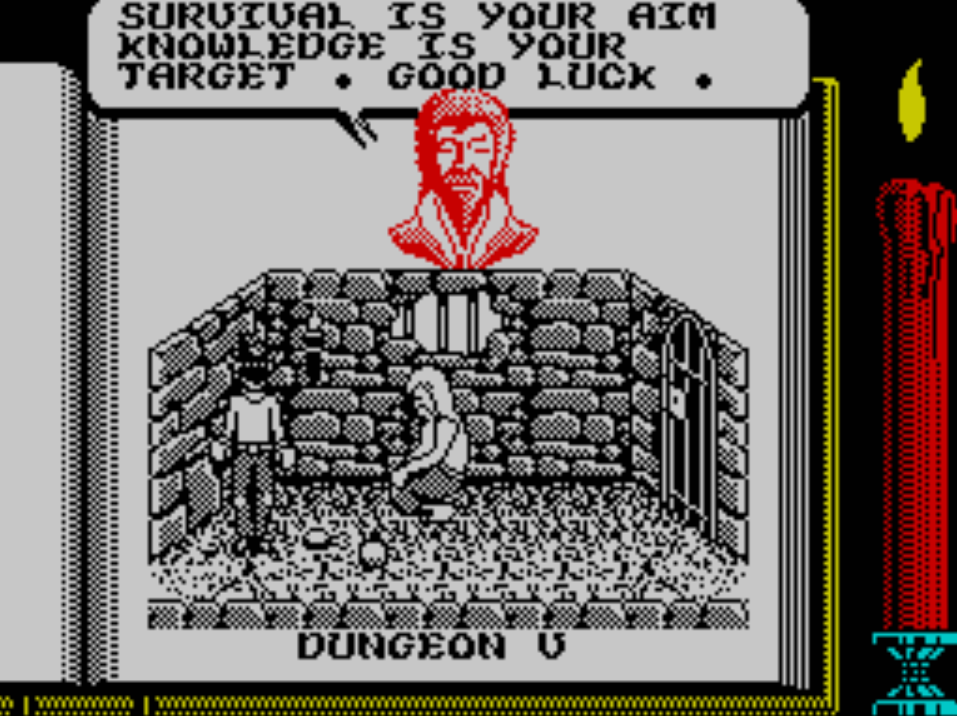
The screen is presented like an open book, with the action unfolding across its pages. Move to a new location and the current page scrolls aside in a wonderfully convincing way to reveal the next scene. Rooms are drawn in single colours with a semi-3D effect, deliberately avoiding the isometric approach popularised by Ultimate. It’s a bold choice, and it works.
Character graphics are clearly defined, if a little slender, and animations are smooth and speedy. Everything moves with purpose and without unnecessary fuss.
Beyond movement and combat, interaction is handled via a two-word input system known as Word Gears. Thankfully, there’s no need for typing dexterity. Press a key and an action word appears at the top of the screen. Cycle through until you find the one you want, select it, and a second word appears alongside it.
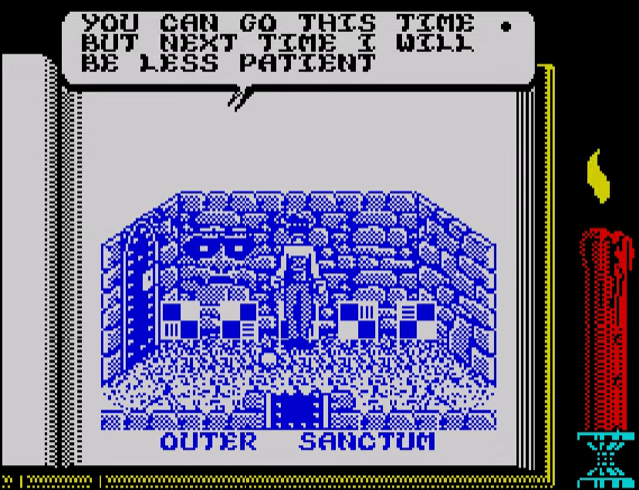

The clever part is that once you choose an action—Open, for example—the game only offers objects that could realistically be opened. This smart filtering saves time, frustration, and potentially your life.
Your most vital statistic, stamina, is represented by a candle on the right-hand side of the screen. As it burns lower, so does your strength.
Puzzles come in many forms. Some involve grotesque creatures appearing out of nowhere to demand answers to riddles, with instant death awaiting any wrong response. Others are visual challenges, such as spot-the-difference tasks. All must be solved before the timer expires. Failure unleashes absolute chaos, usually in the form of harpies swooping in from every possible angle. Chaos, it must be said, is a frequent occurrence.
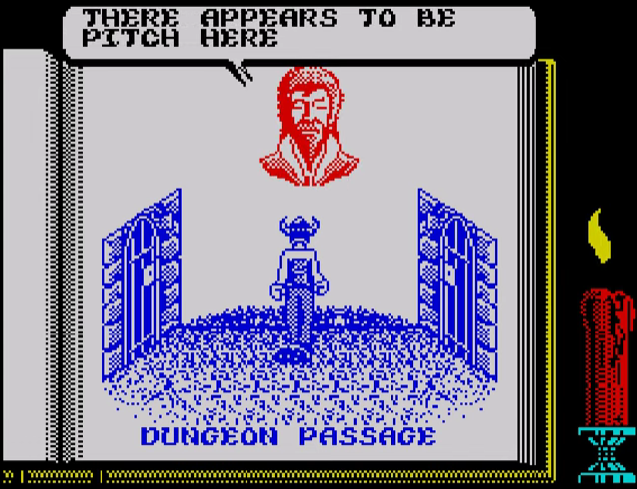
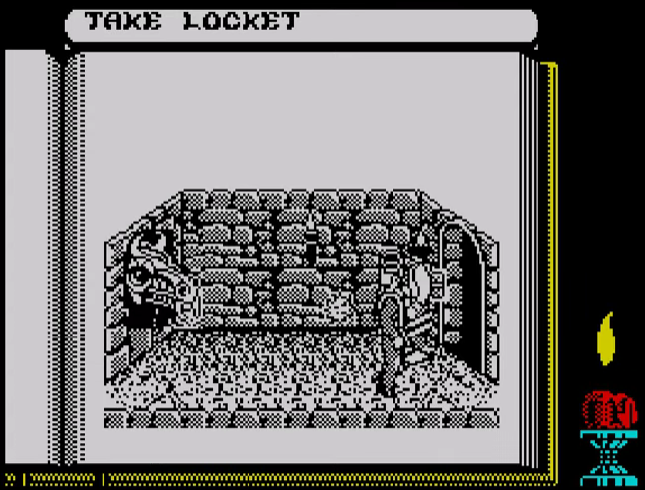
Among the most valuable items are scrolls that grant spells. Some are practical—Torch illuminates dark areas—while others are gleefully destructive, such as Toad, which turns everything in a room into harmless frogs. There’s also Metamorph, a risky spell that transforms your nearest enemy into something else. Used wisely, it can save your life; used poorly, it can make things far worse.
The game is divided into two main sections. The first focuses on dungeon environments, while the second opens out into a woodland setting for a change of pace.
Although there’s no immediately obvious goal beyond scoring points, subplots soon emerge. Without spoiling too much, expect a familiar fantasy setup involving a woman, a dragon, and a wealthy old man.
Activision has taken a strong licence and delivered a game that, while not flawless, is consistently imaginative and enjoyable.
Overall:
An original, fast-moving adventure with plenty to hook players of all kinds. Smart, engaging, and well worth your time.
BREAKDOWN:
GRAPHICS: 78%
MUSIC/SFX: 30%
PLAYABLITY: 81%
OVERALL: 80%

Platform: ZX Spectrum
Genre: Adventure – General
Developer/ Publisher: MD Software / Activision
Release: 1987