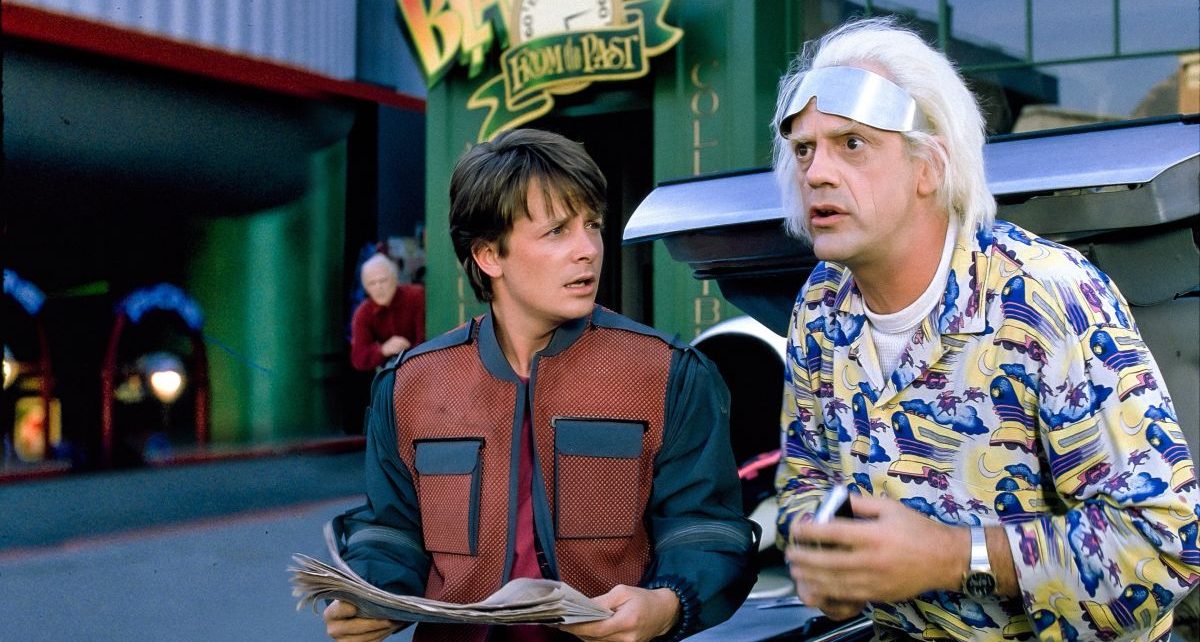

Back to the Future Part II is a gleefully goofy exercise in time-travel excess, hopping between multiple pasts and futures with such enthusiasm that even the characters themselves are forever stopping to explain what’s going on. I half-wished I’d brought a large yellow notepad to the cinema just to keep the timelines straight. Still, despite – or perhaps because of – its bewildering complexity, the film is great fun.
Any story built around time travel inevitably invites paradoxes, a playground science-fiction writers have enjoyed for decades. What happens if you kill your grandfather? How do you react if you run into yourself? One classic sci-fi tale even suggests that a time traveller stepping on a single insect in the distant past could erase the entire future. Back to the Future Part II revels in these ideas, using them as fuel for its increasingly convoluted plot.
The film follows Marty McFly and Doc Brown as they attempt to meddle with history without tearing reality apart—only to do exactly that. Their mistake results in an alternate future where Marty’s mother has married his loathsome nemesis, Biff Tannen. Michael J. Fox and Christopher Lloyd return as Marty and Doc, reprising their roles from the 1985 smash hit. In fact, Parts II and III were filmed back-to-back, and this installment even ends with a trailer teasing the third film, due the following summer. (Film trivia fans may note that Russ Meyer was one of the few other directors bold enough to end a movie with a trailer.)
One can only imagine the confusion during script meetings, as director Robert Zemeckis and writer Bob Gale tried to navigate the tangled web they’d created. The story opens in 1985, moments after the first film ends. Doc Brown reappears in his modified DeLorean, brimming with urgency, and whisks Marty off to the year 2015. Something has gone terribly wrong there, and Marty must intervene to prevent his own son from landing in prison.
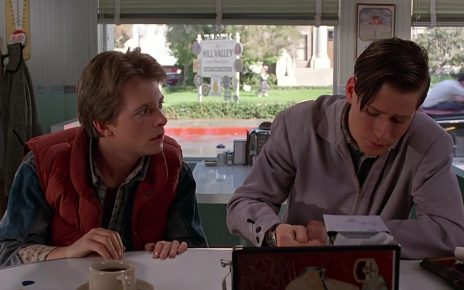
The 2015 version of Hill Valley looks like something straight off the cover of a vintage pulp sci-fi magazine. The familiar town square is now criss-crossed with skyward ramps, jet-powered vehicles zip overhead, and skateboards have evolved into hoverboards. This setting gives rise to one of the film’s most memorable sequences, as Marty flees a gang of futuristic hooligans in a dazzling special-effects chase.
Marty largely succeeds in fixing the immediate problem, but makes a crucial error: he buys a sports almanac listing game results from 1950 to 2000. The book—and the DeLorean—fall into Biff’s hands, and he travels back in time to give them to his younger self, setting himself up for a life of crooked bets and obscene wealth.
The result is a dystopian future ruled by billionaire Biff, prompting Marty and Doc to head back to 1955 to retrieve the almanac. If you’re still following the plot at this point, congratulations—you’re doing well. Trying to explain how the parents and children of the main characters intersect across timelines, how Marty nearly ends up on a double date with himself, or how Michael J. Fox manages to play multiple roles (including his own daughter) would only add to the confusion.
Much of the film’s charm lies in Christopher Lloyd’s performance as Doc Brown, frantically attempting to make sense of the chaos he’s helped unleash. His breathless efforts to “fix” history are endlessly entertaining, even if they rest on a questionable assumption: that he knows which timeline is the correct one. For all he knows, the supposedly “original” reality from the first film was already an alternate version. Deciding that might be a job for a higher power.
For all its cleverness and manic energy, Back to the Future Part II lacks the emotional core of the original. The 1985 film had real heart, built around Marty’s relationship with his parents and the very real possibility that he might erase himself from existence. In contrast, Part II leans heavily into absurdity, visual gags, and comic invention. It may not be as moving, but on its own terms—as a wild, inventive, and thoroughly screwy ride through time—it delivers plenty of fun.