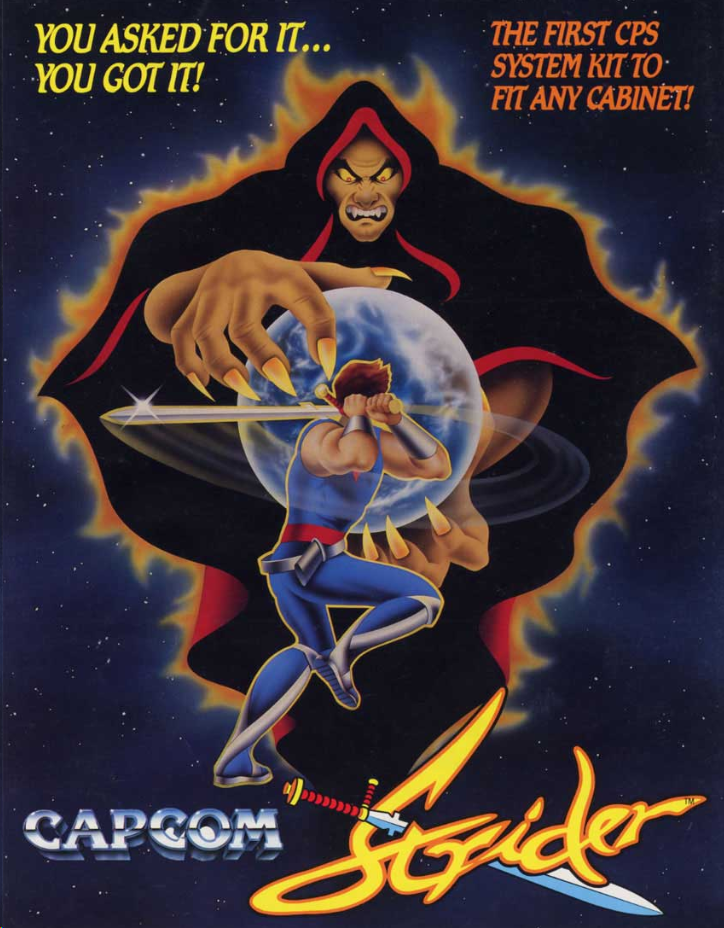
One of the Best Arcade Platformers of it’s time – A True Classic

Strider, an action-platformer rooted in a Japanese manga series, embarks players on Hiryu’s quest to thwart the Grandmaster’s ambitions of conquering Earth, slicing through five challenging stages. Navigating perilous terrains teeming with foes and obstacles, Hiryu wields a potent sword and is aided by robotic companions.
This game delves deep into the essence of gaming prowess. Initially, the challenge is so formidable that mere quarters won’t suffice. Ironically, as one delves into the gameplay, the initial resistance transforms into a love for the challenge. Completing the game often sparks a desire to restart, pushing oneself to lose fewer lives in subsequent attempts. With time and practice, mastering the game to a one-coin run becomes achievable. The sense of accomplishment upon completion is a unique aspect, setting Strider apart from other games that may feel satisfying but lack the motivation to replay repeatedly.


Gameplay: Strider stands out as a pinnacle in the realm of platformers, earning the title of possibly the greatest ever. The brilliance of the platform gameplay lies in its meticulous design. Virtually every surface features an incline, challenging players to adopt creative combat strategies rather than straightforward attacks. The simulation of speed is masterfully executed, with Hiryu swiftly descending slopes and gradually ascending inclines.
While Hiryu effortlessly dispatches armies and enemies, the true challenges lie in overcoming diverse obstacles. Whether navigating downhill, leaping over treacherous cliffs, commandeering airborne platforms, or navigating in reverse gravity, the variety is vast, each section possessing standalone brilliance.
Boss battles are a testament to classic gaming. Imposing, visually striking, and with distinct patterns, they never fail to astonish. The satisfaction of completing a level, having conquered an intricate boss like an amalgamation of evil committee members formed into a monstrous dragon snake, adds a unique flavor to the overall gaming experience.


Controls: The controls are straightforward, utilizing a joystick for movement and two buttons for jumping and attacking. Hiryu can execute a Mega Man-style slide by holding down and pressing the jump button. The simplicity of the controls does not compromise functionality, offering precise and easy maneuverability. Whether scaling a building, gripping the bottom of airships, or sliding across the ceiling to dispatch foes, executing actions requires nothing more than a quick button press.
Graphics: Capcom’s achievement in 1989 remains remarkable, producing visuals that could not be replicated until a full generation later. The game features expansive landscapes beyond the immediate action, vibrant characters, and smooth animation throughout.


Music: Describing the music as cinematic captures its essence accurately. While not necessarily catchy, the tunes immerse players in an epic action film experience. For instance, the heroic fanfare in the first level, serene melodies in the snow contrasted with the acceleration down a cliff, or subdued tones within a techno-boss lair. The music dynamically syncs with the player’s actions, location, and predicament, a remarkable feat for its time.
Difficulty: In the realm of arcade games designed to consume quarters, Strider adheres to the tradition of challenging gameplay. Success triggers increased enemy and projectile onslaughts, presenting a constant test of skill. While initially discouraging, repeated playthroughs transform it into a one-coin endeavor, satisfyingly navigated with experience. Newcomers might face early game overs, possibly in the second stage, but mastery over time turns the gameplay into a manageable challenge.


Gripe: The lone gripe surfaces in occasional glitches and seemingly unfair occurrences, detracting from an otherwise perfect score. Instances of falling through platforms, encountering an inescapable line of bombs, or random enemies falling through hanging platforms are not uncommon. While forgivable as a product of its time, these “cheese deaths” become particularly frustrating during attempts at no-death runs. The frequency of such occurrences varies with difficulty levels, prompting the question of whether scaling back some elements on normal difficulty would maintain challenge while reducing frustration.
Overall: Should you encounter this game, be it a port from the Genesis, PSX, or Capcom Collection, give it a go. Don’t let initial setbacks deter you; persist and keep at it.
BREAKDOWN:
GRAPHICS: 90%
MUSIC/SFX: 87%
PLAYABLITY: 92%
OVERALL: 91%

Platform: Arcade
Genre: Action-Platformer-2D
Developer/ Publisher: Capcom
Release: 1989
Franchises: Strider