I’m not convinced I could pass a test on the plot of Mission: Impossible. That’s some comfort, since the screenwriters probably couldn’t either. The story unfolds as a dense maze of post–Cold War espionage and double-crosses, but the specifics are largely beside the point. The plot exists mainly to propel a series of stylish chase scenes and an intricately staged computer heist, punctuated by familiar spy-movie staples — including the inevitable late-night meeting beneath a lonely streetlamp in a cold, foreign capital.
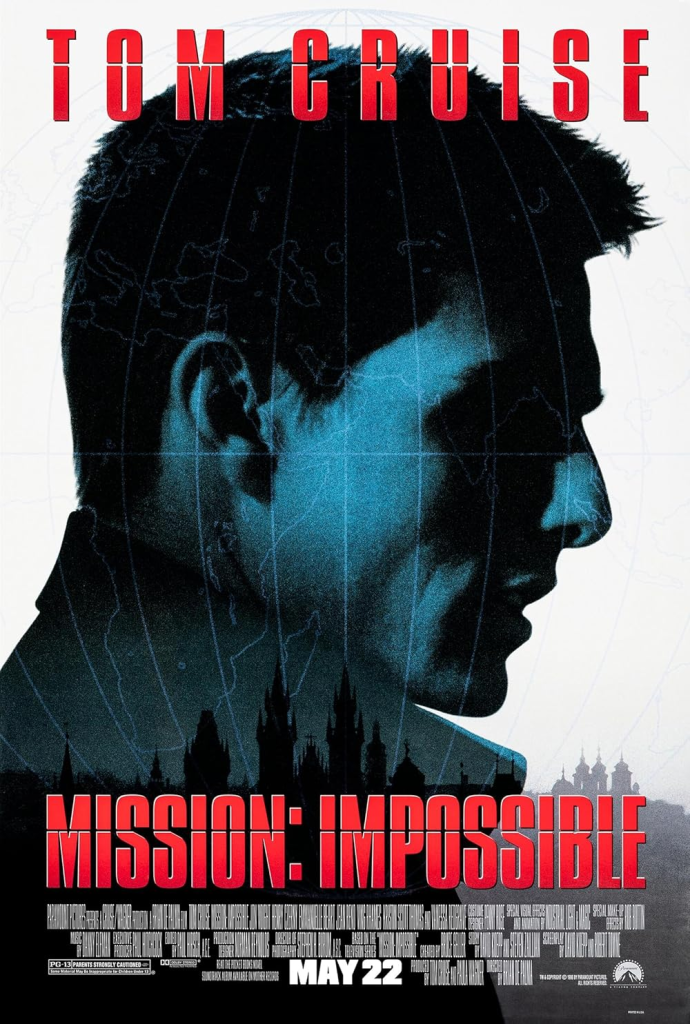
Tom Cruise stars as Ethan Hunt, a professional spy whose mission — one he eagerly accepts — is to prevent the theft of a computer file containing the real identities of America’s double agents. Stopping the theft isn’t enough. Hunt and his team, which includes Jon Voight, Kristen Scott Thomas, and Emmanuelle Béart, must photograph the enemy in the act and trail him until the information changes hands. What follows is a checklist of classic espionage clichés: eyeglasses equipped with hidden cameras, concealed microphones, laptops, elaborate disguises, exploding cars, stabbings, gunfire, bodies tumbling into rivers — all centered around a diplomatic reception in Prague.
Because Mission: Impossible is directed by Brian De Palma — a filmmaker known for stylish thrillers and sly Hitchcockian touches (Blow Out, Body Double) — taking the plot seriously is itself a nearly impossible mission. De Palma prioritizes style over story, a sensible choice, since stopping to explain the narrative would require an enormous detour.
The first half-hour is packed with double and triple reversals, conditioning the audience to trust nothing — not even faces, which may turn out to be latex masks. The sheer visual momentum discourages logical questions, such as whether physically copying a computer file onto a disk is truly the only way to steal it. (As my colleague Rich Elias has noted, the CIA could have simply hired Robert Redford’s team from Sneakers to pull off an online theft.)
Mission: Impossible is all sleek surfaces and technical finesse. The characters are thinly drawn, with the exceptions of Vanessa Redgrave’s information broker and Jon Voight, who brings a weary gravity to a film that has no patience for weariness. The plot is almost impossible to follow, and the elaborate strategies of heroes and villains alike collapse under scrutiny — but none of that really matters.
This is a movie meant to be experienced moment by moment. To enjoy it, the audience must live in the instant and suppress any lingering questions raised earlier.
De Palma excels at extended, dialogue-free action sequences, and the film features three major ones: the opening chaos at the diplomatic reception, the silent and painstaking computer heist, and a climactic chase in which a helicopter pursues the London–Paris train into the Channel Tunnel, with Cruise and a villain clinging to its roof.
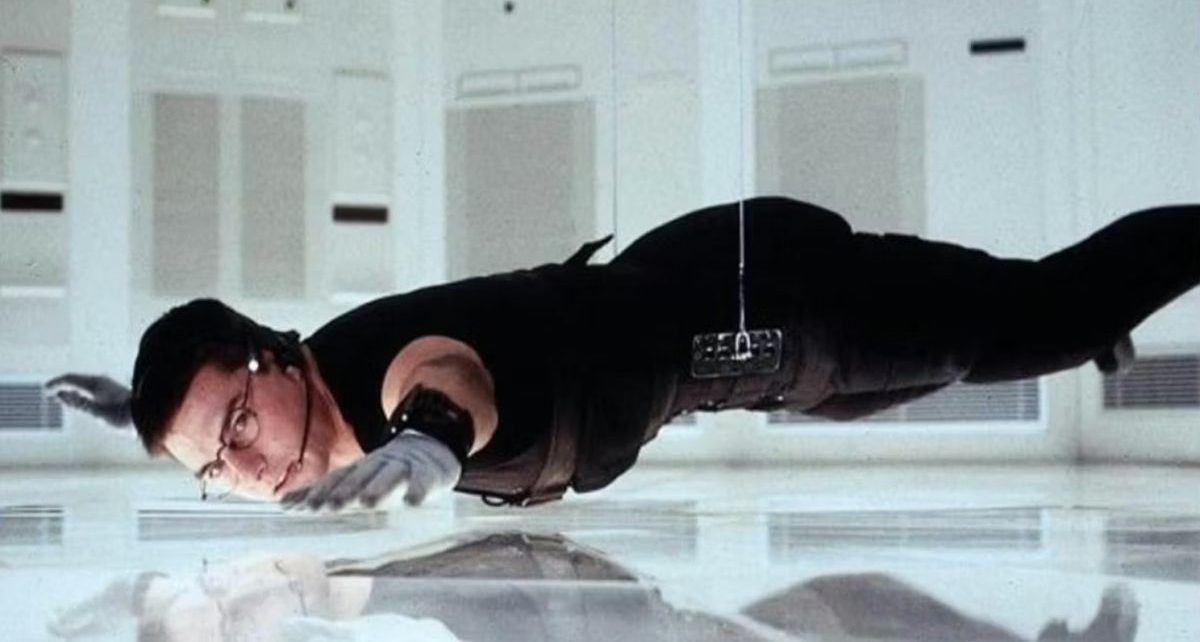
The heist sequence will feel familiar to fans of Jules Dassin’s Rififi (1954) and Topkapi (1964), both famous for extended theft scenes played in near silence. Like Topkapi, the film features a thief suspended from the ceiling to avoid pressure-sensitive floors. De Palma updates the concept with a computer “safe room” rigged with alarms triggered by sound, temperature changes, or the slightest pressure. Cruise, dangling in a harness, carefully inserts a blank disk to copy the file.
Conveniently, the sound threshold is set high enough to ignore the noise of a computer copying data — precisely what the system is meant to detect. It’s equally convenient that the infrared security beams are easily neutralized, and even more convenient that they’re visible to the naked eye. (For a more convincing use of infrared security, see Grand Slam from 1968.)
While the heist may not break new ground, the finale certainly does. Even the James Bond films haven’t attempted anything quite like a helicopter chasing a high-speed train into the Chunnel. Earlier, we’re told the train is moving so fast that Cruise risks being blown off — a detail British viewers may enjoy, despite knowing the train only reaches such speeds on the French side, since the British high-speed tracks weren’t yet complete.
Never mind. The train is fast, the helicopter follows it underground, and De Palma’s special effects team at Industrial Light & Magic cleverly obscures the scale of the stunt — since helicopter blades clearly wouldn’t fit inside the tunnel. But why nitpick? The entire sequence is spectacularly impossible anyway.
In the end, the appeal of Mission: Impossible is simple: Tom Cruise looks cool, commands the screen, and performs impressive feats we barely have time to question. He moves so fast, and with such polish, that logic is temporarily suspended and we’re swept along by the momentum. When the film ends, we realize there wasn’t much beyond that momentum — but at least it was fun while it lasted.