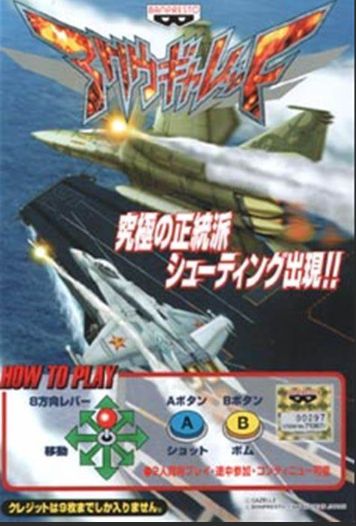
A Decent Shooter , but nothing Spectacular…..

When discussing the decline of Toaplan, four companies often come to mind: Cave, Raizing, Takumi, and Gazelle. Shooter enthusiasts are familiar with these developers, known for creating games like Dodonpachi, Battle Garegga, and Mars Matrix. However, one company that often raises questions is Gazelle. A relatively small studio, they released only a handful of games before fading into obscurity, and one of those games was Air Gallet (“Air Gallet blows your socks off!” declares the rather eccentric opening voice).
At its core, Air Gallet is a typical vertical shooter reminiscent of the titles previously produced by Toaplan. As you navigate through hordes of enemies and confront colossal bosses, your comrades back at the base engage in lighthearted banter with you through digitized radio chatter. They provide hints, commentary, and a touch of personality to a game that might otherwise seem like just another anonymous shooter. Air Gallet benefits greatly from these interactions, as the visual presentation itself is lacking. The buildings appear dull and muddled, resembling gray nimbus clouds. Many of the smaller enemy units lack intricate details, and the visual effects of your firepower are somewhat lackluster. The overall aesthetic feels washed out and dim. Granted, there are some impressive bomber effects, enjoyable parallax scrolling, and a visually striking final boss, but for the most part, Air Gallet falls into the realm of generic visuals.
Once you insert your quarter, Air Gallet treats you to an engaging cutscene where your character prepares for the mission with the assistance of their crew before taking flight. From there, you have the opportunity to enhance your weapons and achieve impressive scores. Both the weapon system and scoring system share a common element: cycling. Certain enemies will drop weapon changers when destroyed. These changers cycle between four different weapons: Fire, Laser, Missile, and Hunter. Fire functions as a standard spread gun, while Laser offers a familiar experience. Missile unleashes thin bullets and powerful homing missiles, whereas Hunter provides an indestructible satellite akin to R-Type’s force pod. The Hunter orbits your ship and remains stationary while firing, enabling precise shots. However, its weakness lies in its lack of firepower, resulting in longer times to eliminate enemies that should otherwise fall quickly. While it safeguards against dive-bombing foes, it offers no protection against bullets. If it did, the hunter weapon would transition from “useless” to “overpowered.” You can enhance your weapons by collecting P-chips, which are found in special boxes or dropped by common enemies.
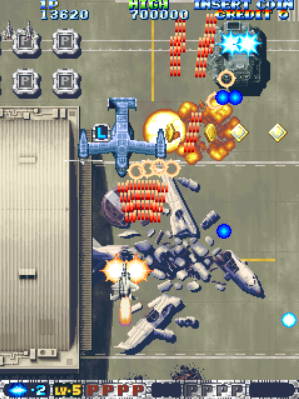
Another cycling aspect of Air Gallet is the bomber. Upon picking up a bomb, all your bombs change to match the corresponding color. The two bomb types are green and blue, resembling those found in the Donpachi series. Green bombs inflict damage across the entire screen and prove invaluable when confronted with challenging bullet patterns. Blue bombs release an enormous energy ball that travels straight ahead before detonating and vanishing. Both types serve their purpose effectively, and choosing between them is a matter of personal preference.
The scoring system in Air Gallet also embraces the cyclical theme. Frequently, defeated enemies will drop diamonds that undergo a slow cycle between gold and gray. The shinier the diamond, the more points it yields. Knowing when and where to seize a diamond becomes crucial for scoring, as it can reward you with significant point bonuses if executed skillfully. However, it’s disheartening to accidentally collect a completely gray diamond, resulting in a meager ten points, compared to the two thousand points earned from a golden one. Another method to amass substantial points is by collecting P-chips once your ship is fully upgraded.
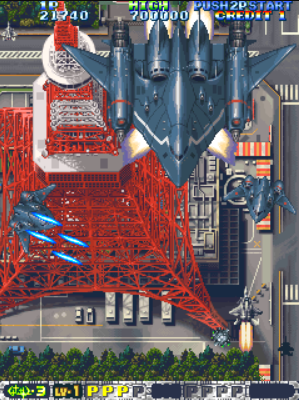
The game comprises six levels, featuring typical shooter scenery such as cityscapes (including Tokyo), castles, and more. Among the stages, the fifth level stands out as particularly intriguing. It takes you on a peculiar journey that exemplifies Air Gallet’s penchant for veering in different directions and occasionally losing its way. The level commences above picturesque cliffs near a forest and mountains. Subsequently, you swoop down low over a small village and launch an assault on a colossal mansion. Finally, you find yourself engaged in a battle against a giant robot in a duck pond. It’s an odd progression that adds an element of surprise. Fans of Toaplan’s classic Batsugun may notice some familiar sound effects in Air Gallet. This similarity arises from the utilization of the same audio driver and involvement of some shared team members between the two games.
Air Gallet imposes several restrictions that can pose challenges for players. While you have the freedom to choose which weapon to pick up, the cycling and scrolling mechanics make it essential to grab them at the right moment; otherwise, you may find yourself in a difficult situation. This becomes especially problematic when you end up with a weapon that isn’t particularly effective against bosses, which often happens with the Hunter weapon. Additionally, power-ups never appear during boss fights, adding to the frustration. It can be incredibly disheartening to unintentionally acquire the Hunter power-up right before facing the final boss.
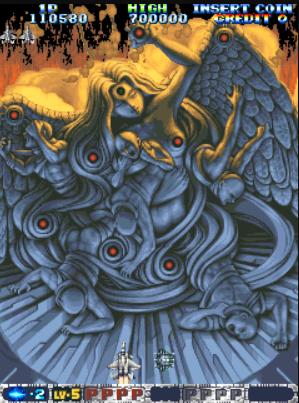
Speaking of the final boss, it undoubtedly stands as one of the most impressive adversaries in the shooter genre. The boss takes the form of a massive demon statue engulfed in flames, its long, tentacle-like hair strangling its victims. It unleashes formidable attacks and even sheds blood once enough of its turrets are destroyed. Furthermore, the boss has a few surprises up its sleeve, catching players off guard even after they believe they’ve defeated it for good. The game’s graphical design, including this remarkable boss encounter, is credited to Junya Inoue, also known as Joker Jun, the renowned artist behind visually striking games like Batsugun, Guwange, ESP Ra. De., and Dodonpachi.
While Air Gallet may not surpass some of the earlier Toaplan classics or later offerings from Cave, it still manages to impress. It leaves one pondering what kind of games Gazelle could have created if they hadn’t faded into obscurity.
BREAKDOWN:
GRAPHICS: 82%
MUSIC/SFX: 77%
PLAYABILITY: 73%
OVERALL: 76%

Platform: Arcade Games
Genre: Action-Shooter-Shoot-‘Em-Up-Vertical
Developer/Publisher: Gazelle/Banpresto
Release: 1996