Excellent puzzle game from Ocean that just falls short of outstanding……
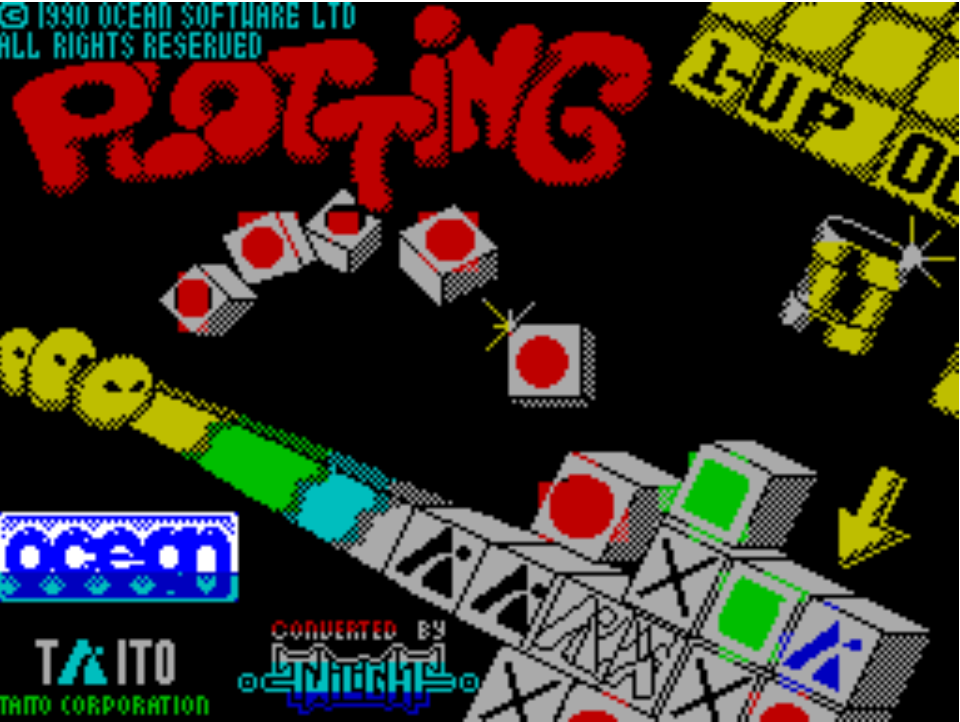
Full of vibrant colours, crisply defined sprites, and gameplay that mirrors the 16-bit (or even the arcade original) experience – how often can you make such a claim, dear Spectrum enthusiasts? Plotting is precisely the type of game that seamlessly transitions to the Speccy (with no need for scrolling and only a bunch of bricks to animate), but why scrutinize a gift horse? This is an exact replication of the original game.
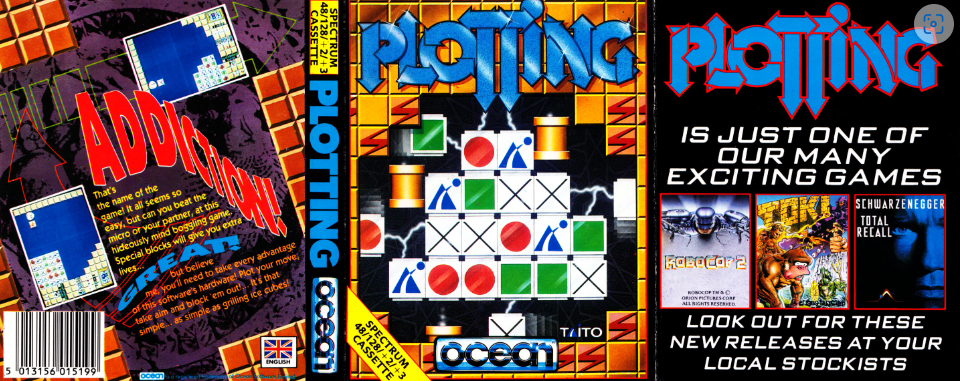
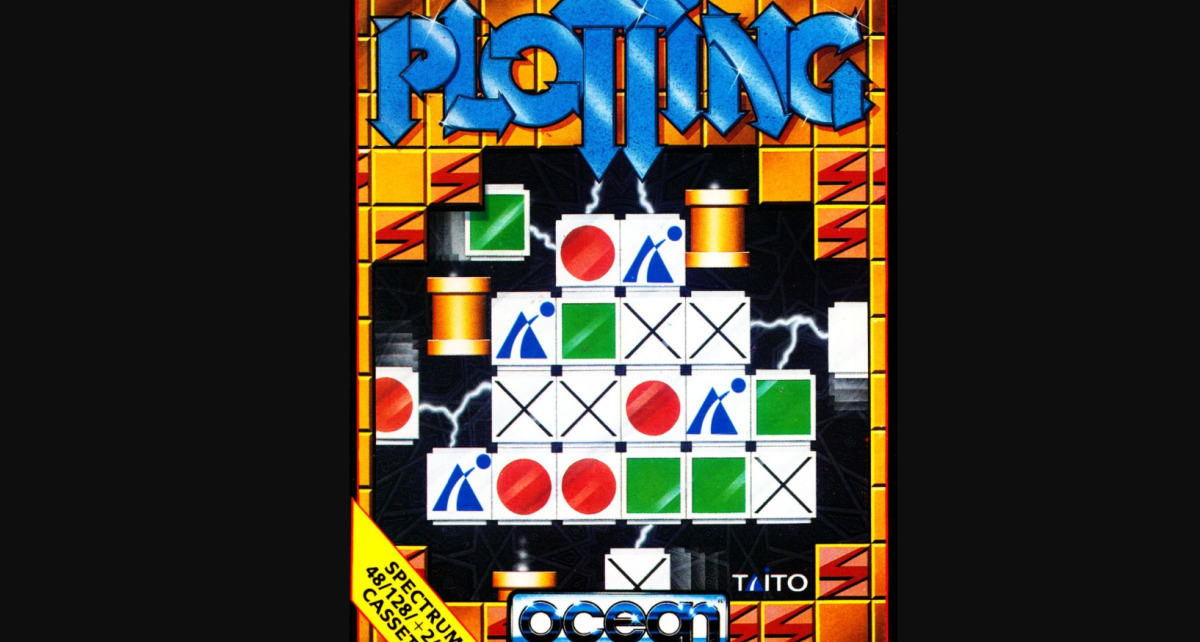
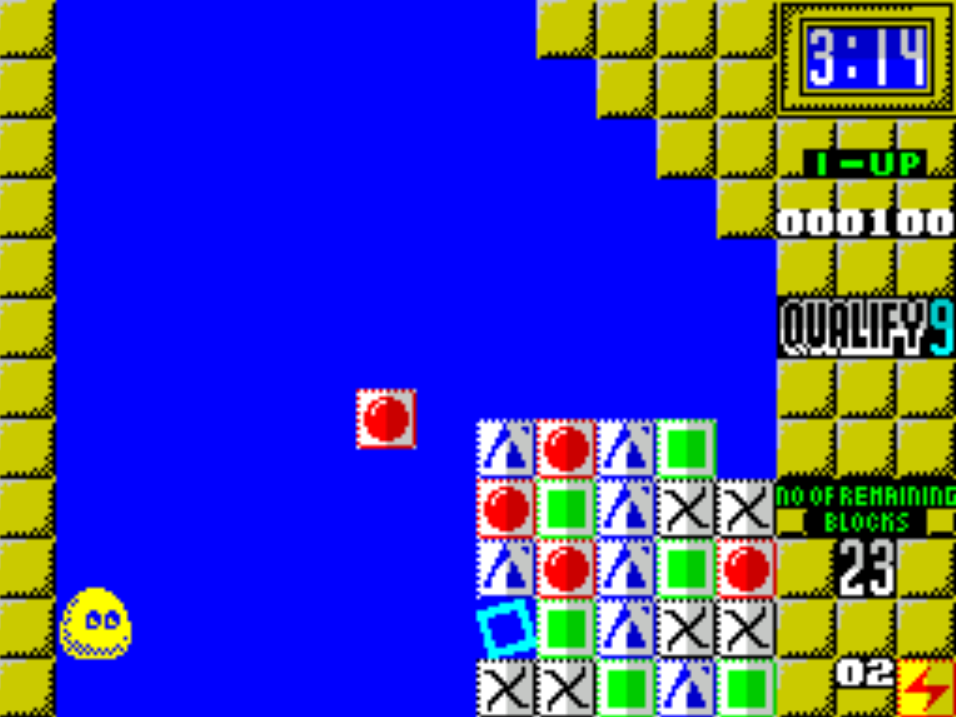
Fortunately, the arcade version was an engaging little puzzle game. You assume the role of the endearing ‘potato man’ (or something of that sort) positioned in the bottom left-hand corner, tasked with eliminating all the coloured bricks stacked on the right-hand side. Your method is to hurl the brick you currently possess (well, theoretically, if you had any hands) at a matching brick – for instance, if you’re holding a red circle-coloured brick, you throw it at a red circle, or if you’re equipped with a Taito sign-covered brick (the blue triangle emblem), you toss it at another Taito sign. Your brick-tossing isn’t confined to a straight shot across the screen – you can bounce it off the uneven ceiling onto the top row of the stack as well.
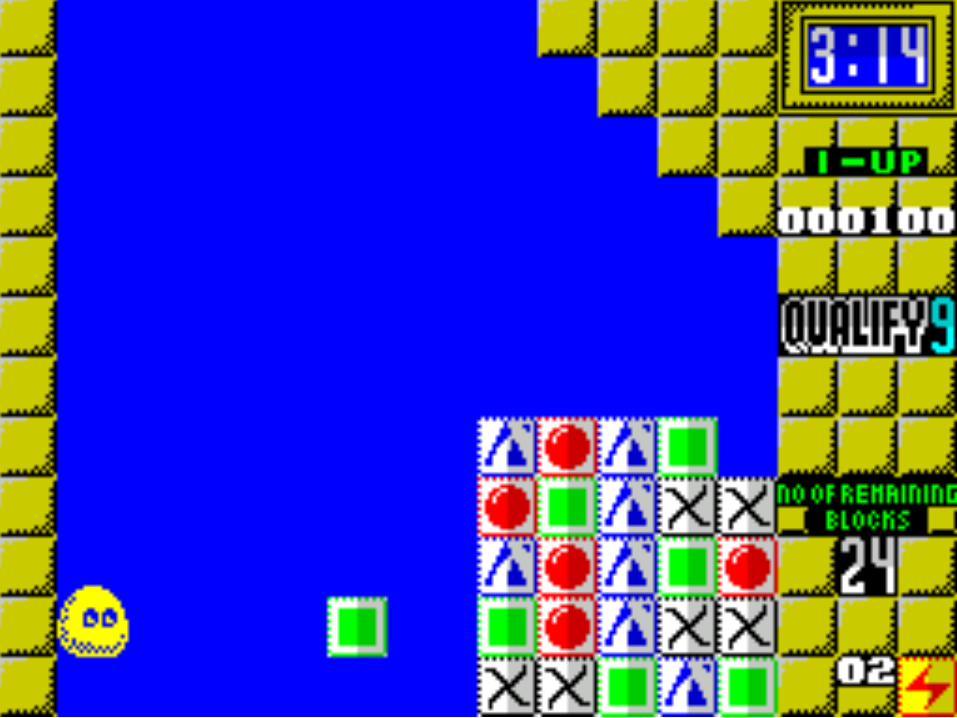
Upon impact, the two bricks vanish (naturally), and you gain possession of the brick immediately behind them, which you must then dispatch in the same manner. This cycle continues, with bonus points awarded for any clever maneuvers like clearing an entire cluster of blocks simultaneously.
So far, it all seems rather straightforward, doesn’t it? However, there’s a catch – it demands a considerable amount of concentration (always a bit of a challenge, I must admit). You need to carefully plan each move before executing it, as landing yourself with a block that you won’t be able to eliminate on your next turn (due to the absence of a suitable exposed partner) is a fruitless endeavor. If you find yourself in such a predicament, you’ll be granted a ‘wild card’ block that can be used to remove any block, but if you repeat this mistake too many times, it’s game over, my friend.
That’s essentially it. Naturally, it becomes more intricate as you progress (for instance, pipe-like obstacles appear in the air between the ceiling and the target blocks, restricting your angles of attack from above), but the core gameplay remains relatively simple and engaging.
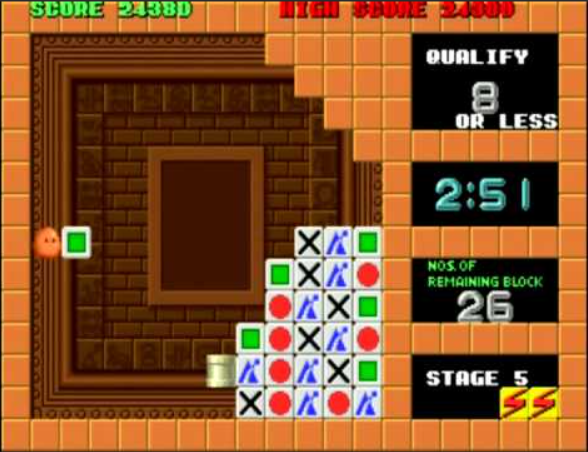
So, what’s the final verdict? Well, as you may have guessed from the outset, it largely depends on your fondness for puzzle games. This one is quite commendable – it boasts vibrant visuals, professional presentation, and smooth gameplay, complete with a dash of charming appeal. However, it may not have the long-lasting allure of, let’s say, Puzznic (released around the same time). The similarity between each screen and its predecessor is a limitation of the game design rather than a fault of the Spectrum programmers. This repetition can make the game feel monotonous and predictable. There were moments when my attention waned, causing me to neglect planning my next moves – a potentially perilous approach. I’m not implying that I didn’t enjoy the game – quite the contrary – but the puzzle game market has seen its fair share of “simple yet incredibly addictive” titles already. Strangely, they don’t appear as original anymore, even though original yet straightforward gameplay is their hallmark, isn’t it?
In summary, Plotting is a likable puzzle game with polished presentation, but it does have a tendency to become slightly repetitive. It’s undeniably addictive in the short term.
BREAKDOWN:
GRAPHICS: 89%
MUSIC/SFX: 71%
PLAYABLITY: 87%
OVERALL: 84%

Platform: Arcade Games
Genre: Puzzle-Matchin
Developer/Publisher: Twilight Games/Ocean
Release: 1990