Action!!! Reload!!! Light Gun Time…….

Time Crisis, developed by Namco in 1995, marked the inception of an ever-expanding series of quasi-rail-shooter/light gun games. Originally introduced in arcades and later ported to PlayStation consoles with gun accessories, each installment in the series presents its own unique storyline while maintaining the classic theme. Players progress from one area to the next, eliminating enemies on each screen while strategically taking cover to avoid enemy fire and reload between shootouts.
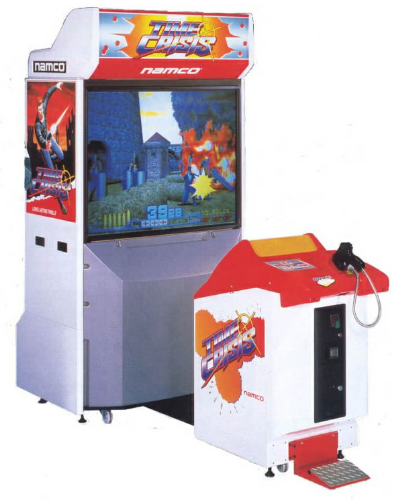
The original arcade cabinet of Time Crisis features a light gun accessory that allows players to aim at the screen and pull the trigger to fire. Additionally, a foot pedal is used to bring enemies into view. What sets this game apart from other shooters is that while players remain hidden, they are impervious to damage. The key is to know when to attack and when to take cover in order to preserve your life count. However, there’s a time limit per area, so staying hidden for too long is not an option!
The game follows a typical storyline of rescuing a kidnapped hostage, in this case, Rachel MacPherson, daughter of the president of the fictional nation of Sercia. The kidnapper, Sherudo Garo, believes himself to be the rightful heir to the throne and demands military secrets in exchange for Rachel’s life, setting a deadline of sunset. You, playing as top V.S.S.E. agent Richard Miller, are dispatched to infiltrate Sherudo’s castle and rescue Rachel. However, this is no easy task, as the castle is heavily guarded by henchmen working for Wild Dog, Sherudo’s arms supplier. Prepare for a fast-paced and frantic shooting game as you navigate through various rooms in the castle and the weapons manufacturing warehouse.
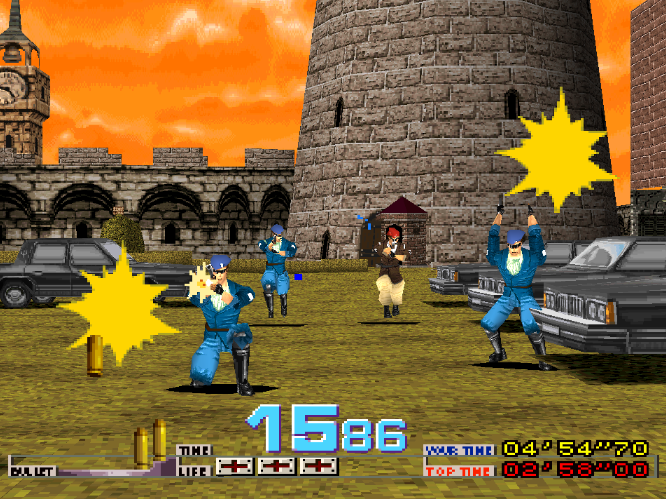
As the title suggests, the objective of Time Crisis is to beat the timer and eliminate all enemies on-screen in each area. This requires quick and precise shooting, taking down any moving target. While accuracy and speed contribute to the points scored and your ranking, the primary goal is to stay alive by strategically shooting and retreating. Richard will find various vantage points as he moves from one spot to another, allowing him to take up to six shots at a time. These vantage points can be behind crates, walls, statues, or under ledges. Once the game shouts “Action!”, you must eliminate all enemies within the given time limit, as adversaries will be firing at you from various angles and distances.
Time Crisis presents players with easily identifiable enemy threats through the use of different colored uniforms. Enemies in blue and green uniforms are abundant but pose a lower threat, armed with handguns and rifles. Their accuracy is often lacking, and they can withstand several hits before causing any harm to Richard, the protagonist. On the other hand, enemies in red uniforms are highly dangerous, capable of instantly killing Richard with a single hit. Occasionally, you may encounter enemies in yellow uniforms who attempt to flee, offering a challenge to hit them before they escape. Successfully eliminating them grants additional time on the timer. While the game offers mindless and enjoyable shooting action, it presents a significant challenge, requiring players to memorize each stage’s progression and determine the optimal moments to retreat and avoid hazards.
Time Crisis consists of three levels, each divided into three sub-areas, with a boss character awaiting at the end of each third sub-area. Regular enemies can be taken down with one or two shots, while bosses employ various attack patterns and require numerous hits to defeat. Success in the game hinges on memorization and strategic decision-making, with boss battles serving as the ultimate test of players’ skills. Despite subsequent sequels surpassing it, the original Time Crisis’s gameplay style remains gripping and enjoyable.
The stage design in the game exhibits a decent level of detail, although the graphics occasionally appear cartoonish and pixelated. It’s worth noting that certain enemy types tend to repeat throughout each section. However, the game effectively conveys depth and distance, demanding precise aiming to hit enemies attacking from afar. While the enemies may appear polygonal and blocky, their animations and movements are realistic and well-executed. The game also features a Hollywood Movie Trailer-style opening sequence, offering glimpses of the action, introductions of the main cast, and a closer look at each main character. Overall, Time Crisis maintains a fast and solid flow, complementing its race-against-time theme admirably.

When it comes to audio, Time Crisis features standard, fast-action background music that persists throughout most of the game. Occasionally, the music shifts to a lower beat to create a tense atmosphere in specific areas, such as darkened rooms or empty hallways. The boss theme, on the other hand, exudes adrenaline and complements the frantic pace of the game exceptionally well. However, the prominence of the sound effects, including gunshots, enemy yells, and background noises, often overshadows the background music.
The game’s sound effects are solid and realistic, contributing to an immersive experience. Notably, Time Crisis is known for its distinct voice acting, which can sometimes sound amusingly cheesy. The narrator’s voice sets the tone in the opening story sequence and provides one-word commands like “Action!,” “Danger!” (warning of impending hazards that can cost you a life), and “Reload!” when Richard’s handgun runs out of ammo and requires a retreat to reload the clip. Each character, including Rachel, Sherudo, and Wild Dog, has their own unique voice, and enemy units frequently utter memorable phrases such as “Freeze!,” “Shucks!,” and “There he is – gotcha!” Although you’ll encounter repetitive sounds throughout the game, they don’t significantly detract from the overall gameplay experience.
Time Crisis offers a relatively short yet challenging gameplay experience that can be completed after a few playthroughs by memorizing level layouts and finding efficient ways to clear each screen quickly. While the initial playthrough is exhilarating, the game’s linear nature means there is little novelty upon subsequent replays. Aside from aiming for higher scores or ranks, there is minimal incentive to revisit the game multiple times. However, later installments in the Time Crisis series, including the Special mode edition in the PlayStation port of this game, provide different routes or characters to enhance the replay value and offer unique perspectives.
Overall, Time Crisis served as a solid introduction to a remarkable series that has been surpassed by its successors in many aspects. Despite its age, the game still holds up reasonably well, making it worth a try if you encounter an original arcade machine. However, obtaining the PlayStation port would be more ideal since it compensates for its graphical limitations with substantial gameplay. It’s worth noting that this entry in the main Time Crisis series is single-player only, lacking the cooperative multiplayer mode introduced in Time Crisis 2 and subsequent titles. Nevertheless, the action remains fast-paced and relentless, making Time Crisis a worthwhile investment if you stumble upon an original light gun cabinet for a few thrilling attempts.
BREAKDOWN:
GRAPHICS: 73%
MUSIC/SFX: 71%
PLAYABLITY: 80%
OVERALL: 79%

Platform: Arcade Games
Genre: Action-Shooter-Light Gun
Developer/Publisher: Namco
Release: 1996
Franchises: Time Crisis