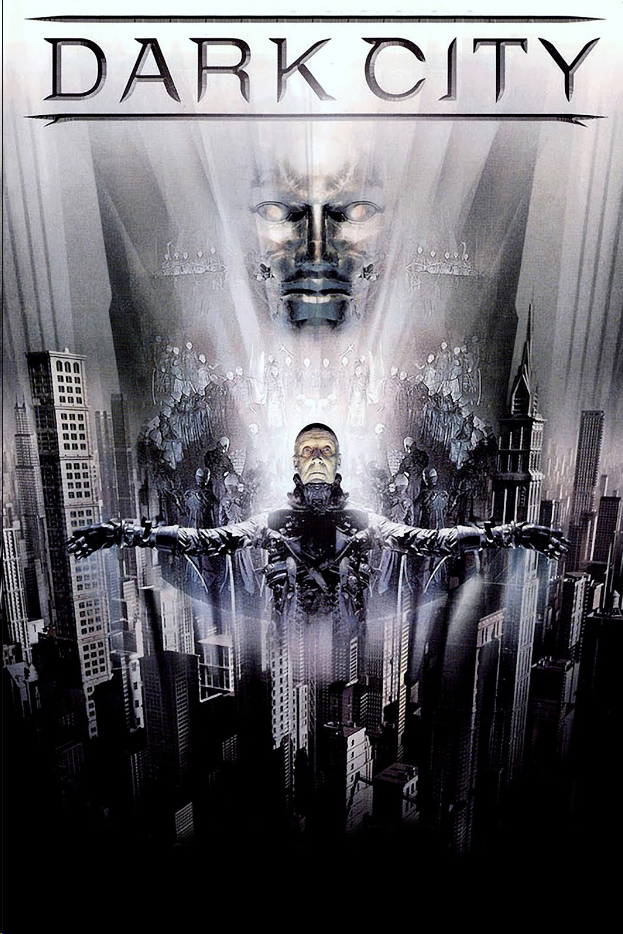
“Dark City” by Alex Proyas echoes its silent predecessor “Metropolis” in exploring the essence of humanity and why it remains unalterable by decree. Both films delve into fabricated worlds designed to construct ideal societies, with the machinery of rulers crumbling under the influence of the hearts of the ruled. Both serve as parables featuring a disruptive force challenging the existing order: a free human capable of perceiving reality and questioning it. However, “Dark City” introduces a more menacing threat compared to the horrors in “Metropolis” — the rulers’ ability to control the memories of citizens. If our identity is shaped by our experiences, what becomes of us when those experiences are manipulated?
In the realm of “Dark City” (1998), human memories are entirely reset when the clock strikes 12, signifying “midnight,” although there is no corresponding noon. The film begins with the statement, “First came darkness, then came the Strangers.” The Strangers, originating from another galaxy, select a group of humans for study as their civilization faces demise. They aim to unlock the enigma of the human heart or soul — the aspect eluding their understanding. Creating a colossal artificial city, they can “tune” it at will to conduct experiments.
The tuning process unfolds as all humans lose consciousness, machinery halts, and the city undergoes alterations. Skyscrapers emerge from the underworld’s raw materials, architectural structures are designed, and rooms are readied for inhabitants, complete with set props. Assisted by a human scientist, the Strangers implant memories into the subjects’ foreheads, erasing their recollections of the prior day. Injected from a shared memory bank, these memories reshape identities. The film probes deep questions — if a man, after committing murder, is given a new identity, is he still capable of such an act? Are individuals inherently good or evil, or is it a matter of self-perception? These are the inquiries driving the Strangers’ experiments.
Murdoch (Rufus Sewell) has developed an immunity to the devices employed by the Strangers. His most recent memory injection was incomplete, administered by Dr. Schreber (Kiefer Sutherland), a scientist working for the Strangers but harboring no affection for them. Upon waking in a hotel room with the body of a deceased woman, the scripted narrative has framed him as a serial killer of prostitutes. Schreber cautions him about being the subject of an experiment but commends his resistance. Fleeing becomes imperative as the Strangers close in.
This catalyzes the narrative as Murdoch navigates the city, seeking to unravel its true nature. Detective Bumstead (William Hurt) endeavors to apprehend him, gradually swayed by Murdoch’s inquiries. Bumstead, programmed as a cop but not an adept one, laments, “No one ever listens to me.” Adding complexity is torch singer Emma (Jennifer Connelly), who recalls being John’s wife, professing love, and claiming they met at Shell Beach. Although everyone claims knowledge of the route to Shell Beach, its precise location remains elusive.
The Strangers inhabit human cadavers, their forms varying in height, with one in a child’s body displaying an unnerving maturity. The alien entities within the corpses resemble spiders made of anxious noodles, possessing levitation abilities, the power to alter the city at will, a hive-like insect organization, and a collective process to retune the city in a subterranean cavern. The visuals in this cavern evoke Fritz Lang’s films, particularly the underworld mechanisms in “Metropolis” (1927) and the rows of pale-faced criminals in “M” (1931).
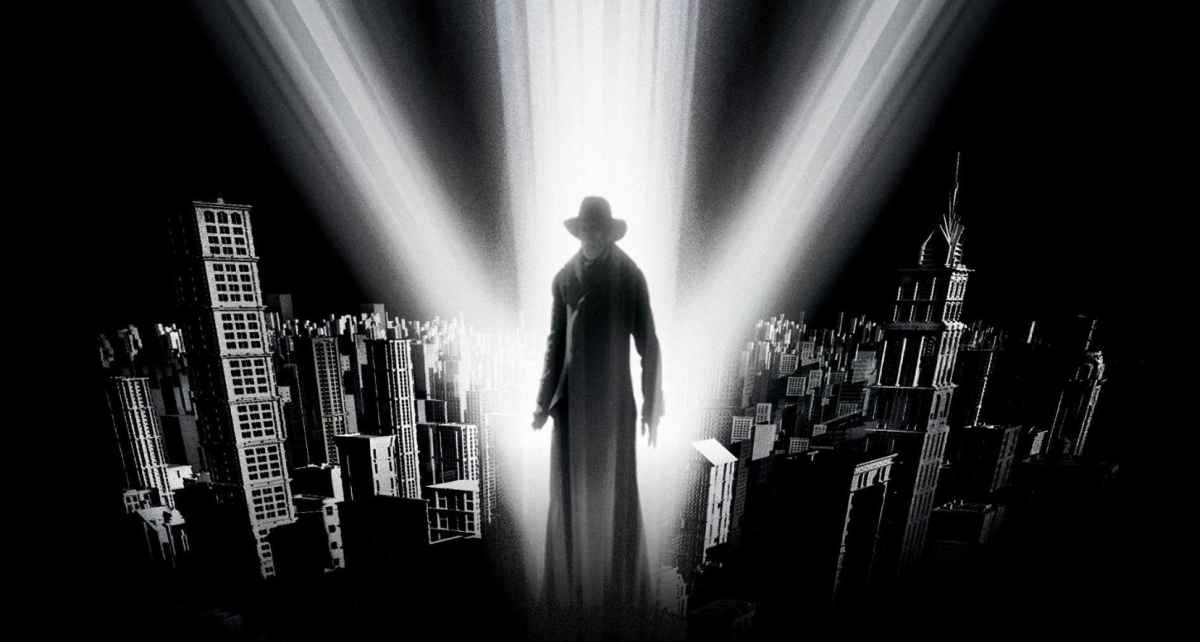
During the Hawaii Film Festival, “Dark City” underwent meticulous analysis, freezing frames, dissecting effects, and debating meanings. The film’s beauty, generosity, rich depth, and unnecessary but welcome details captivated viewers. Notably, the Strangers’ world borrowed from 1940s film noir, featuring fedoras, cigarettes, neon signs, automats, and a mix of older and newer cars. The deep-focus compositions, long and narrow interior spaces, and low-key, moody lighting contribute to the film’s atmospheric allure. Proyas, co-writing with David S. Goyer and Lem Dobbs, cultivates a visual feast reminiscent of the same notes found in Dobbs’ “Kafka” and Goyer’s “Batman Begins.”
Proyas employs a color scheme emphasizing blacks, browns, shadows, and the Strangers’ pallor, while warmer colors shine in human faces, neon signs, and the Shell Beach billboard. The film’s craftsmanship, particularly its shots, prompted expressions of gratitude during the Hawaii Film Festival. The sense of creators transcending requirements to passionately craft something exceptional aligns with the feeling inspired by other great films.
Undeniably, “Dark City” stands as one of the great modern films, predating “The Matrix” by a year and achieving similar thematic objectives with a smaller budget and effects rooted in imagination as much as technology, all executed earlier and with heightened emotional resonance.
The emotional depth of “Dark City” comes to the forefront through its exploration of love stories. In a pivotal moment, John Murdoch reveals to Emma, “Everything you remember, and everything I’m supposed to remember, never really happened.” Emma finds it difficult to believe, expressing, “I so vividly remember meeting you. I remember falling in love with you.” While she retains these memories, this is their first encounter. “I love you, John,” she insists. “You can’t fake something like that.” Murdoch agrees, acknowledging the inability to fabricate genuine emotions. Despite the Strangers’ attempts to dictate love through memory injection, the essence of true feelings eludes them. Emma’s modest role holds profound significance, embodying genuine love, while John embarks on the journey to discover and comprehend it through her.
The Strangers, devoid of malicious intent, operate on alien premises. Lacking omnipotence, they afford Murdoch, Bumstead, and Schreber the freedom to navigate the city. In the end, a sense of pity lingers for the Strangers, who face mortality surrounded by contented beings whose mysteries elude them.
An interesting visual cue appears in the opening shot, approaching the hotel window where Murdoch is introduced. The window, a circular dome within a rectangular frame, strikingly resembles the “face” of Hal 9000 in “2001.” Hal, a computer, comprehended everything except the human experience and emotions. “Dark City” delves into the same theme, constructing an entirely artificial world where humans strive to define and understand their true selves.