

Amazing, Amazing, Amazing , Retro TV at it’s very best………

Today’s children have become the architects of their own television schedules, wielding the power to customize the vast array of programming to suit their preferences with a simple tap of a button, whenever they desire. Contrastingly, back in the 1980s, young viewers in the UK were limited to just a handful of channels, and the content specifically designed for children was both sporadic and severely restricted. In those bygone days when youngsters seeking niche entertainment felt somewhat alienated from the mainstream offerings, there were only rare occasions when they could relish their chosen delights.
Then, on the 7th of September 1987, a beacon of hope emerged in the form of CITV’s groundbreaking series, Knightmare.

“Enter, Stranger…” Knightmare was a unique creation, a live-action role-playing adventure geared towards kids, taking inspiration from Dungeons & Dragons, featuring cutting-edge CGI, virtual reality, and all the while providing a haven for aficionados of acronyms. This imaginative series spanned eight thrilling seasons from 1987 to 1994, captivating countless viewers and stimulating young minds in ways few other shows had accomplished.
The premise was elegantly simple: a quartet of young participants collaborated either to escape from a perilous dungeon (in the earlier seasons) or to embark on a quest to retrieve a sacred artifact within a mythical realm (in the later seasons). Of the four contestants, only one would physically enter the virtual world to undertake the quest, while the remaining trio communicated with and guided their every move — right down to the minutest detail — via a seemingly “magical” viewing screen situated in the “real world” of the dungeon master’s chamber. The virtual reality setting, complete with castles, caverns, and kitchens, was exclusively crafted to engage the guides and the audience at home, as the questing participants themselves could only perceive the narrow confines of the imposing Helmet of Justice that loomed over their heads, resembling a rather elaborate waste-paper bin.

For those of us who grew up in the late 80s and early 90s, the inner workings of the VR technology used in shows like Knightmare often sparked our curiosity. We were well aware that the brave contestant, or “conquestant” as it were, wasn’t truly traversing a realm inhabited by hobgoblins, dragons, and talking walls. Most of us speculated that they were navigating a sprawling, labyrinthine warehouse. The mischievous among us even pondered if they had been dropped into a Tesco car park, about to embark on a real-life, sightless rendition of the 8-bit classic Bullfrog. “Spell-casting: R – E – V – E – R – S – E! Watch out, Brian, that orc is actually a Ford Fiesta reversing your way!”
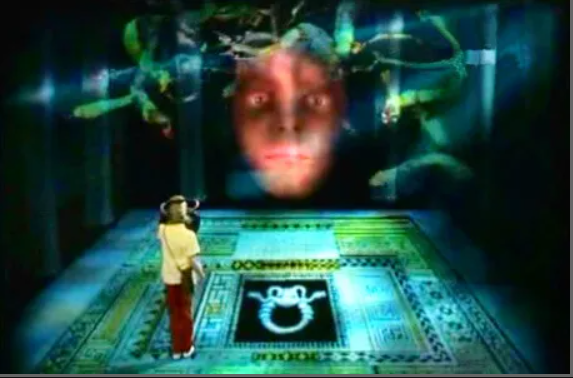
The actuality, as often happens with reality, was a tad less thrilling. Throughout the entirety of their adventure, the conquestant stood within a solitary blue room, employing chroma key technology (the same method utilized to position weathercasters in front of a map featuring cloud-covered UK). Just one room. No warehouse. No mansion. A solitary room ingeniously doubling as every conceivable location. On occasion, all four young participants would have to bide their time for an hour or so between “rooms” while the production team reconfigured the set. During these breaks, some teams grew so bored and restless that upon resuming their quest, they would deliberately cause the conquestant’s demise, all in the name of amusement. This is likely why kids aren’t entrusted with voting or driving privileges.
Oooooooh, Nasty Numerous teams vied for a spot on the show over its run. Only 70 were chosen, and from that elite group, a mere eight emerged victorious. Knightmare’s difficulty level and learning curve were akin to those of Shadow of the Beast 2, but also, well, kids can be rather foolish.
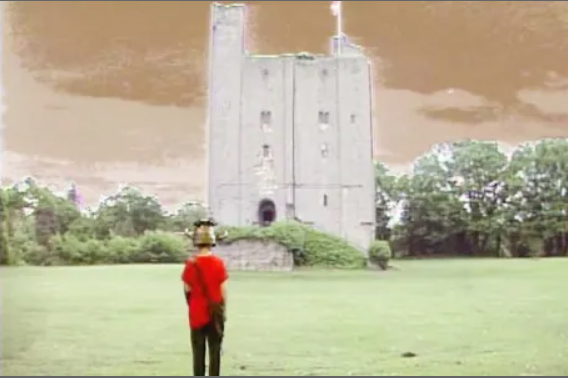
Within the game rooms, there were colossal ACME-esque bombs with alarmingly brief fuses and spikes that shot from the walls. Some compelled the conquestants to navigate narrow bridges spanning chasms, while others had them teeter along paths composed of floating stepping stones that would plummet into the abyss one by one, underscoring the importance of precision and teamwork. No doubt these scenarios were riveting for the participants, but if you were to close your eyes during these pivotal moments, the game might sound less like a high-stakes, life-or-death odyssey and more like a group of middle-aged individuals attempting to maneuver a sofa. “Shift a bit to the left… no, no, your left, not mine. Take a small step left again. Slowly! Even slower! Okay, a few more half-steps to the right…” To be fair, there are very few instances of actual furniture relocation concluding with the words: “Oh dear, we’ve inadvertently caused their demise.”

Mary Whitehouse, a prominent advocate for television decency and a bane to creative minds everywhere, briefly took issue with Knightmare for its violent content, though she later issued an apology, confessing she hadn’t actually watched the show. However, had Mrs. Whitehouse witnessed the life-force meter in action, she might have brandished her Sword of Censorship once more. Whenever a conquestant’s “health” began to dwindle, viewers at home were treated to a chilling CGI image of a man’s face gradually peeling away to reveal the bone beneath, ultimately leaving only a skull with two unsettlingly glaring eyes. Truly spine-tingling.
In reality, when a conquestant “perished,” the producers took great care to display the entire quartet standing in a picturesque, sun-drenched CGI landscape, waving enthusiastically at the audience, as if they had entered a child-friendly version of the cyber-afterlife featured in Westworld.

Knightmare was truly cutting-edge during its time and perfectly timed, capitalizing on the burgeoning interest in home computing that had captivated the youth. It’s no coincidence that around the inception of Knightmare, Tim Child, the show’s creator and producer, had a sister working at Sinclair, the company responsible for the ZX Spectrum. David Rowe, the artist selected by Child to bring Knightmare’s beautifully crafted world to life, began his career as a video game cover artist. Post-Knightmare, both went on to establish lucrative careers in computer technology, including VR and game design.
While Knightmare boasted visually appealing and opulent aesthetics, its longevity was not solely based on its looks; it needed a compelling story, a history, heroes, and villains, much like how the World Wrestling Federation relied on storytelling to enchant audiences beyond its technical aspects. To achieve this, Knightmare featured a diverse cast of delightfully dramatic actors who either guided or obstructed the children on their quests. At the forefront was dungeon master Treguard of Dunsmore, played by Hugo Myatt, renowned for his iconic catchphrase, “Oooooh, nasty,” which he uttered following a child’s harrowing on-screen “demise.”

While the conquestant regularly interacted with actors portraying friends or foes within the game world, Hugo spent the first four years of the show as the sole omniscient link between the children and the game. Later, he was joined by other “real-world” characters such as Pickle the Elf (David Learner) and the wonderfully pantomime-esque Lord Fear (Mark Knight).
In the Beginning… The pace of Knightmare’s inaugural episode, which premiered 35 years ago, may seem sluggish by contemporary standards. Part of this can be attributed to the production still finding its footing and experimenting with the format, but much of it is likely a reflection of the slower and gentler nature of children’s TV during the Gen X and Y eras (with the exception of shows like Transformers). Today’s producers cater to a very specific demographic – kids who spend their days on electric massage chairs consuming seventy-eight bags of Maltesers in one go. The result is shows that resemble a warzone in a school disco.

As adults looking back, Knightmare can at times feel like a human rendition of Crufts, featuring the unparalleled excitement of three kids trying to guide another child in circles for three minutes at a stretch. Sometimes it resembles a solo game of Twister played by a child. Yet, in truth, these quirks are all part of its charm, and we, at the time, eagerly embraced it.
Because, for all its cutting-edge appearance and atmosphere, Knightmare understood that children didn’t need their adrenaline glands constantly prodded and provoked every ten seconds. Beyond the bomb-filled rooms, colossal scorpions, and pursuing hobgoblins, the show was unafraid to allow the format and the audience at home to breathe. Some of Treguard’s early speeches were remarkably Shakespearean in both content and length. Certain riddles presented by the wall-monsters were intricate and required quiet, collaborative contemplation to solve.

In later seasons, thanks to the introduction of the Eye Shield, both the contestants in the antechamber and the viewers at home were treated to captivating video footage showcasing adventures through ancient castles and lush gardens, not to mention thrilling dragon-back rides. The expanding ensemble of actors delivered increasingly intricate cut-scenes – at times ominous, at times humorous – that wouldn’t have felt out of place in a contemporary computer game. While occasionally it was swift and unforgiving, most of the time, it exuded a charming and gentle quality – a quintessentially British touch.
Today’s children can effortlessly don a VR headset and explore any destination they desire from the comfort of their homes. Consequently, a revival of Knightmare seems improbable. Nevertheless, for a brief period some thirty odd years ago, the show’s distinctive enchantment and wizardry enraptured an entire generation. Which is why it gets the gold star treatment and a very high score.
Overall : Fabulous!!!!!


Tart lollipop jelly beans I love apple pie cupcake gummi bears jujubes