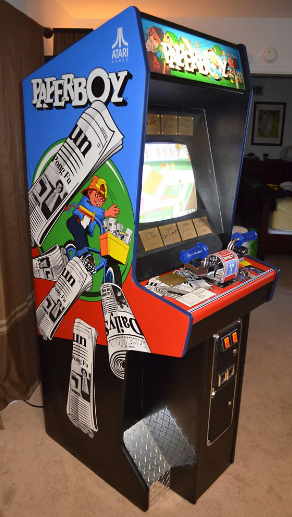
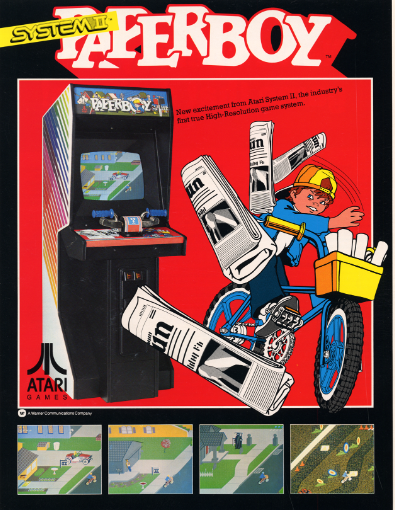
A bit of a golden oldie and a very decent one…..

Games like Paperboy tend to develop questionable reputations over the years due to numerous console ports, and this is truly unfortunate. The original arcade version was a gem. Playing as a paperboy, your task was to deliver newspapers to houses on the left side of a bustling street, while dealing with various distractions and obstacles that could spell doom for your character. Over the course of a week, you had to demonstrate your top-notch paper-throwing skills by following the same route every day, maintaining your subscribers, and potentially gaining new ones. It was the most enjoyable way to experience the life of a paperboy, complete with different difficulty settings that could multiply your high score. But first, you had to survive a week, and you only had a limited number of lives with several ways to fail. Paperboy was undeniably challenging and perfectly suited for the arcade—easily fitting in my list of favourite arcade games from the early eighties.
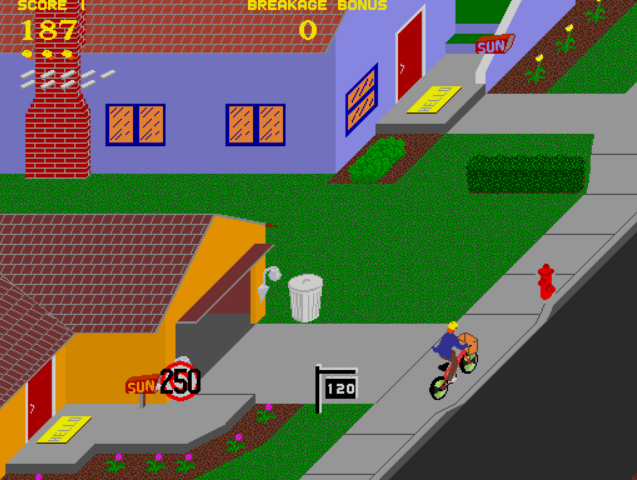
At the outset, you started with a bag of papers, a basic bicycle, and a map displaying your subscribers, though you could only view the map before the game began. Setting off from a quiet street corner, your objective was to throw a paper at every house with a welcome mat in front of the door. However, it was essential to toss the paper directly in front of their door or into their mailbox for the delivery to count. Missing these spots or accidentally tossing the paper through a window would result in the customer unsubscribing at the end of the day. This meant fewer points for you, as the game unfolded over the course of a week, and you couldn’t earn points for delivering to people who weren’t paying. If you successfully delivered to all your designated houses, you’d gain a new subscriber or reacquire a former one at the end of the day, which was evidently a good thing in the world of electronic paper routes.
As for unsubscribers, their houses would still appear on your route. Instead of welcome mats, they’d have deterrent mats with phrases like “beat it” or “get lost.” You could score points by throwing extra papers at their windows, priceless statues, and even gravestones in their yard. The cumulative damage was tracked under a score called the Breakage Factor, which combined with various other scores at the end of each day. However, it was crucial not to waste too many papers, as your limited stock dwindled with each throw. If you ran out, you might not have enough to serve regular subscribers, resulting in fewer points overall. Papers could be replenished by bundles found on the sidewalk and road (which was far better than having to cycle to a paper hub and wait in the cold for a refill), but it was possible to miss them, and you couldn’t backtrack in Paperboy—a fitting analogy for the working world in general.

The paperboy faced even greater challenges. On his very first day on the Easy Street route, he had to watch out for cars driving down the center of the road, kids on go-karts, a boy with a remote-controlled car, inebriated individuals in the road, and even neighbors brawling in their yards. Colliding with any of these, in addition to more commonplace obstacles like sewer grates, signs, boom-boxes, and even walls if you lost control, would cost you one of your precious lives. You could earn an extra life at every 10,000-point milestone, but that was at least two days of successful paper deliveries away—if you were lucky! As the week progressed and the weekend approached, the chaos on the street escalated, adding an element of excitement to Paperboy. By Friday night, people were truly eager for action!
Now that you have a sense of what the paperboy had to contend with and how the challenges intensified, you also realize there were hints of what was to come. For instance, on Tuesday, you might spot a car peacefully parked in a driveway. By Wednesday, it would be moving erratically up and down the driveway, forcing the paperboy to swerve into the road. Similarly, you might see a motionless kid on a go-kart one day, but the next day, that same kid would be zipping around all over the place, perhaps even with a friend. Paperboy introduced variety like this to keep the game engaging, as delivering papers up and down the same street day after day could grow monotonous otherwise. Diversity was also reflected in the dynamic scenery, which changed based on your actions the previous day. For example, bags would be placed over broken windows, boards would cover shattered glass doors, and houses would remove their welcome mats if the residents unsubscribed. This added a communal feel to the game, far more relatable than rabid cats lunging at you or vengeful unsubscribers tossing bombs out of windows.

At the close of each day, in an entirely unexpected twist, Paperboy transforms into an Excitebike-like experience. You have the option to navigate an obstacle course filled with ramps, moats, bridges, and dangers. Curiously, this is the sole segment in the game where crashing is not a concern, and it’s entirely voluntary. However, it’s a fantastic opportunity to accumulate points for extra lives, and you also receive a generous supply of papers to hurl at various targets throughout the course. The quicker you navigate the course, the more points you earn, and hitting targets and leaping ramps also awards bonus points. This part of the game can be quite exhilarating because it’s the only time when you’re genuinely compelled to accelerate your bicycle. Nevertheless, it can be challenging since you lack control over your bike when it’s in mid-air. Thus, when you approach a ramp, you must already be pointing in the desired direction, and in Paperboy’s isometric perspective, maneuvering the bike into the right position can be tricky. However, given that this is a game from 1984, such quirks are expected.
Oh, and yes, your paperboy can “die.” Well, sort of. He’s not actually deceased, but he might wish he were. His bike crumples up, and a paper bag lands on his head, which is only slightly less embarrassing than donning a backward yellow cap and resembling Beaver Cleaver (“Gee, Wally, perhaps this paper route isn’t my calling.”). Paperboy even has his own admissions of defeat, with phrases like “I feel like a fool” and “Oh man” being among the more memorable ones. Unless he’s accumulated extra lives, Paperboy can only withstand three “deaths.” After three mishaps, he gets the boot, and the final paper he delivers bears amusing headlines such as “Daily Sun Subscription Rate Plummets!” and “He was a real nuisance!” The front page even features a humiliating image of him sulking over his broken bike with a bag on his head, watched by a black cat and a construction worker enjoying a beer. Clearly, this is not an ideal outcome.

Nevertheless, even when the main character is struggling, Paperboy ultimately triumphs. It’s undeniably more entertaining than a real paper route, where you have to rise at ungodly hours, deliver papers to the doorsteps of disabled individuals, and deal with elderly ladies who confront you on the street. It’s undoubtedly one of the classic arcade greats, and though it arrived somewhat later than Pac-Man, it boasts significantly more intricacy. I would genuinely welcome a modern-day iteration of Paperboy, one that could incorporate even more humor, with drivers often running you over while driving SUVs with obstructed views or chatting on cell phones while paying no attention whatsoever. Adding more random variables, such as plummeting subscription rates due to unsolicited newspaper telemarketing, could make it even more amusing. However, the gameplay might be compromised, so, for now, I’m content to enjoy this straightforward yet entertaining arcade game. It makes the most of its limited technology, and, most importantly, it’s enjoyable, which is ultimately all one can ask for in a video game.
BREAKDOWN:
GRAPHICS: 79%
MUSIC/SFX: 80%
PLAYABLITY: 86%
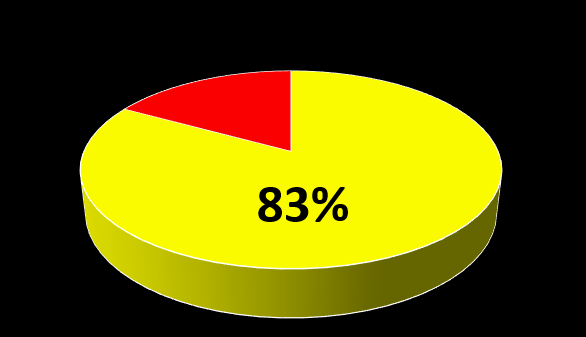
OVERALL: 83%
Platform: Arcade Games
Genre: Action-Arcade
Developer/Publisher: Atari Games
Release: 1983
Franchises: Paperboy