As a lover of the movie, this was a real disappointment……

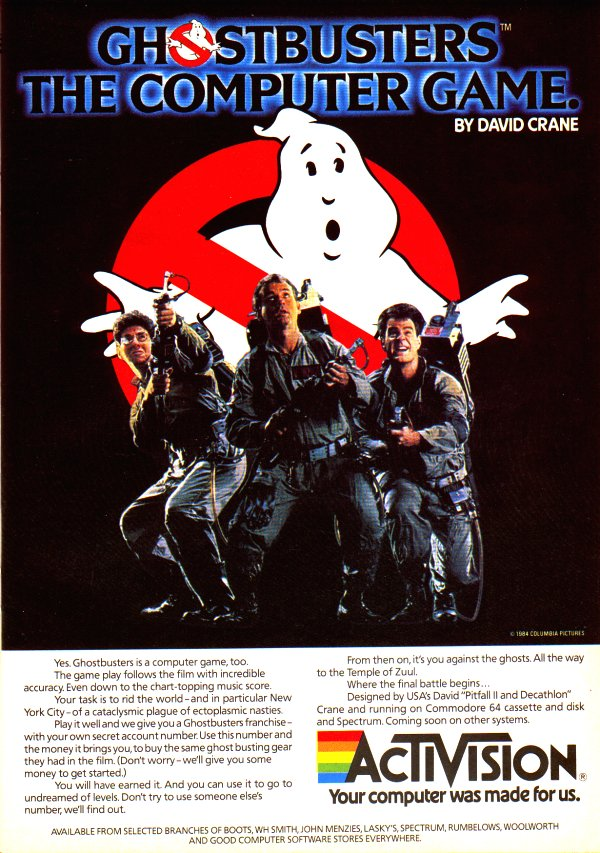
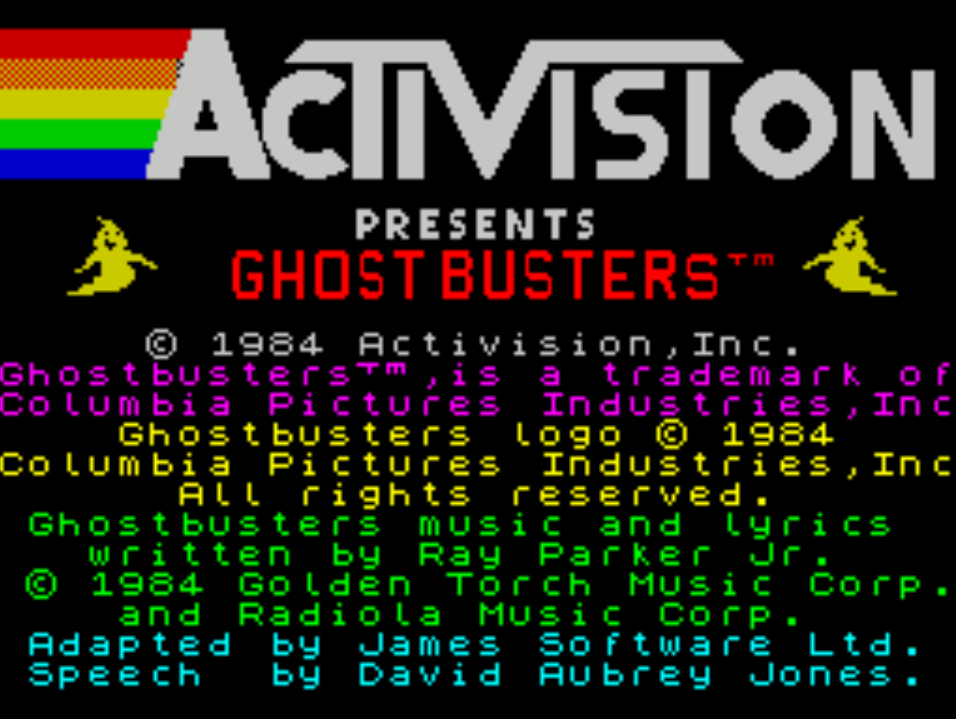
By the end of 1984, it would have been difficult to find anyone who hadn’t heard of Ghostbusters, released during the Christmas period and rapidly becoming a cultural phenomenon. As such, the premise of Activision’s game adaptation needs little explanation. Unfortunately for Spectrum owners, the ZX Spectrum version of Ghostbusters was completely overshadowed by its Commodore 64 counterpart, which launched in time for the film’s release and generated most of the buzz—largely thanks to its excellent soundtrack. While the Spectrum version also features the iconic Ghostbusters theme, it’s implemented far less effectively.
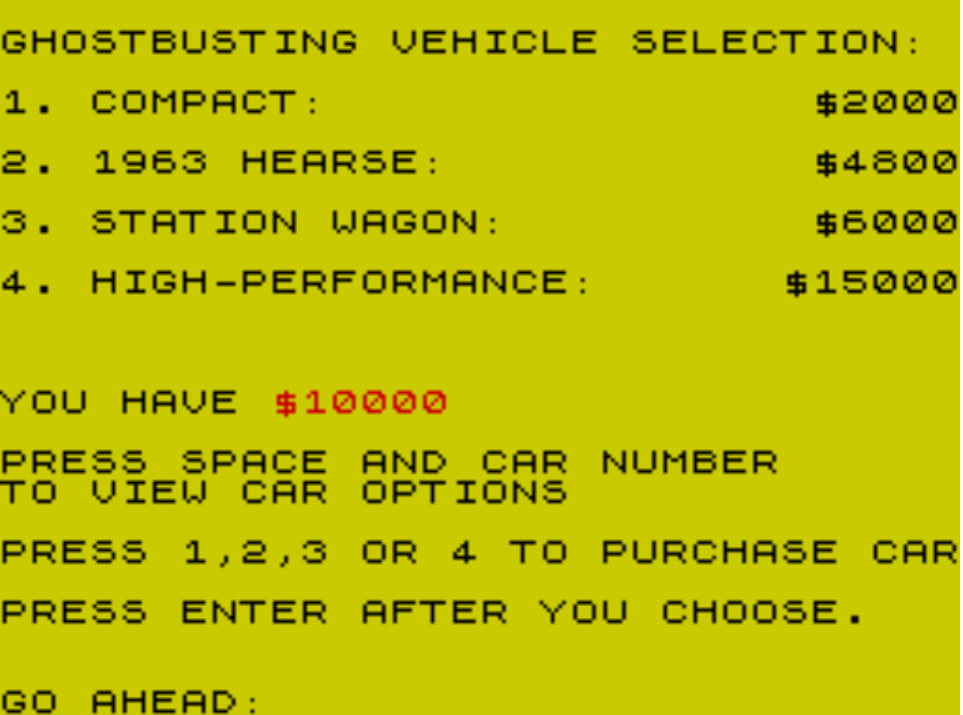
Rather than being a straight arcade game, Ghostbusters is more of a strategy title, built around managing a Ghostbusters franchise tasked with clearing New York City of paranormal activity. At the start, you enter your name and an account number if you have one carried over from a previous session. New players are issued a starting balance of $10,000. You must then choose one of four vehicles, each varying in speed, equipment capacity, and price.
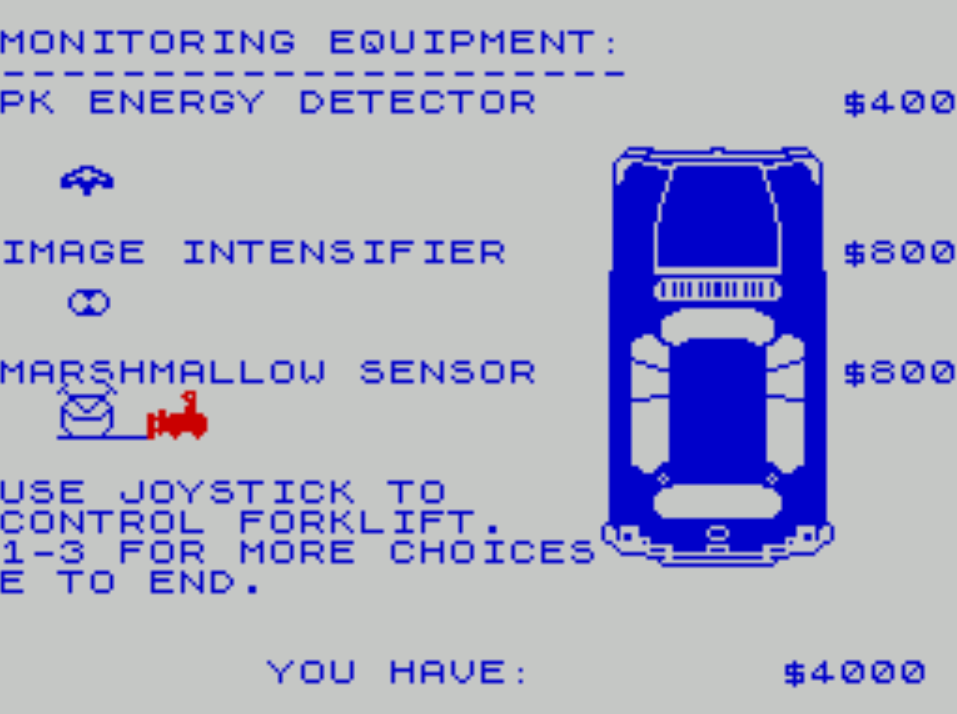
Once you’ve selected a vehicle, it’s time to equip it. Monitoring equipment includes the PK Energy Detector, Image Intensifier, and Marshmallow Sensor. Capture equipment covers Ghost Bait, Ghost Traps, and the Ghost Vacuum, while storage is handled by the Portable Laser Confinement System. Each item serves a specific purpose and comes with its own cost, meaning your starting funds won’t stretch to everything. Experience quickly becomes important when deciding what to prioritise.
The PK Energy Detector warns of approaching Slimers, the Image Intensifier makes ghosts easier to see during capture, and the Marshmallow Sensor alerts you to the arrival of the dreaded Stay Puft Marshmallow Man. The Ghost Vacuum is used to suck up roaming spirits, while traps—once baited—are used to capture Slimers. The Portable Laser Confinement System allows you to store up to ten ghosts in your vehicle, reducing the need for frequent returns to Ghostbusters HQ.
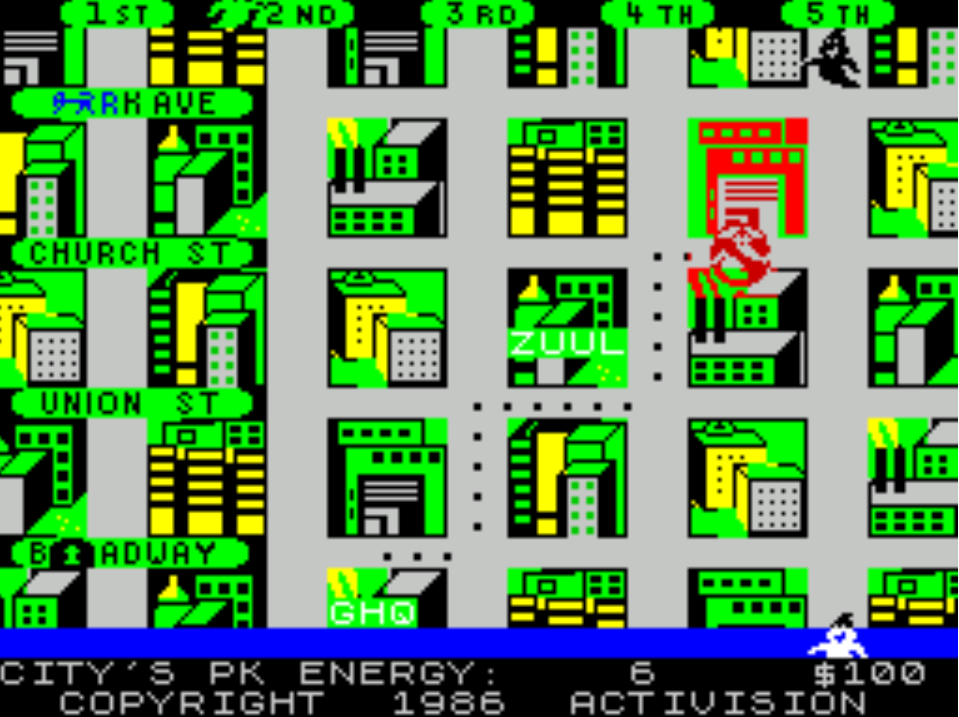
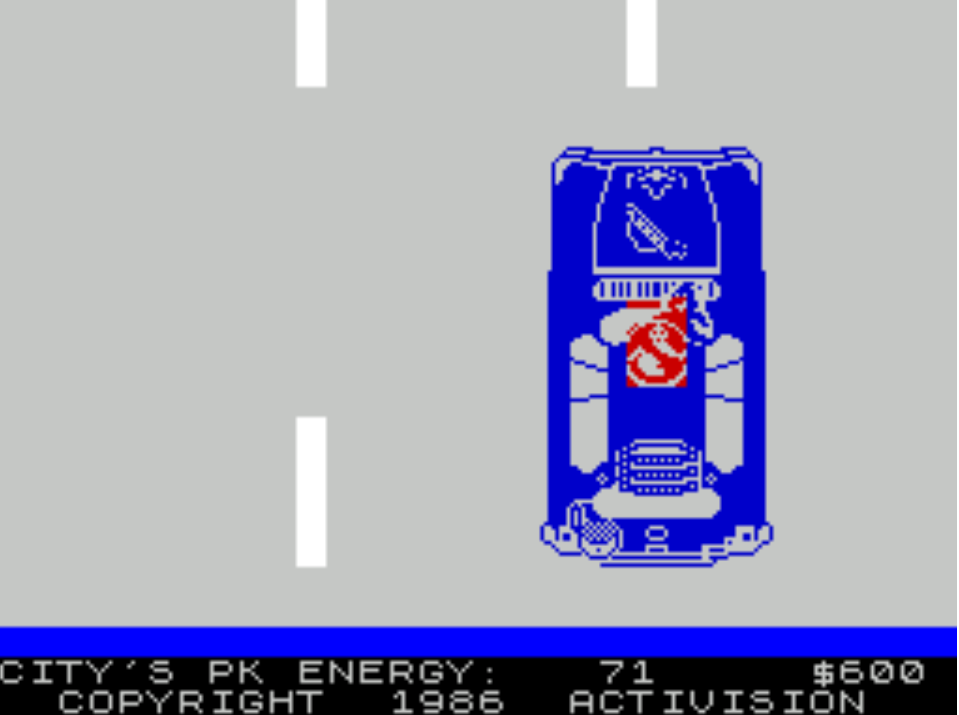
Gameplay proper begins on a map of central New York, with Zuul’s Temple marked at the centre and GHQ at the bottom. Buildings flashing red indicate ghost infestations. Your goal is to cleanse these buildings while stopping roaming ghosts from reaching Zuul’s Temple. After selecting a route, the game switches to an overhead view of your vehicle driving through the streets. Roamers can be vacuumed up with careful timing.
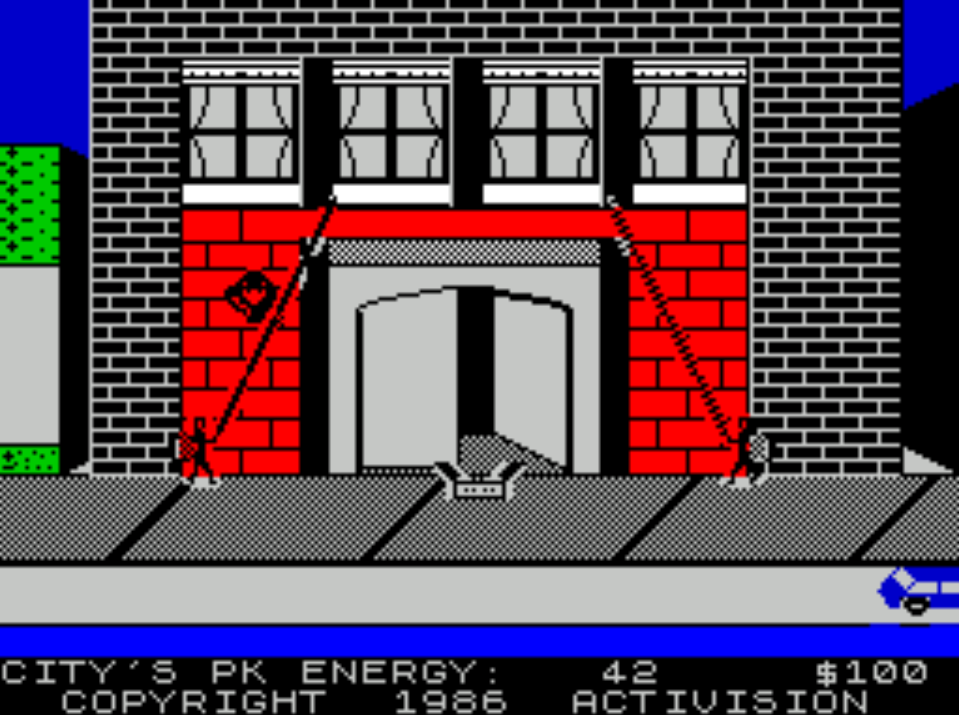
Upon arriving at a haunted building, the view shifts again to a side-on perspective showing the Ghostbusters at its base. You must lay traps and then use the proton streams to corral the ghost between the beams—without allowing them to cross, which is crucial.
The more ghosts you capture, the higher your credit rating climbs. The game ends if the Gatekeeper and Keymaster unite at Zuul’s Temple before you’ve earned more money than you started with, if you fail to infiltrate the temple despite having sufficient credit, or if you succeed in doing so and bring the game to a conclusion.
Criticism
Released to coincide with the film, Ghostbusters invites inevitable comparison with the earlier Commodore 64 version. Unsurprisingly, the C64 boasts superior sound and visuals, particularly thanks to its continuous use of the iconic theme music, which gives the game a strong rhythm and atmosphere. While the Spectrum version looks broadly similar in terms of graphics, the lacklustre audio leaves the experience feeling flat by comparison.
This ultimately highlights a more fundamental problem: the game itself feels thin on content. There are long stretches where very little happens, and capturing Slimers can be frustrating due to their erratic movement and tendency to hover awkwardly at the edges of the screen rather than making full use of the play area. Several people I knew eagerly awaited the Spectrum release, only to be disappointed by its lack of polish and lasting appeal. At its original price, it felt uncomfortably close to a rip-off.
As someone who loved the Ghostbusters film, I was excited to finally get my hands on the Spectrum version. With a £10 price tag, I expected something worthy of the license. Sadly, that wasn’t the case. The game lacks atmosphere, the tasks quickly become repetitive, and the overall experience is unexciting. On one occasion, after successfully busting a Slimer, I found myself unable to return to the city map, rendering my progress pointless despite several attempts.
Overall, Ghostbusters on the Spectrum feels like poor value for money. While the graphics are serviceable, they’re nothing remarkable, and the game fails to deliver the addictive qualities needed to sustain interest. It’s slow to get started and tedious once it does, leaving a sense of disappointment in its wake.
Inevitably compared to the Commodore 64 version, the Spectrum edition comes off second best. While visually acceptable, the pacing feels sluggish and the experience lacks energy. In the end, Ghostbusters for the Spectrum is a missed opportunity and, ultimately, a letdown.
BREAKDOWN:
GRAPHICS: 73%
MUSIC/SFX: 75%
PLAYABLITY: 45%
OVERALL: 59%

Platform: ZX Spectrum
Genre: Action – General
Developer/ Publisher: James Software / Activision
Release: 1984
Franchise: Ghostbusters