
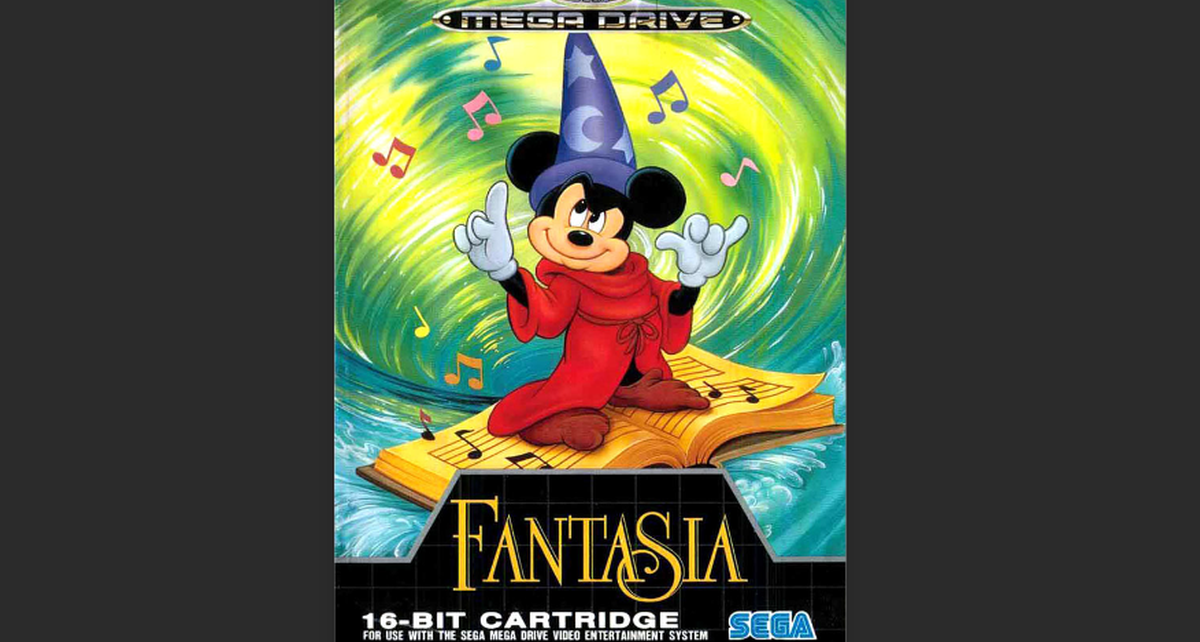
An atrocious game with very little redeeming features, Walt Disney would be horrified……
In 1941, Walt Disney took on his most ambitious project yet—a concert film combining classical symphonic music with animated short films. His vision for Fantasia was to continually update the film with new segments, creating a fresh experience each time it was viewed. Unfortunately, Disney did not witness his dream come to fruition, as Fantasia initially struggled financially. However, over the years, the film has gained a large and devoted audience. Today, it is celebrated as one of Disney’s finest works and an animation masterpiece.
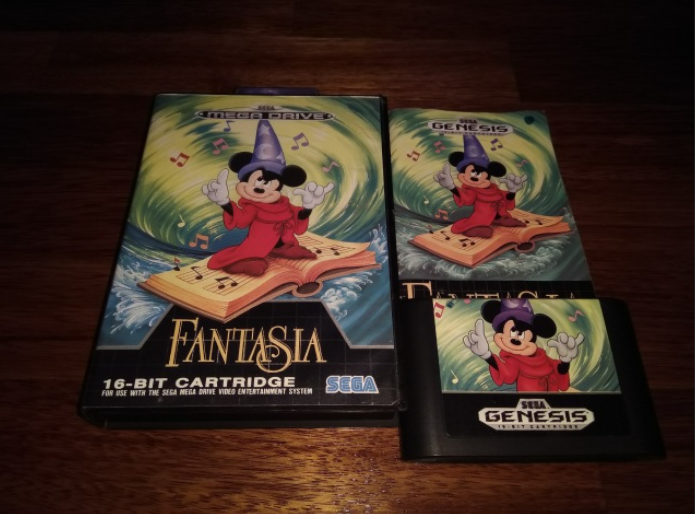
In 1991, to commemorate Fantasia’s 50th anniversary, the Disney studio re-released the film. Inspired by the success of their earlier Disney title, Castle of Illusion with Mickey Mouse, Sega believed they couldn’t go wrong with a game based on Fantasia. Although the concept of creating a game around an animated sketch and music-centric film might seem unconventional, the diverse fantasy characters and settings within Fantasia offer great potential for a successful video game adaptation. Unfortunately, instead of relying on the same team that had created Castle of Illusion, Sega enlisted developer Infogrames (known for their recent Dragon Ball Z games for the Game Boy Advance). The result was an instantly forgettable game that simply isn’t worth the time or trouble, even for fans of the film.
Given that the film lacks a defined storyline, Sega and Infogrames took some creative liberties. In the game, Mickey Mouse serves as an apprentice to a wise sorcerer. Mickey’s task is to guard the sheet music necessary for the orchestra to perform the film’s songs. As he dozes off, a gust of wind from Bald Mountain, an evil dwelling, blows the music notes away, disrupting the orchestra’s performance. Upon waking and discovering the missing notes, Mickey embarks on a quest to recover them, enabling the orchestra to play once again.
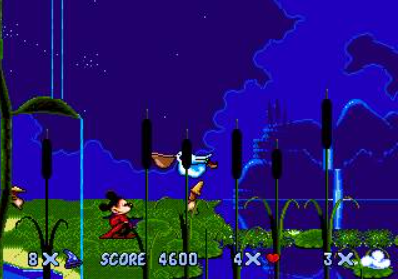
Players guide Mickey through five extensive levels based on settings from the film. These include the Sorcerer’s Dungeon, where the famous marching brooms pose a threat; a mythical forest; a prehistoric wasteland inhabited by dinosaurs; ancient ruins featuring ballet-dancing hippos; and the nefarious Bald Mountain. Each of these areas comprises multiple levels, and Mickey must collect all the scattered blue music notes before reaching the end of each stage. Failure to do so results in restarting the level from the beginning. Notably, the areas in Fantasia are expansive, containing secrets and hidden rooms that require thorough exploration.
Mickey possesses two primary forms of attack. He can bounce on enemies’ heads, a classic move found in many side-scrolling platform games. Additionally, he can utilize his magic powers to shoot energy blasts at foes from a distance. However, his magic power is limited, necessitating careful management.
Unfortunately, even with these abilities, Mickey’s journey proves immensely challenging. Despite the Disney theme, Fantasia is one of the more frustratingly difficult platformers in recent memory. Screens are often teeming with enemies, demanding precise jumps that require exceptional patience to execute. Moreover, the search for music notes can be laborious, as some are cleverly hidden, leading to frequent replays of levels.
Perfect control is vital in a game like this, where the developers expect players to tackle demanding feats. Regrettably, Sega and Infogrames made the puzzling decision to make Mickey’s movements somewhat sluggish. This lack of responsiveness amplifies the game’s inherent difficulty, deterring younger players, the apparent target audience, as well as older gamers.
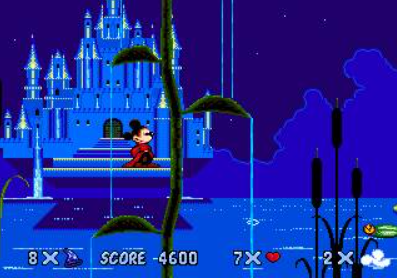
Graphically, Fantasia fares relatively well. Although the visuals are dated by today’s standards, they were considered quite good at the time of release. Character sprites boast reasonable size and detail, with numerous recognizable characters straight out of the film. From the marching broomsticks to the enchanted dancing mushrooms in the forest, Sega and Infogrames deserve credit for their attention to detail. Even briefly appearing characters, such as the flaming ghost heads on Bald Mountain, make appearances in the game.
As the film centers around famous classical music pieces, one would expect the soundtrack to reflect these iconic tunes. Here, the game’s audio presents both good and bad news. On the positive side, Sega invested in the actual songs from the movie, which play during the levels. Unfortunately, the renditions of these songs are some of the worst heard, suffering from the limited sound capabilities of the Genesis console. Imagine listening to Tchaikovsky’s “Nutcracker Suite” performed with primitive-sounding blips and bloops, or Johann Sebastian Bach’s “Toccata and Fugue in D Minor” played by what seems like a broken toy synthesizer. It is unclear whether the sound designer fully understood the impact of altering these classical pieces. The sound effects also fall short and quickly fade from memory.
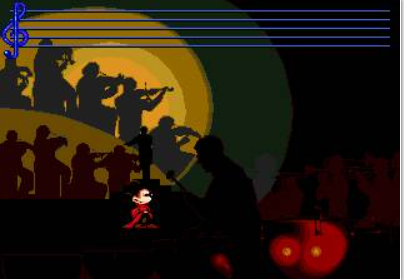
Despite the obscene level of challenge and the disappointment of classical pieces being poorly represented, the most frustrating aspect of Fantasia is its lackluster climax. Fans of the film will recall the thrilling sequence featuring a giant demonic monster summoning an army of undead creatures, set to the song “Night on Bald Mountain.” This demon would have made an ideal final boss, particularly since the game’s storyline attributes the theft of music notes to him. However, when players finally reach the end, they are greeted with a sudden black screen, followed by a lackluster ending sequence featuring a mere picture of Mickey shaking hands with the conductor. No text, no credits—nothing. It is an incredibly anticlimactic conclusion, leaving players feeling further cheated after enduring the gameplay experience.
It is regrettable that what could have been an original and captivating platform game falls short due to uninspired gameplay, extreme difficulty, and a complete absence of a satisfying climax. Fantasia represents one of the worst Disney games ever created, highlighting wasted potential. One cannot help but wonder what Capcom or one of Sega’s better development studios could have accomplished with the concept. Ultimately, Fantasia’s lackluster execution leaves players feeling let down.
BREAKDOWN:
GRAPHICS: 75%
MUSIC/SFX: 40%
PLAYABILITY: 29%
OVERALL: 37%

Platform: Sega Megadrive
Genre: Action-Platformer-2D
Developer/Publisher: Infogrames/Sega
Release: 1991
Franchises: Mickey Mouse

Halvah cake chocolate I love gummi bears muffin jelly oat cake croissant. Cookie powder muffin jelly wafer danish.
Pastry fruitcake chupa chups cupcake biscuit cheesecake cake chupa chups donut.