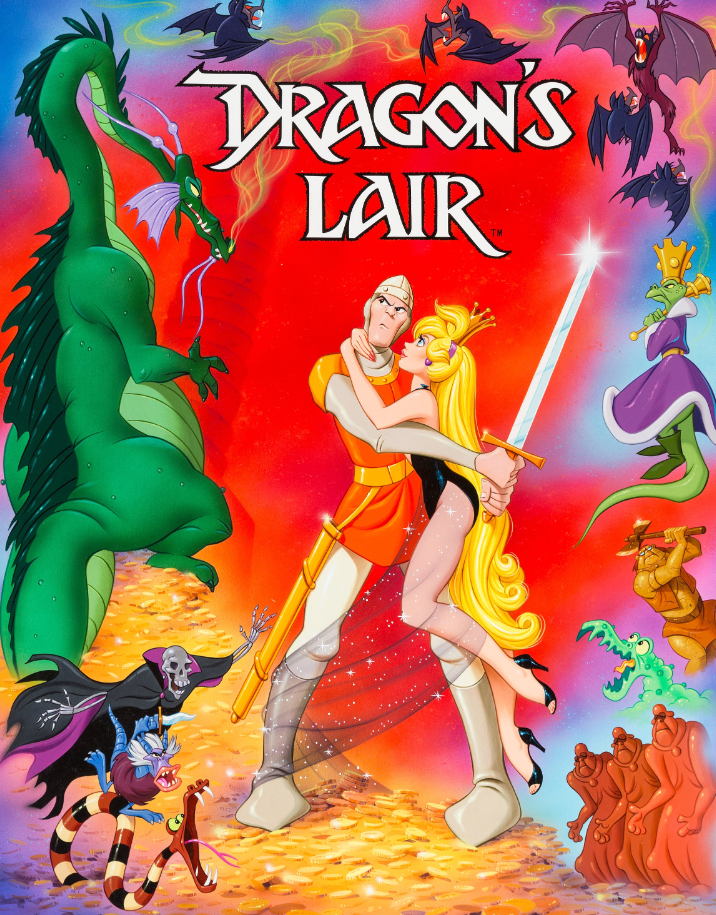
The Curious Tale of Dragon’s Lair………

In the year 1983, it wasn’t just the video game industry facing a crisis; the world of cartoons was also in a precarious state.
During this time, Disney studios found themselves in a creative slump, bordering on an existential crisis, uncertain about the direction of their future projects. The desire to venture into more “adult” and unconventional projects, championed by emerging animators like Tim Burton, was persistently stifled by the conservative factions within the company. This resulted in a prolonged period of uncertainty that eventually led to the ill-fated release of “The Black Cauldron” in 1985.
Amidst the discontent among animators who felt Disney’s creative management was lacking, Don Bluth had already departed from Disney in 1979 after eight years of dedicated service. He, along with his colleagues Gary Goldman and John Pomeroy, had founded Don Bluth Productions. Unfortunately, their first project, an adaptation of Robert O’Brien’s “Mrs. Frisby and the Rats of NIMH,” was released just a week after the groundbreaking success of “E.T. the Extra-Terrestrial” in 1982 and failed to find commercial success. With their financial resources depleted, Don Bluth and his team were left in a precarious financial situation.
This is where Rick Dyer enters the picture. Rick Dyer, the founder of Advanced Microcomputer Systems (later known as RDI Video Systems), was a game designer with a deep passion for adventure games and ambitious visions. His epiphany came when he encountered the first glimpses of “Astron Belt,” a SEGA game that utilized the LaserDisc, a cutting-edge optical medium at the time, to deliver unprecedented visual quality in arcade games.
Rick Dyer had envisioned a narrative heavily inspired by “The Lord of the Rings” and named it “Shadoan.” He even went so far as to conceptualize a game console called “Halcyon” that would use LaserDisc technology to offer games with exceptional visual fidelity. In 1985, the Halcyon console was indeed released, but its exorbitant price and abysmal sales led to its near-oblivion, with only two titles developed for it: “Thayer’s Quest” and an American football game called “NFL Football LA Raiders vs. SD Chargers.”

However, Rick Dyer’s career extended beyond the Halcyon’s failure. “Shadoan” eventually saw the light of day in 1996. More importantly, his ideas converged with the Bluth Group, which emerged after the closure of Don Bluth Productions, resulting in the creation of one of the most ambitious, improbable, and accomplished titles in the gaming world: “Dragon’s Lair.”
Picture the most clichéd story of all: that of a beautiful and youthful princess named Daphne, abducted by a malevolent dragon who keeps her imprisoned in the depths of a notoriously disreputable castle. To rescue her, we dispatch the knight Dirk, who may not possess the stature of a flawless hero, but who clearly harbors no fear – he is, naturally, the character you’ll embody as he embarks on his quest to liberate Daphne, live happily ever after, and raise a family. And believe me, you’ll need to earn every bit of it.
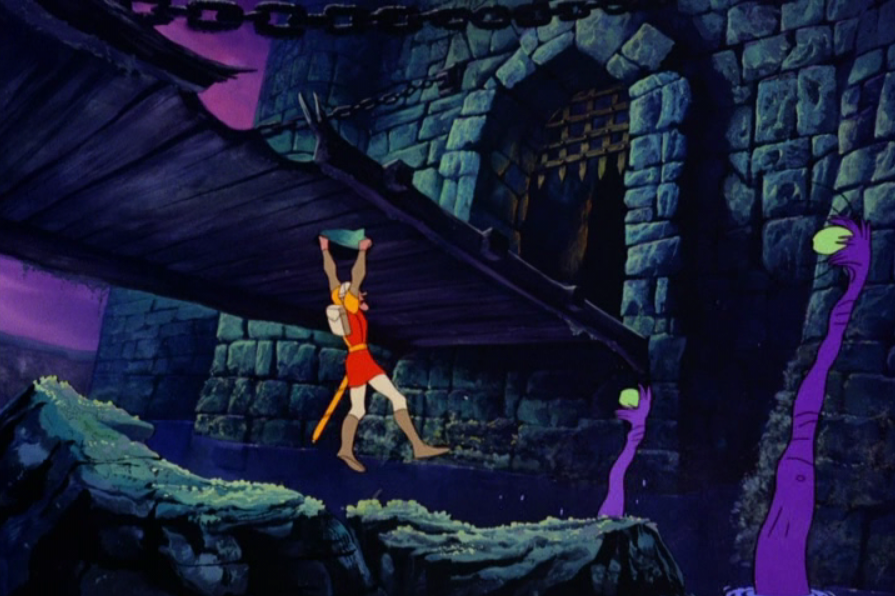
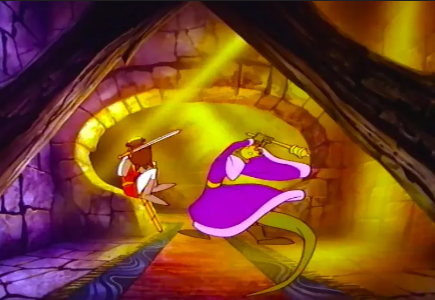
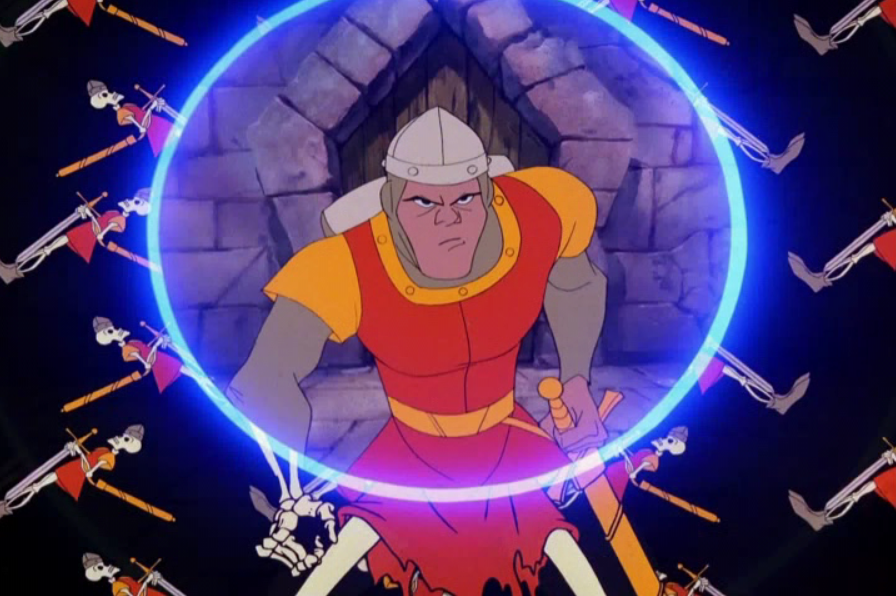
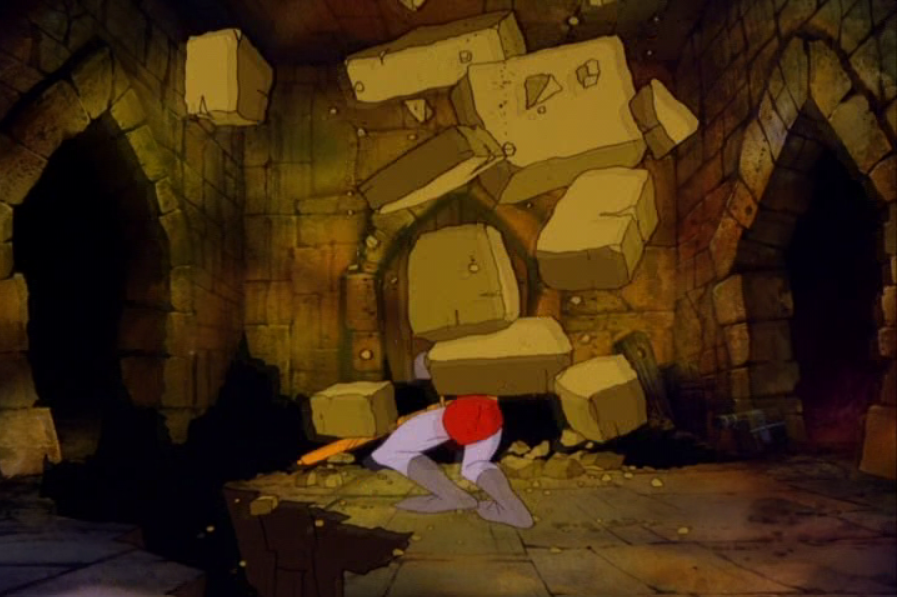
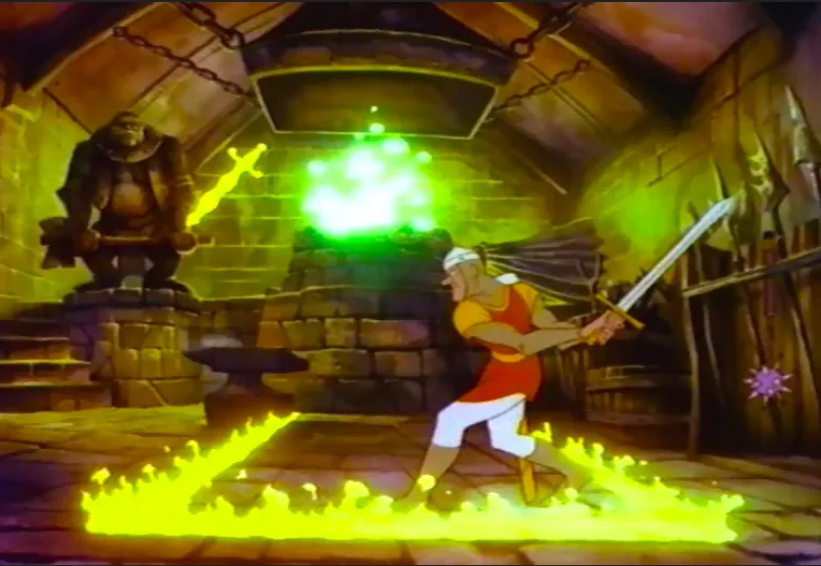
The game took on a unique and truly spectacular form at the time of its release when technical innovations were still in their infancy. It adopted the guise of an interactive cartoon. Even though the concept was revisited in the years that followed (notably with titles like Badlands, Cobra Command, or Road Blaster), few productions could boast having a (former) Disney animator at the helm. Thus, the gameplay is somewhat distinctive as well. Imagine a series of sketches, each corresponding to scenes brilliantly animated by Don Bluth and his team, spanning over twenty minutes in total. Each of these sketches represents a set of challenges that can only be resolved in one way: by utilizing one of the four directions of the joystick to move Dirk at precisely the right moment, or by using the solitary button on the arcade cabinet to prompt him to wield his sword.
Deciding which action to take and when to take it is entirely up to your discretion, although the game is considerate enough to highlight certain elements to direct your attention in the right direction. Succeed, and you’ll discover what unfolds next and what the subsequent steps are. Fail, and you’ll be treated to one of the myriad animations depicting Dirk’s demise before restarting from another scene. One of the game’s brilliant ideas is that the adventure’s progression isn’t strictly linear. The sketches are presented in a random order to introduce some variety and, admittedly, to complicate your mastery of the various challenges. Nonetheless, you’re essentially experiencing a cartoon of Disney quality (or more accurately, Don Bluth quality), and having the privilege of watching a few more seconds of it becomes your primary reward. That, and the fact that I departed with the most desirable princess in the history of video games.
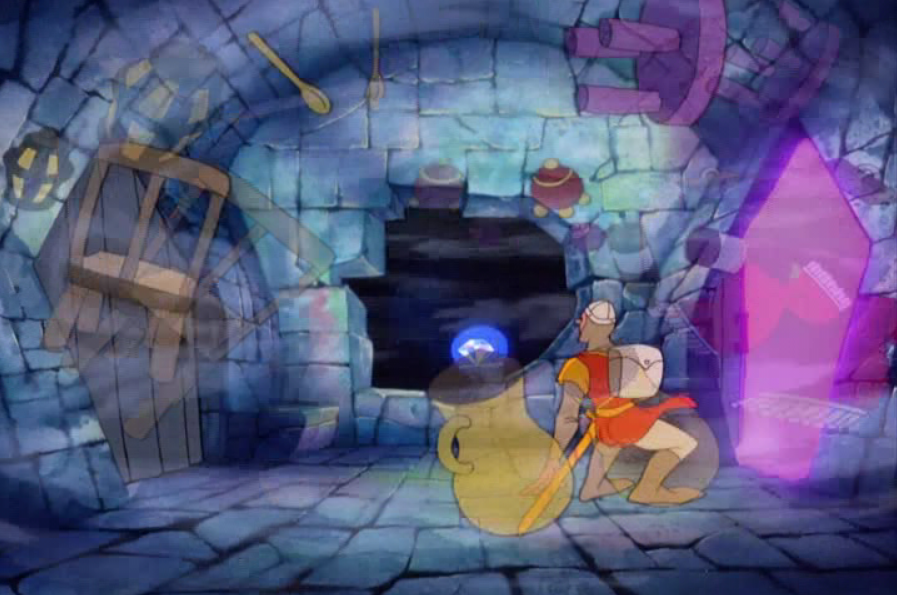
As one might anticipate from a pure gaming perspective, Dragon’s Lair amounts to little more than a lengthy sequence of trial and error with extremely strict timing (though this can vary depending on the cabinet’s difficulty setting). It largely relies on your memory and not much else. On paper, it’s incredibly constrained, and once you find yourself in a particular situation, it can feel both unjust and exasperating. It should simply not succeed, and yet, it does.
Every pitfall is a part of its charm!
The truth is that dealing with such a well-crafted cartoon, featuring animations that are as whimsical as they are inventive and a medieval world that is dark and ominous, yet not overly so, is what we had yearned for Disney to produce at the time. Dragon’s Lair in 1983 was akin to the animated film we had always hoped to witness amidst a sea of saccharine productions filled with saccharine songs. It finally presented us with monsters, fatalities, and a princess whose appearance seemed to be inspired by models from Playboy(!). In retrospect, it still possesses a touch of this allure, at least from the perspective of Western studios, where neither Disney nor Pixar ever fully reconsidered their view of animation as a medium primarily intended for children. Dirk is the adventurer we never witnessed on the silver screen, living an adventure that was never adapted into a feature film. And that, my friends, is truly remarkable.

Certainly, this implies that you must approach the game with a particular sense of curiosity, a blend of childlike wonder, and the determination to overcome situations that are not inherently complex, all for the sake of witnessing more of the experience. It’s understandable that some players may be resistant to its charms – many might prefer to watch others play it rather than venture themselves, as Dragon’s Lair fundamentally engages the player through visual spectacle.
But here’s the catch, we’ve all been seeking in adventure games that special thrill that transports us to a different realm, allowing us to live a fantastical experience. In this regard, Don Bluth’s creation consistently delivers on its promise: to make you feel like that eager child rolling up their sleeves to rescue a princess, and to wholeheartedly believe in it like never before. It’s not just a (very well-executed) cartoon; it’s about concluding, after investing twenty minutes of effort, that it was, to a significant extent, us – as much as Dirk – who triumphed over that wretched dragon. This realization always has its unique impact. It’s an experience worth having at least once, especially given the widespread availability of beautifully remastered editions across a variety of systems. It remains one of the few titles nearly four decades old that can still be enjoyed with family and friends – and while you’re at it, why not explore Space Ace or Dragon’s Lair II?
Playing a cartoon on an arcade machine, directed by Don Bluth, and utilizing cutting-edge digital technology – all in 1983? The concept behind Dragon’s Lair seemed utterly audacious, and in many ways, it still is. However, despite its challenges, the game offers a unique opportunity. While guiding a knight on a mission to rescue a princess can be vexing, cryptic, and frequently unforgiving, it’s difficult to find a more captivating experience.
BREAKDOWN:
GRAPHICS: 95%
MUSIC/SFX: 82%
PLAYABLITY: 78%
OVERALL: 83%

Platform: Arcade
Genre: Action-Arcade
Developer: Advanced Microcomputer Systems
Publisher: Cinematronics
Release: 1983
Franchises: Dragon’s Lair