A pioneering game from the late 80’s, not a true classic, but certainly one to be remembered……

Technology has frequently served as a catalyst for expanding the horizons of gaming possibilities. Ideas come to life most effectively when we possess the means to turn them into reality.
Hence, it’s not merely due to inertia or opportunism that a significant majority of racing games in the 80s adhered closely to the mold established by the classic Pole Position. When it came to striking a balance between immersion and the sensation of speed, this template was the best achievable with the technology available at that time. Blockbusters like OutRun, Chase H.Q., or Hang-On only slightly deviated from this fundamental principle. Similar to many other video game genres, the first true revolution arrived with 3D technology in 1989, courtesy of an Atari game – Hard Drivin’.

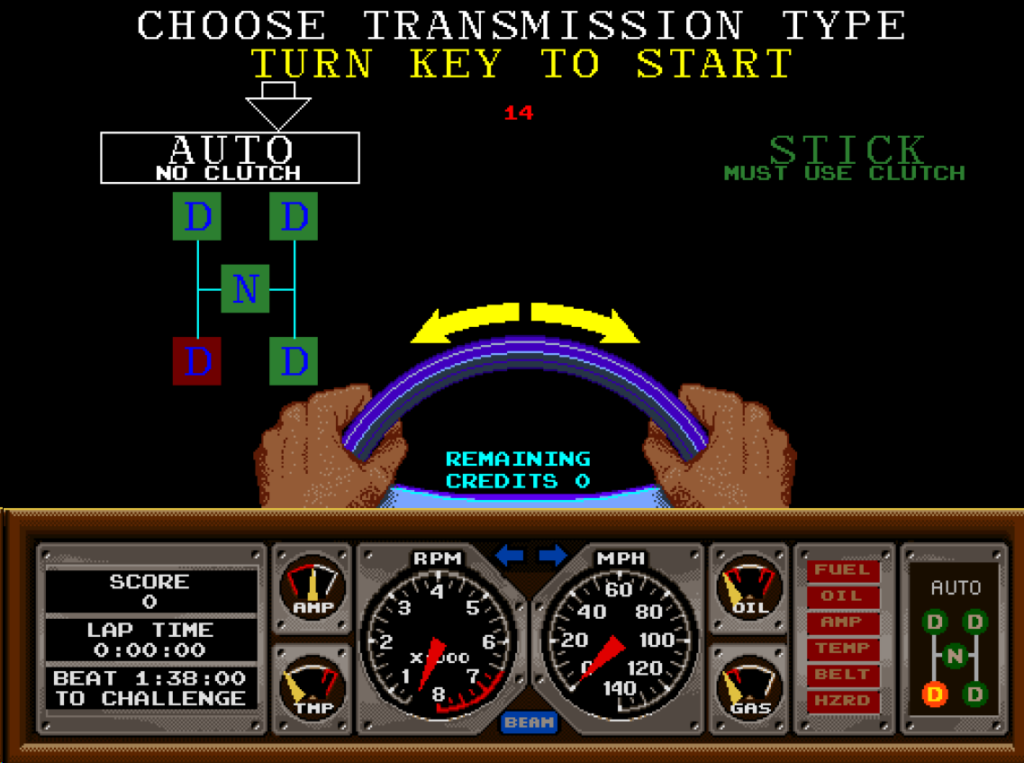
The game’s promotional material boldly declares its intent: forget the game; you’re in a real car. Hard Drivin’ claims to be a simulation – a notable incongruity in the arcade scene. This claim becomes palpable the moment you settle into the arcade cabinet: a force-feedback steering wheel, an adjustable seat, a five-speed manual gearbox – every effort has been made to immerse you in the driver’s seat, at least as convincingly as cabinets like After Burner. You can even initiate the game by turning an ignition key! This attention to detail emphasises the real innovation at play – 3D solid surfaces, making Hard Drivin’ the pioneer in utilizing this technology for car simulation.
The objective of a racing game needs no explanation, but what sets Hard Drivin’ apart is its inclusion of two distinct courses. Predictably, there’s a speed track, but there’s also a more daring circuit filled with thrills – featuring loops, jumps over gaps, and banked turns.


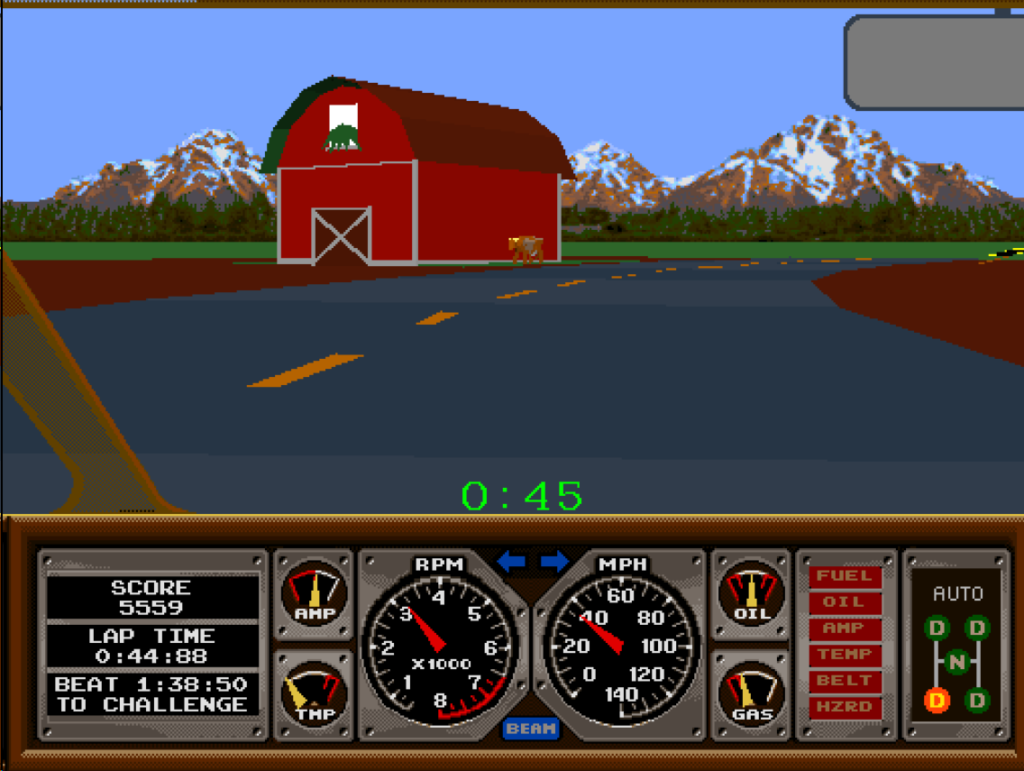
While the ultimate goal remains navigating from checkpoint to checkpoint until the race concludes, the first unique feature is the inclusion of two-way traffic. Caution is advised during overtakes on hills, as you might unexpectedly encounter a tanker truck coming from the opposite direction. Another distinctive element is the ability to choose your circuit mid-race. The game releases you onto the road with clear signposts indicating the path to follow. Go straight, and the speed circuit is yours; take a right, and you’ll engage in the stunt race; cut across the field, and you’re destined to lose the race – but that’s the beauty of 3D; you can do it.
It’s evident that Atari’s title was conceived as a simulator, offering a distinct sense of driving sensations. Although occasionally rudimentary, especially in collision management, it undoubtedly surpasses the physics of titles like Vettel. Slam the throttle into a tight corner, and the consequences are swift – it won’t be long before you find yourself spinning. Sensing the tires spin or the rear of the vehicle chasing when pushing the limits was an innovative experience in 1989. However, occasional surprises may await, launching you into the stratosphere following a collision or seemingly innocuous fall.
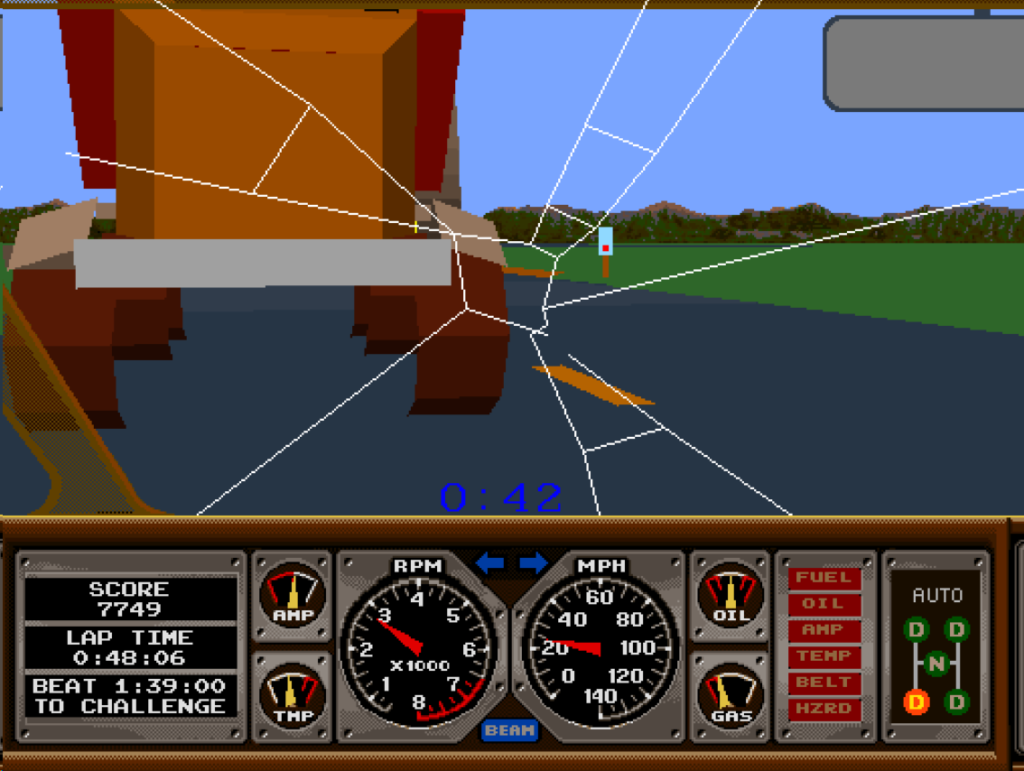

Despite these quirks, the simulation functions objectively well, with the only regret being the somewhat lackluster feeling of speed. Nevertheless, the attention to detail is appreciable: recognizable buildings, distinct vehicles, and even a visible cow (alas, no pedestrians). The immersion is compelling, aligning with the game’s core concept. Additionally, a slow-motion camera with an external perspective allows you to savor your spectacular crash from a privileged angle – albeit at speed, as the timer continues while you witness the aftermath. It’s almost impossible to forget that we’re discussing an arcade game.
The primary weaknesses stem from the limited content. While having two races is enjoyable, the novelty wears off quickly. Upon beating the best time, the program presents the opportunity to challenge the former record holder by pitting you against their ghost – a system introduced by Hard Drivin’, still under patent. However, in terms of content, it remains somewhat restricted. Players not inclined to meticulously perfect their laps may be tempted to move on, especially considering that the groundbreaking 3D of 1989 now pales in comparison to current productions in terms of physics and realization. Nevertheless, for enthusiasts curious about the evolution of sports simulation, the game’s charm is likely to endure, at least long enough to appreciate that contemporary cutting-edge simulations may not be as distant from what was achievable in the late 80s.

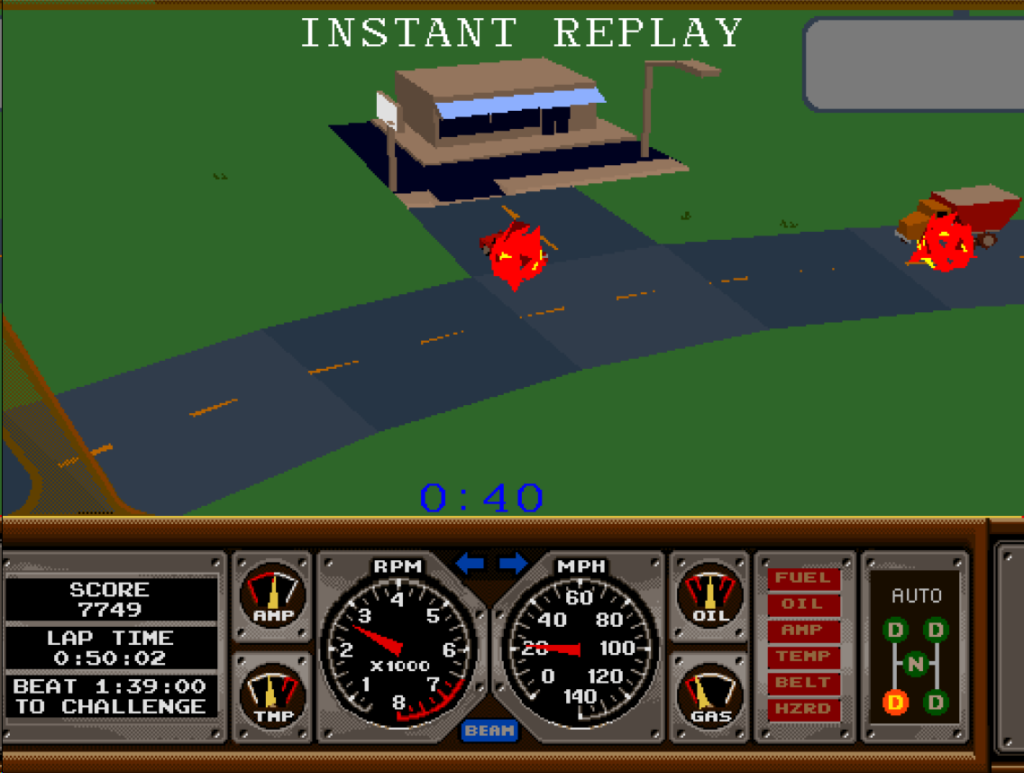
Ultimately, much like many titles in its genre, Hard Drivin’ will endure as a game for the nostalgic and the inquisitive. The realm of 3D simulation has evolved comprehensively since the game’s release. It lacks the immediacy and pixelated charm of classic arcade games. Nevertheless, akin to a fine wine, Atari’s software has matured gracefully, avoiding turning stale. While dedicating extended sessions to it might prove challenging, there’s still considerable enjoyment to be derived from a few laps—especially if you have access to the original arcade cabinet. If you’re captivated by the history of video games, it’s worth exploring. You might rediscover some of that enchantment experienced when taking the wheel of a virtual car in an era long past.
BREAKDOWN:
GRAPHICS: 86%
MUSIC/SFX: 77%
PLAYABLITY: 81%
OVERALL: 82%

Platform: Arcade
Genre: Racing-Arcade-Automobile
Developer/Publisher: Atari Games
Release: 1989
Franchises: Hard Drivin’