An absolutely outstanding effort from US Gold, let down by an exceptionally painful multiload……

A little bit of story time for you before the review, are you sitting comfortably? Then I shall begin, ha ha
During the Christmas season of 1991, a significant controversy erupted in the media regarding the impact of video games on young individuals. The focal point of the debate revolved around the two major console manufacturers and their iconic characters – Sega’s Sonic and Nintendo’s Mario. Surprisingly, Streetfighter 2 managed to sell as many SNES units during that festive season as Mario, despite its higher price tag of over sixty currency units.
As concerns grew beyond the influence on children’s minds to encompass the financial strain on parents (with some newspaper editors perhaps having to confront the reality of contributing to their child’s gaming expenses), the controversy escalated to epic proportions. Ultimately, both Sega and Nintendo emerged victorious, enjoying substantial financial gains.


Curiously, amidst all the discussions, there was a conspicuous absence of mention regarding the Spectrum – a detail that might not surprise many. It went unnoticed that US Gold successfully released a version of the game for only one-fifth of the price of the Nintendo product. However, the Spectrum’s reputation as subpar likely overshadowed this achievement in the larger conversation. Let’s be honest, the Spectrum is crap isn’t it?
NO!!!…. witness the brilliance of the Speccy showcased in Street Fighter II, where a combination of top-notch product quality and innovative programming truly shines. At first glance, all the iconic characters are meticulously rendered – these are not mere approximations; they authentically mirror their real counterparts, complete with lifelike animations. Despite the limitation of having only one fire button for controls, the characters boast a repertoire of moves comparable to those found in the arcade or S-NES versions.


Initially, Tony Bickley, the project manager for Street Fighter II, expressed skepticism about including the Vs battle option on the Speccy due to loading and memory constraints. However, it seems his team put in tireless efforts because the released version did indeed feature this option. And so the game’s functioning can be summarised as follows:
Upon loading, you encounter the title screen and options menu, offering three choices. The options menu lets you toggle SFX, sound, backgrounds (which theoretically enhances speed but proves negligible in practice), etc. You can also customise controls and set difficulty levels ranging from 0 to 9. Opting for the Championship allows entry into the competition, facing the computer in its predetermined ranking order. On the other hand, the Vs game permits you and a friend to select fighters and engage in a delightful bout, pummelling each other into virtual submission. Delightful indeed!
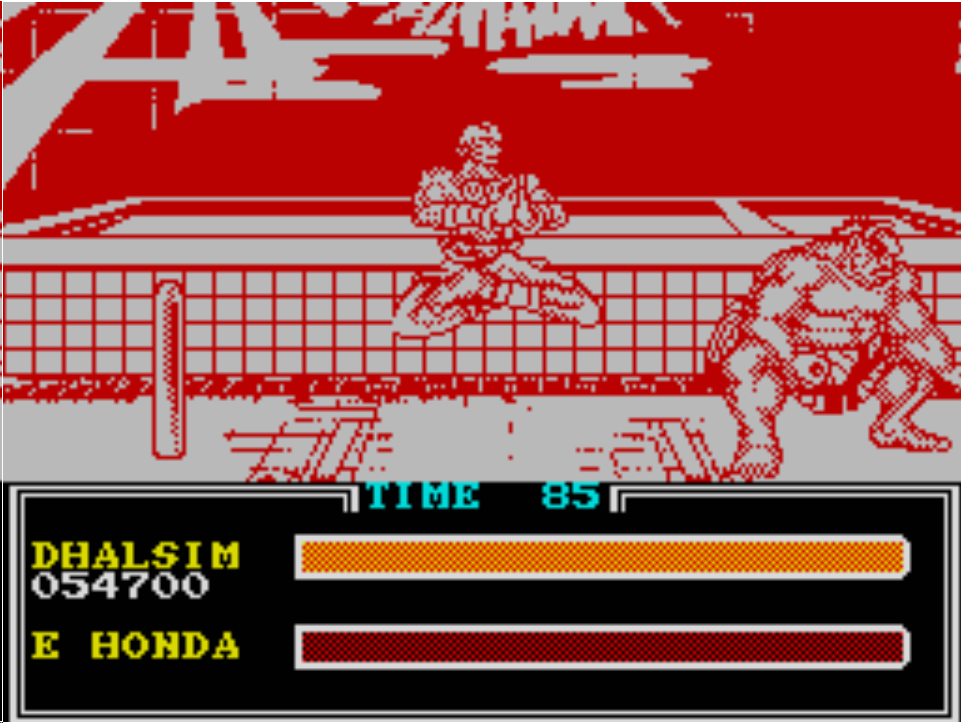

Should someone claim that Street Fighter II lacks vibrancy, a quick-witted commentator might counter that the game indeed offers a diverse array of colors. While true, the game predominantly features scenarios with no more than two colors or shades on the fight screen simultaneously, a deliberate choice to navigate the intricacies of sprite complexity and avoid color clashes.
While the sound in Street Fighter II is acceptable, its true strength lies in its playability. Initially skeptical, I anticipated controlling characters in Speccy Street Fighter II would be akin to observing slugs attempting karate. To my surprise, the gameplay proved swift enough for an engaging experience, earning nods of approval even from enthusiasts at Mean Machines and Nintendo Magazine System.
Mastering the numerous moves requires time, and the instruction manual isn’t entirely trustworthy – some discoveries must be made through personal experimentation, preferably with a touch of contortionism. The primary drawback of Street Fighter II lies in its reliance on tape loading, a time-consuming yet unavoidable process. Despite this, USG deserves commendation for delivering the most visually appealing Speccy title in years.


While I’m inclined to bestow Street Fighter II with a Gold Star award – graphically deserving and nearly earning it in terms of playability – the prolonged loading procedure remains a significant let down. The game’s arduous loading times make it feel like an eternity to complete just a few rounds. Nevertheless, given its likely status as the last substantial licensed coin-op conversion for the Speccy, it’s worth acquiring if only to preserve cherished memories of the Speccy’s capabilities when pushed to its limits.
Despite its imperfections, Street Fighter II remains an essential addition for Speccy enthusiasts. US Gold’s final full-priced offering was almost the one that slipped away. Many doubted the feasibility of its development, and even fewer believed it could be executed with even a modicum of respectability. Yet, against prevailing skepticism, the game has defied expectations. While it may exhibit a slight sluggishness and occasional jerkiness, there’s no mistaking it – it’s Street Fighter II. Despite the substantial loading procedures, the game is worth exploring, particularly given its affordability at less than a quarter of the price of some competing game formats.
BREAKDOWN:
GRAPHICS: 96%
MUSIC/SFX: 74%
PLAYABLITY: 85%
OVERALL: 81%

Platform: ZX Spectrum
Genre: Action-Fighting-2D
Developer/ Publisher: Tiertex Design Studios / US Gold
Release: 1992
Franchises: Street Fighter