A refreshing and interesting experiment in arcade gaming, hits the mark but in an awkward sort of way…..
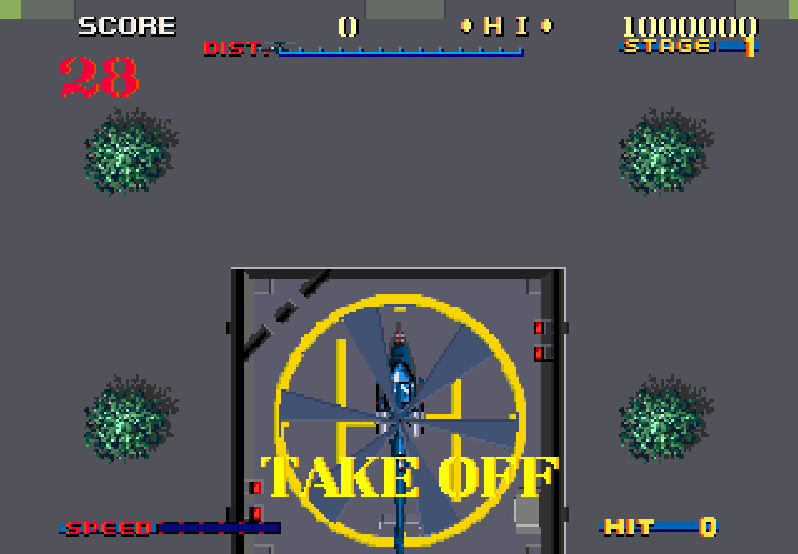
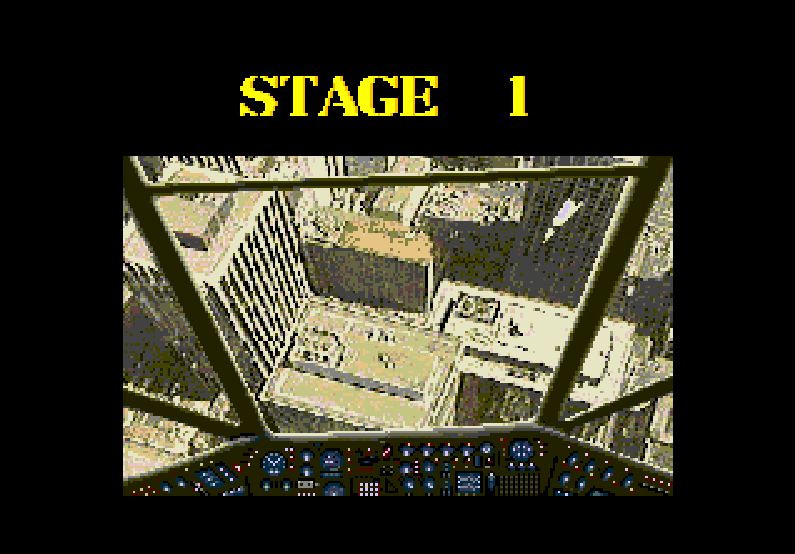
Ah, Thunder Blade — a true classic. This was one of my regular stops in the arcade as a kid, a perfect counterpart to After Burner and OutRun, which together fueled my lifelong love for vehicle-based games. Built on Sega’s evolving X Board hardware (first seen in After Burner), Thunder Blade aimed to push 2D scaling into something resembling true 3D. The result was an impressive step forward for its time — a fascinating glimpse at how developers were experimenting with depth and perspective just before polygonal graphics took over.
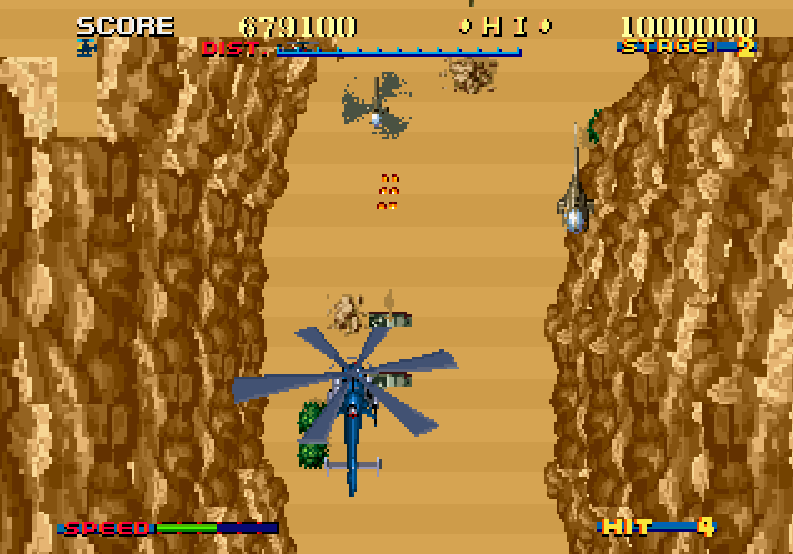
By cleverly layering and offsetting flat sprites, the game convincingly mimicked 3D environments. Fly over a building on the right, and you’ll see its right wall slant down to the ground; shift left, and that side vanishes as the left wall appears. This pseudo-3D trick worked especially well for cityscapes and canyons, creating a dynamic sense of movement and spatial awareness.
The effect, however, wasn’t as strong in the forward-facing “behind the chopper” sections. These parts look more like a high-speed evolution of Space Harrier or After Burner, with larger environmental elements but less visual sophistication. Enemy design — a mix of ground tanks, trucks, jets, and helicopters — doesn’t push graphical boundaries, though they look fine for the era. You rarely get close enough to admire the details anyway… unless, of course, you’ve just crashed.
Natural environments, such as caves, don’t hold up quite as well visually as the city sections. Perspective tricks are harder to pull off on rock formations, leaving these scenes feeling flatter by comparison. Each level wraps up with a massive boss battle against a heavily armed battleship or base, and the final stage — a frontal assault on an enemy stronghold — ends rather abruptly, without any real sense of closure or credits.

Sound
FX:
Like Yu Suzuki’s other arcade hits, Thunder Blade centers on the roar of powerful engines — in this case, your helicopter’s blades. Unfortunately, unlike After Burner, where the jet noise fades to let music and effects shine, the chopper’s droning dominates the soundscape here. The mix feels flat and indistinct, with little separation between elements.
Music:
Sega’s arcade titles are famous for their iconic soundtracks, but Thunder Blade’s music falls a bit short. While the production values are solid — tight drums, punchy slap bass — the compositions themselves lack memorable hooks. With only two main stage themes and some boss music, the score feels limited and somewhat forgettable compared to After Burner’s energetic tunes.

Gameplay
Length & Format:
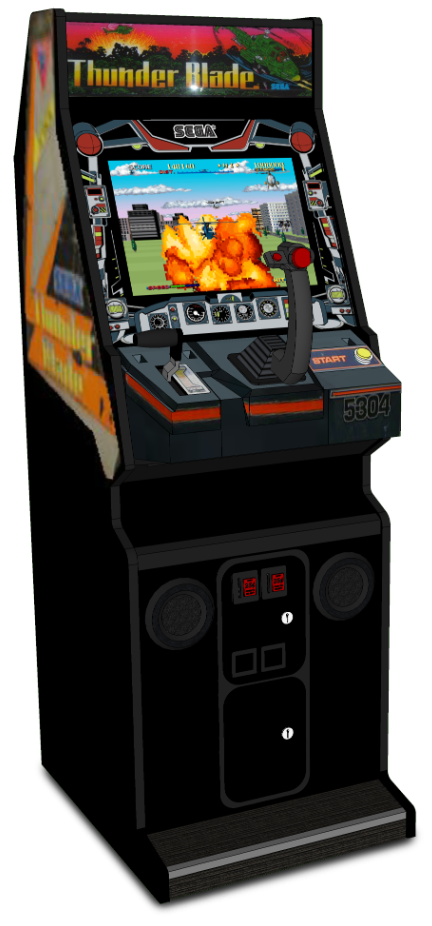
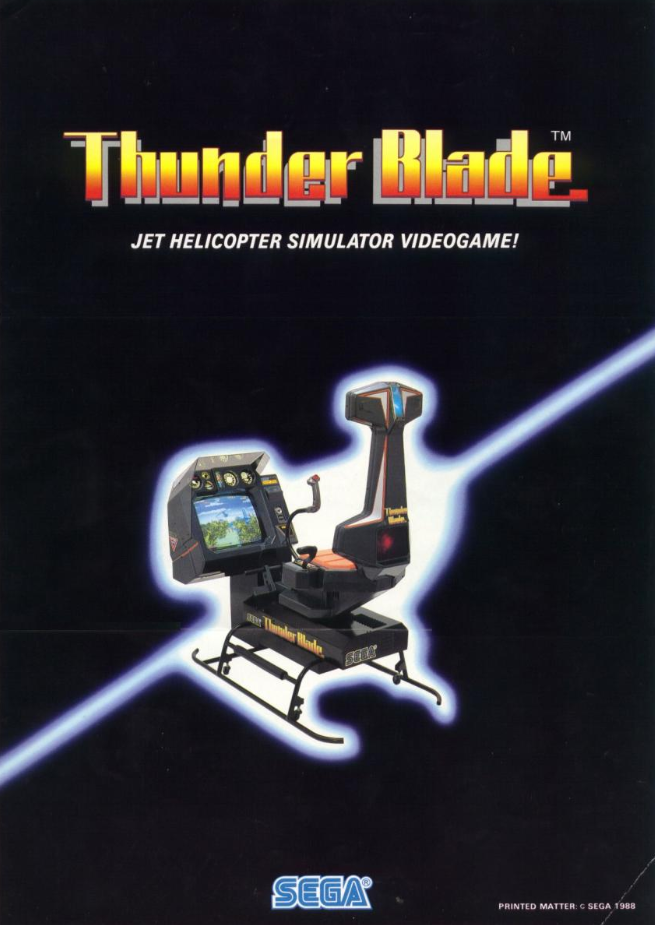
I mostly played Thunder Blade in the sit-down cockpit cabinet — which looked fantastic but didn’t always play well. The controls and moving chassis, while ambitious, often worked against the experience. And because it was premium hardware, each play cost extra quarters, making it less approachable than Sega’s other hits.
Design & Controls:
The game came in both sit-down and upright versions. The sit-down cabinet featured a downward-angled screen that matched the game’s opening top-down perspective nicely, but once you switched to the forward-facing view, the illusion fell apart. The motion-simulated seat, which swiveled as you turned, was more distracting than immersive. Combined with a flight stick that wasn’t exactly smooth, precise control was tough. Altitude control via pushing the stick forward and back felt clunky too.
The upright version removed the seat motion, which actually made the game easier to play — though I rarely encountered it.
Enemy behavior is another quirk worth noting. Regular foes often fire straight ahead, assuming your movement will make their shots dangerous through collision rather than precision. Bosses, on the other hand, fire directly at you, concentrating the challenge in those encounters.
Interestingly, the game rewards fast, aggressive flying. You earn bonus points for both enemies destroyed and completion time — but finishing faster is worth more. This clearly encourages full-speed play, shortening each level from five minutes to two or three. It also likely kept arcade operators happy by increasing coin turnover. Flying faster even ramps up enemy density and projectile speed, subtly adjusting the difficulty to match your pace. Once I realized this, I never flew slow again — the game was far more fun at top speed.
Final Thoughts
I never managed to beat Thunder Blade in the arcade, but it remains a fascinating piece of Sega’s late-’80s experimentation with pseudo-3D graphics and motion cabinet design. Its ambition often outpaces its execution — the controls can be frustrating, and the sound design isn’t quite up to Sega’s usual standards — but its visual ingenuity and fast-paced action make it an important and memorable entry in arcade history.
If I stumbled upon that sit-down cabinet again today, I’d be inclined to give it one more shot.
BREAKDOWN:
GRAPHICS: 78%
MUSIC/SFX: 74%
PLAYABLITY: 72%
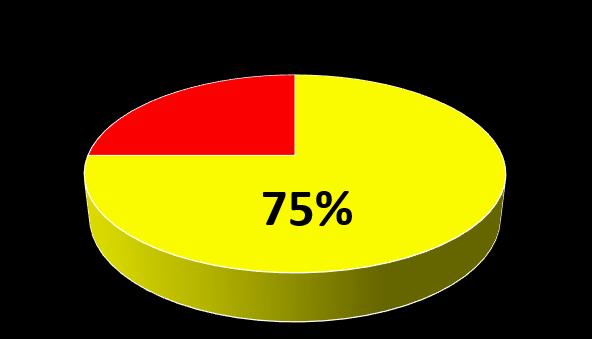
OVERALL: 75%
Platform: Arcade
Genre: Simulation – Action – Shooter- Shoot-em-up – Vertical
Developer/ Publisher: Sega
Release: 1987
Franchise: Thunder Blade