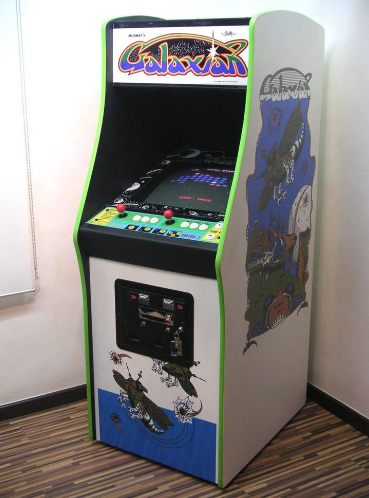
Another Namco Shooter!!!
If you’re familiar with classic arcade games, chances are you’ve come across Galaxian (Namco/Midway, 1979) and its popular successors like Galaga. Following in the footsteps of Space Invaders, Taito’s immensely popular space-themed shooter, Galaxian quickly became a standout entry in the arcade scene. Even after 40 years, it remains a solid and enjoyable game to play. While it may have a few minor flaws and lacks overall variety, it excels in delivering essential gameplay elements. Galaxian is easy to pick up and play, with a captivating hook that motivates you to improve your skills and progress further with each attempt.
The game’s storyline is nothing groundbreaking, as it revolves around the familiar theme of saving the universe from hostile extraterrestrial forces. However, it’s worth noting that during the time Galaxian was created, it was uncommon for games to have any kind of story at all. The narrative is summarized by a couple of lines displayed on the Title Screen as the enemies roll by: “WE ARE THE GALAXIANS – MISSION: DESTROY ALIENS.” It raises questions about the identity of these “Galaxians” and their motives for destroying other aliens. Additionally, considering that “Galaxians” is a plural term, it’s intriguing why the game title uses the singular form “Galaxian.” While some additional context would be appreciated, the main premise remains unchanged: as the player, you assume control of the armed space vessel known as the “Galaxip” and embark on a mission to shoot down wave after wave of hostile giant space bugs, the Galaxians, in order to uphold peace throughout the Galaxy!
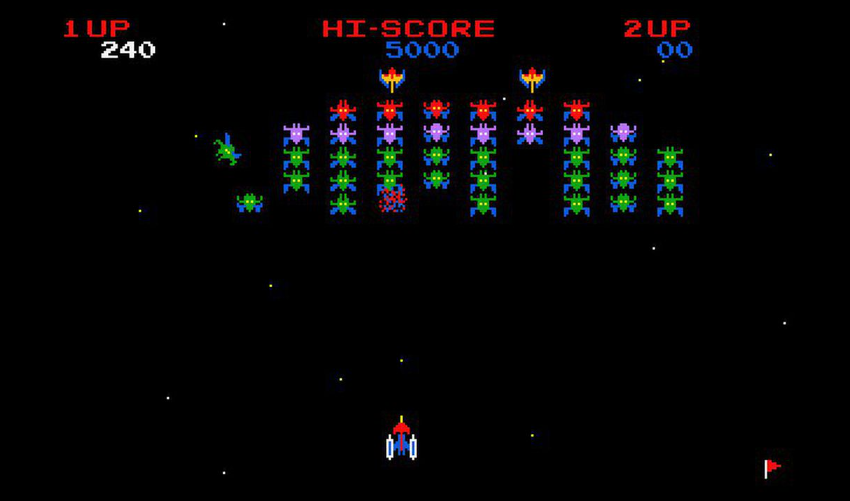
The gameplay in Galaxian closely resembles that of Space Invaders, with a few minor differences. Similar to Space Invaders, your spaceship is positioned at the bottom of the screen, while the formation of enemy attackers starts at the top. These enemies constantly move from side to side and slowly descend towards you. However, some of the bugs may break away from the formation and charge directly at you while firing their weapons. This requires you to be quick and aware of your positioning to avoid getting hit, as the game follows the rule of losing a life with a single hit. If a bug manages to pass you and reach the bottom of the screen, it will reappear at the top and attempt to kamikaze its way towards you again. As you shoot down the Galaxian enemies and reduce their numbers, more bugs will frequently target you.
Clearing the starfield of Galaxian enemies signifies the completion of a stage, and you progress to the next one. The number of red flags displayed at the bottom of the screen indicates your current stage. Each stage doesn’t introduce significant changes, except for increased enemy speed and improved AI. This provides a solid challenge that gradually intensifies as you become better at the game. The primary motivation for replay value lies in trying to achieve the highest score possible to top the leaderboard, which is visible during the game’s attract mode on the Title Screen. There is no definitive ending; the game loops indefinitely until you exhaust all your lives.
Galaxian, while not particularly remarkable by today’s standards, was a visually appealing game for its time. Like many space shooters of that era, it featured a simple black background with bright, flashing dots representing stars, giving it an outer-space aesthetic. The Galaxian enemies, depicted on the Title Screen, had four distinct designs—winged alien insects of different colors (yellow, red, purple, and grey)—each indicating their starting positions and the points awarded for destroying them. The Galaxip, your own spaceship, had a modest design with various colors and enough detail to resemble a spacecraft. Laser beams, both from your ship and the Galaxian enemies, were depicted as quick-moving, short white lines.
In terms of sound, Galaxian had a passable audio experience. While there were no background music tracks, you could hear the humming sound of your ship’s engine as you navigated through space. High-pitched notes accompanied the approach of enemy bugs, while simple laser zaps and a loud buzzing explosion-like noise represented the firing and impact of lasers, respectively. Although none of the audio elements were particularly attention-grabbing, they served their purposes adequately and didn’t become overly irritating during extended gameplay sessions.
Overall, Galaxian can be considered a standard vertical space shooter that heavily drew inspiration from Space Invaders. However, it successfully delivers an enjoyable challenge, and its limitations, such as basic visuals, lack of variety, and originality, can be overlooked. Whether playing it through compilations like the Namco Museum series or in other formats, Galaxian remains a fun experience today. Any dedicated old-school arcade gamer should give it a try at least once, as it represents one of the classic shooter games of its time.
BREAKDOWN:
GRAPHICS: 47%
MUSIC/SFX: 61%
PLAYABLITY: 64%
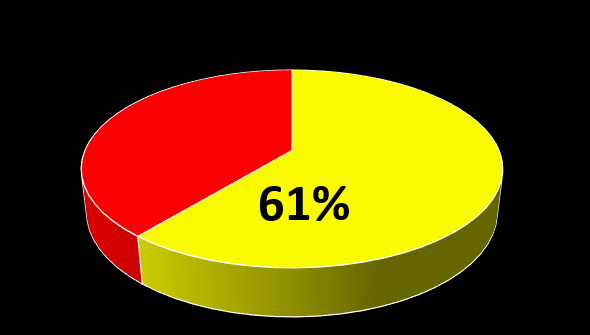
OVERALL: 61%
Platform: Arcade Games
Genre: Action-Shooter-Shoot-‘Em-Up-Vertical
Developer: Namco
Publisher: Midway
Release: 1979
Franchises: Galaxian / Galaga, Arcade Archives