A distinctly average police car race game, not bad, but struggles against it’s peers of the genre……
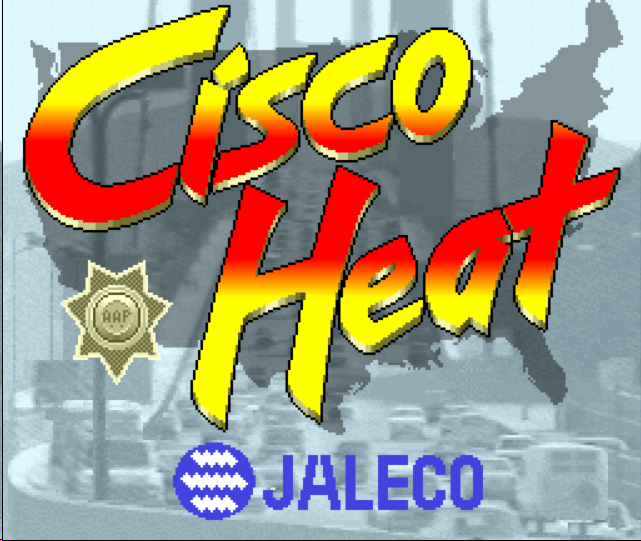
Readers familiar with our reviews may be aware of our more than slight fascination, and at times, peculiar admiration for the works of Japanese developer Jaleco. Their games, occasionally bad but mostly reasonable, never quite ascend to the stellar heights deserving of a Gold Star award. They consistently occupy the middle ground, avoiding the fast lane, so to speak. However, today’s game, belonging to a genre I genuinely enjoy, featuring a simple enough concept that should avoid significant mishaps, involves putting countless lives at risk for a bit of amusement – it’s the 1990 arcade game Cisco Heat!
Cisco Heat follows the standard formula of most arcade racers of its kind. Sprite-scaling effects create a sense of 3D movement, players use a steering wheel and pedals (part of a sophisticated moving cabinet, if fortunate) to control the action, and there’s a gear lever with “low” and “high” settings. Despite the presence of other competitors suggesting a race, the real objective is to beat the clock and reach the end of the stage before time runs out. The gameplay is relatively straightforward, making it easy for players to grasp.


The backdrop for the game is the city of San Francisco. For those acquainted with the city, Cisco Heat may or may not offer an accurate representation, but during the attract mode, it was revealed that there’s a genuine part of San Francisco called Treasure Island. One can only assume this is where all the pirates reside.
Players can choose from two police cars – a robust Cadillac-style vehicle built “for speed” and a sports car designed “for cornering.” The decision appears logical, considering the unpredictable nature of cornering in this game. As we’ll soon discover, turning corners is a significant challenge, and practically, there’s little difference between the two cars, except that the larger one is faster.
Furthermore, the sight of red police cars feels inherently wrong, contradicting a lifetime of expectations about the standard color of police vehicles. Throughout the entire game, I couldn’t shake the feeling that something was off, pondering whether I was supposed to be a fire marshal or another official.

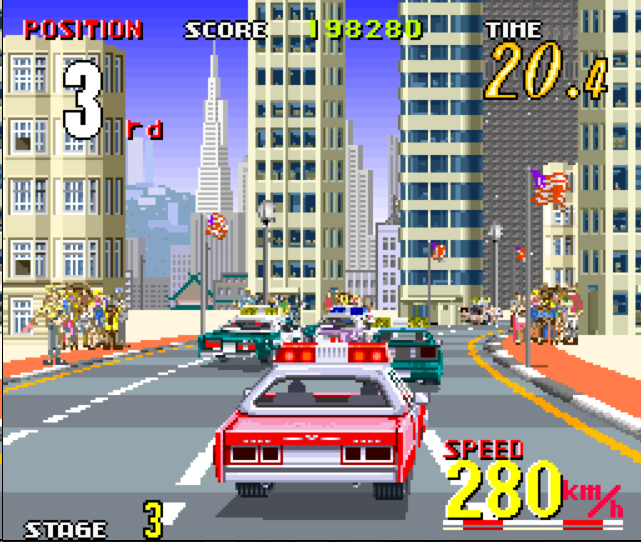
In the early stages, Cisco Heat appeared to fit comfortably into Jaleco’s tradition of being average but not extraordinary. It lacked the sense of speed found in games like AB Cop and didn’t match the precision and overall quality of the genre-defining OutRun. Nevertheless, Cisco Heat compensated to some extent for its technical shortcomings with a distinctive character and bold, impressively designed graphics that filled the screen with a grandiosity achievable only in arcade games of that era. However, the game struggled to deliver all the effects it attempted, with flickering and oddly-scaled sprites and occasional warping of the road. Initially, I attributed these issues to emulation inaccuracies, but further research revealed that Jaleco may have pushed their hardware beyond its limits, resulting in unstable graphics even on the original arcade machine.
Now, let’s address some concerns, notably the extremely sharp turns – right angles, to be precise. While a ninety-degree turn might be expected in a racing game set in a grid-based American city, Jaleco’s implementation of these corners, which appear frequently throughout the game, lacks the smoothness and grace one would desire. The primary issue stems from the viewpoint. In typical racers of this kind, you’re essentially driving along a flat “strip” of road, unable to see what lies ahead on the road you’re about to turn onto. As you navigate these corners, instead of the view rotating to reveal what’s ahead, your car rotates sideways until you’ve passed a certain point in the turn. Then, the view abruptly snaps into place to display the next segment of road. This poorly executed and aesthetically unappealing gameplay mechanic means you can’t see any obstacles around the corner until it’s too late to avoid them. Moreover, because the edges of the road are invisible during the turn, you have no indication of when to stop turning. This flaw, the Jaleco Thing, relegates the game to the status of an entertaining also-ran, slipping away from the top tier once again. The frequent occurrence of these right-angled turns every ten seconds exacerbates the issue.


The game encompasses five stages, featuring some of San Francisco’s iconic roads and landmarks, including the Golden Gate Bridge, Union Square, Lombard Street, and Treasure Island. Most stages follow a linear path, with only stage 5 offering some road choices via the ‘James Lick Sky Way.’ Introducing more optional routes throughout the game could have enhanced replayability and potentially increased profits. Given Cisco Heat’s brevity, a few shortcuts or variations would have provided a welcome break in the monotony.
Cisco Heat operates without considering positioning. Despite finishing in the ‘Numero One’ spot, it doesn’t hold much significance because success in Cisco Heat is solely determined by the remaining time on the clock. The time limits are stringent, adding frustration as the game’s difficulty doesn’t arise from intelligent computer opponents or intricate road layouts but from oversized hitboxes of obstacles appearing suddenly, leading to crashes even when it seems you’ve cleared them.

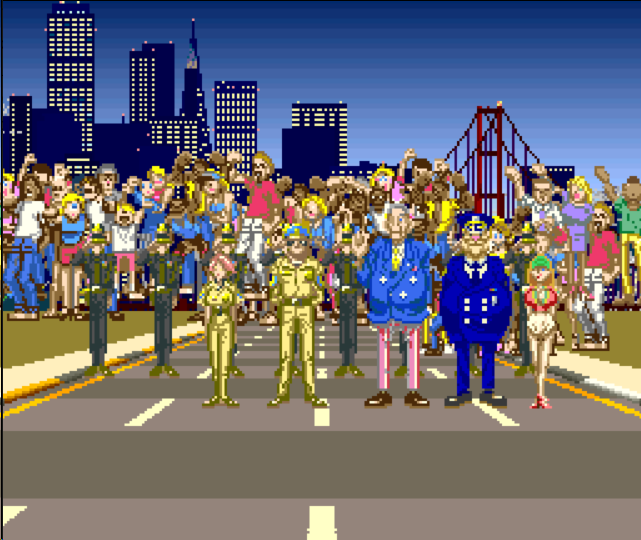
In conclusion, I had hoped to enjoy Cisco Heat more than I did. While I did find it enjoyable when focused on racing against other cars and navigating traffic, several factors detracted from the overall fun. Graphical issues, challenging cornering mechanics, a lack of speed sensation, and unpredictable collision detection collectively diminish the game’s appeal, aligning it with the typical traits found in the Jaleco Files – fairly good but far from great. Nevertheless, there’s a comforting familiarity in its mediocrity. It falls short of earning a Gold Star but manages to offer some decent elements that slightly elevate its standing.
BREAKDOWN:
GRAPHICS: 75%
MUSIC/SFX: 70%
PLAYABLITY: 68%
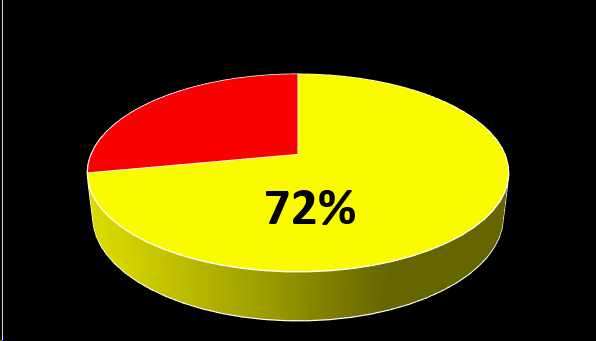
OVERALL: 72%
Platform: Arcade
Genre: Racing-Arcade-Automobile
Developer: Jaleco Entertainment
Publisher: Imageworks
Release: 1990