Late 80’s Gameshow which only lasted 8 episodes, and there’s a reason why….
When I reflect on my childhood, back in the days before the internet’s all-seeing influence, three things stand out as constants in my young life, much like excessive sugar intake and inventing countless excuses for tearing my trousers.
Firstly, there was Bertha (lovely Bertha), the stop-motion animated children’s TV show created by Ivor Wood, featuring a sentient factory machine named Bertha. This show, which gave a generation of British kids a whimsical view of factory life filled with advanced AI, quirky robots, and perpetually smiling faces, turned out to have only 13 episodes, all aired between 1985 and 1986. This revelation shattered my illusion, as I probably spent more time feeling queasy as a child than watching Bertha.
The second childhood fixation was Stefan Dennis’s pop music career, which actually comprised only two singles released in the late 1980s. I had mistakenly believed it lasted much longer. (Stefan’s most famous song, “Don’t It Make You Feel Good?” featured the man from Lassiters in Neighbours donning a leather jacket in an attempt to exude toughness by rolling open partition doors.)
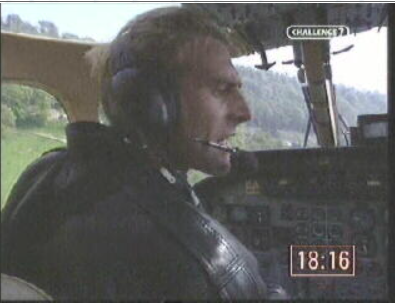
The third iconic memory of late ’80s culture was none other than “Interceptor,” the light-hearted game show that pitched two daring contestants against a helicopter-flying Scottish daredevil known as the “Interceptor.”
Although it seemed like “Interceptor” had a dominating presence in my childhood, in reality, only eight episodes ever aired, all between July 1989 and New Year’s Day 1990. Eight measly hours, commercials included. The internet rudely awakened me to this fact, dispelling my illusion of the show’s vast and enduring existence. I had always thought of it as ancient, ever-present, and eternal, much like God or endless reruns of Friends. Did those eight hours stretch out infinitely because the summer of 1989 felt particularly long? As a cricket enthusiast, The Ashes that summer did seem interminable.
I am not exaggerating when I say that “Interceptor” collided with my childhood like a rocket striking a cathedral’s bell. It resonated so deeply within my nine-year-old soul that it led to something of an existential crisis—I wanted to be the Interceptor. I pleaded with my mom to buy me a Laser Tag set, a combination of gun and sensor that would allow me to emulate my dark-clad hero, a fellow countryman! My request was granted, but my subsequent pleas for a helicopter fell on deaf ears.
However, there were two issues with the Laser Tag set: first, the gun had to be pressed against the sensor to activate it; and second, I had no friends to play with. No matter. I discarded the set and spent my days and nights in the garden, pretending to shoot invisible foes with my wrist-mounted zapper-cannon. My child psychologist was less than thrilled.
While my memory may have inflated “Interceptor’s” presence and influence, it’s the quality that truly matters, right? After all, there are only 12 episodes of “Fawlty Towers,” and it’s rightly hailed as a classic. Perhaps eight episodes are just right.
A few weeks ago, I scoured YouTube (I say ‘scoured’—I pretty much typed ‘Interceptor’ into a search box and the episodes popped up, but somehow that didn’t feel heroic enough, so let’s pretend I scoured) to revisit the show and experience the pure childhood joy once more.
In hindsight, I should have heeded the warning that sometimes it’s best to let the past remain untarnished. “Interceptor” should have been left to live on unspoiled in my memories, alongside Pat Sharpe’s mullet and Rolf’s Cartoon Club. But my baby sister and I truly loved “Interceptor.”
I may have returned from my nostalgia trip slightly disillusioned, but it’s my duty to faithfully recount my experience of viewing “Interceptor” through adult eyes and lovingly recreate some of its peculiar charm for your amusement. So here we go.
Two contestants find themselves in the picturesque British countryside, faced with a choice between two bulky metal backpacks adorned with sensors. Inside one of these backpacks lies a thousand pounds, while the other conceals a worthless lump of plastic. The catch? They won’t know which is which until the game concludes. Blindfolded, the contestants are airlifted by helicopter to separate locations seven miles apart. Once their blindfolds are removed, they navigate the terrain with exclamations like, “Gosh, I’m in a field, how exciting,” and, “Trees? Cor blimey, as I live and breathe.”

With a mere forty minutes on the clock, their mission is to traverse the countryside, beat the ticking clock, reunite with their teammate, and hopefully discover the money-filled backpack. However, time isn’t their only adversary; there’s also…
THE INTERCEPTOR! (Boooo! Hisssss!) This enigmatic nemesis is a tall, blonde, blue-eyed Scotsman donning a long, black leather coat and equipped with a wrist-mounted laser gun. He resembles an SS Officer thawed in the year 2257, sent back in time to avenge the fuhrer. His helicopter, piloted by the beleaguered Mikey, serves as the Interceptor’s mobile command center. Their snarky, passive-aggressive exchanges evoke the spirit of two deeply unhappy people trapped in a loveless marriage. The Interceptor continuously shuttles between the contestants, attempting to shoot the sensors on their backpacks with his military-grade wrist-mounted TV remote. The special effects here are remarkable but only discernible to those capable of perceiving infrared in broad daylight with the naked eye. For the rest of us, it appears as a man angrily pointing his arm out of a window.
If the Interceptor scores a direct hit on a contestant’s backpack sensor, it locks automatically, potentially sealing off their thousand-pound prize money. To prevent this, contestants shuffle around like crabs or move in slow-motion, Twin Peaks-style.
The Interceptor has two signature quirks. First, his bizarre habit of randomly raising his arms aloft and emitting fish-eagle-like shrieks—an amusing spectacle, to say the least. Sean O’Kane, the actor portraying the Interceptor, once revealed that his fascination with fish-eagles began in childhood. He honed his technique on football fields, where he pounced on stray balls heading his way—a habit that likely endeared him to other kids. His other trademark is the catchphrase “I LIKE IT!”—less a catchphrase and more an occasional expression of approval.
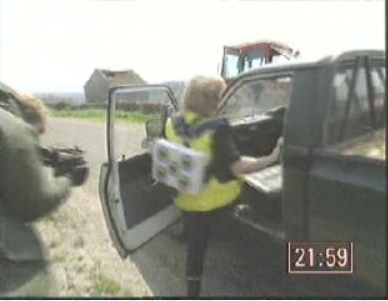
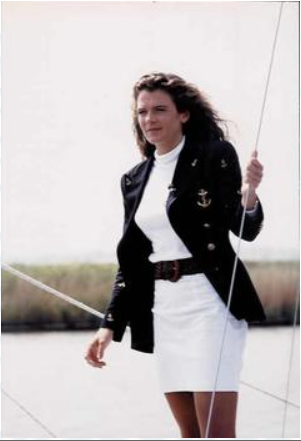
Throughout the show, host Annabel Croft, a former tennis ace, sits in a central location in a plush market town with a spread-out map, communicating with the contestants via a headset, and guiding them through the game. Her initial task is pinpointing their location on her map, a process filled with humorous exchanges. “You’re in a field, are you?” “That’s right. I’m pretty sure this green stuff is grass, but I wouldn’t bet my life on it.” Annabel occasionally inquires, “Is there a signpost anywhere?” showcasing her orienteering prowess. She has her own recurring phrase, “Now listen to me,” delivered sternly, reminiscent of a young Anne Widdecombe irritated by the lack of attention at someone else’s birthday party.
Annabel, with her posh and aristocratic demeanor, seems an odd choice as host for a show like Interceptor. Her presence suggests that the program’s creators were unsure of their target audience, torn between appealing to the nostalgic tweed-clad Treasure Hunt enthusiasts and young boys like myself, who craved action-packed chases led by a formidable Scotsman in the sky. The show’s title sequence embodies this identity crisis, with an intense synthesized rendition of Chopin playing over images of a man performing acrobatics, leaping over fences, and shouting from helicopters. These sequences oddly juxtapose mini-montages of Annabel Croft’s delicate and apologetic appearance.
The show operates on three social strata, creating a layered class dynamic. Annabel, the posh and equestrian-like host, reigns supreme at the top. The contestants, a middle-class mix of Trevors and Poppies, form the filling. In one episode, contestants express their intention to use the prize money to purchase a new sofa, a quintessentially middle-class aspiration. Annabel guiding the contestants through the game feels akin to the Queen herding accountants. At the base of this social hierarchy is the Interceptor—a working-class Scotsman from Cambuslang who terrifies the middle-class contestants with the threat of pursuit.
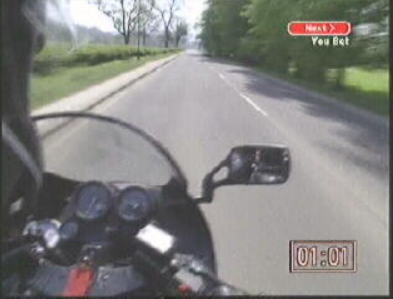
Before the contestants can reunite, they must travel to a bonus location to retrieve the key for their teammate’s backpack. Annabel skillfully guides them when the headsets function correctly. Most of the contestants’ time is spent perched nervously on the back of milk floats, desperately shouting “Annabel?!” into the void. Various vehicles await them along their route, operated by seemingly ordinary members of the public, definitely not stooges. Watching a series of awkward, moon-faced individuals feign surprise when a sweaty middle-class contestant approaches, demanding a tractor ride, provides an entertaining spectacle. Their attempts at acting coy are especially comical. “Give you a lift? Now? But I’m really rather enjoying standing here nonchalantly leaning against a tree for no reason in the middle of nowhere.”
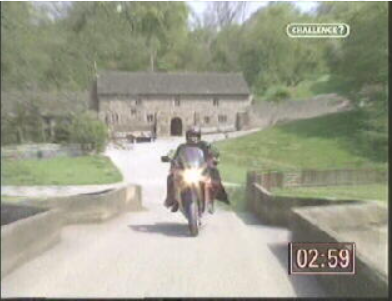
The overt staging serves a practical purpose, as without access to transport, contestants could never cover seven miles in forty minutes—certainly not without a hefty dose of nuclear-grade amphetamines and a hungry T-Rex nipping at their heels. The Interceptor often engages in pursuit on foot, but at times, he employs boats, bikes, and classic cars. However, these additions do little to heighten the show’s excitement, although they probably made Sean O’Kane’s day.
Fans of the show may assert that the Interceptor’s tractor ambush stands as the show’s crowning moment. Sean dupes a contestant into believing he’s an innocent farmer, attempting an English accent that definitively proves Scottish Seans should stick to their guttural brogues. If that’s the show’s finest moment, a close second might be the time a contestant used an incredibly reluctant half-naked man as a human shield.
Once both contestants secure their keys, usually won through activities like ladder-climbing and brief jousting, Annabel guides them towards each other for the grand but largely underwhelming finale. To win, the contestants must touch hands within the forty-minute time limit, with the added caveat that their money-filled backpack hasn’t been locked by the Interceptor. More often than not, they fail, and the dream of owning the coveted couch remains unfulfilled. The Interceptor, with a wicked grin, declares that he “likes it.”
Thank you for joining me on this nostalgia-filled journey through the world of Interceptor. I’ve learned much about the peculiar child I once was and the middle-aged man I’ve become. I’ve realized that, while I may still retain my quirks, I’ve evolved into a gym-built individual, much like the imposing Interceptor himself. As I marveled at Interceptor’s helicopter antics and high-speed pursuits, I couldn’t help but wonder if, should they ever resurrect the show, I should audition to become the next Interceptor.