In recent weeks, we have been discussing the process of creating your own home game room filled with timeless classics that provide endless entertainment and value for your investment. We’ve explored games like Pac-Man, Mortal Kombat, and Arkanoid—titles known for their replay-ability and unique gameplay experiences. However, there is another category of arcade games that holds a special allure for collectors. These games are not sought after for their gameplay or quality, but rather for their rarity and market value. They are often referred to as “Holy Grails” and are notoriously difficult to find, typically already in the possession of avid collectors or displayed in arcade museums.
During the 80s and 90s, the golden age of arcade gaming, the industry was fiercely competitive. Many promising games with innovative mechanics were shelved because they failed to generate enough revenue from their niche target audience. Conversely, some uninspired or subpar creations never made it past the prototype phase and ended up in the hands of collectors, gaining value over time. It wasn’t until 1997 when MAME (Multiple Arcade Machine Emulator) was introduced that modern gamers had the opportunity to revisit these obscure gems by emulating them on alternative arcade cabinets or computers.
In this article, we will focus on games that were initially produced for the mass market but didn’t achieve commercial success. Due to the passage of time and the fragility of old circuit boards and delicate wood components, finding these titles in their original form has become a challenging endeavour.
If you got to play any of these 10 games while they were live, then consider yourself a lucky lad/lass as these are really rare arcade games:
1. The Legend of Valkyrie (1989)

In a previous article, we touched upon the fact that arcade games didn’t typically embrace the concept of “epic sprawling adventures.” Instead, they focused on simple yet captivating mechanics that allowed players to master the game and achieve high scores. However, in 1989, Namco released a game called Legend of Valkyrie that dared to take players on an immersive adventure, where they would assume the role of an armor-clad maiden on a mission to save humanity from certain destruction. This action-RPG with shooter elements even offered a two-player mode, allowing the second player to control a lizardman warrior and assist the Valkyrie on her quest.
Despite its engaging gameplay, Legend of Valkyrie failed to capture the attention of the American audience initially, as it was originally released exclusively in Japan. It wasn’t until 1996 when the game was officially translated and included in a compilation of games for the PlayStation 1, which marked its introduction to the Western market. Unfortunately, by that time, gamers in the West were already engrossed in new and innovative games and machines, making it challenging for Legend of Valkyrie to gain traction among them.
2. Outfoxies (1994)

We’ve got a real gem here, folks! Just like The Legend of Valkyrie mentioned above, Outfoxies is another noteworthy title developed and released by Namco. This game took an intriguing twist on the traditional fighting game formula by introducing a sprawling arena into the mix. The fighting stage was brimming with environmental hazards, scattered weapons, and deadly obstacles that players could interact with to unleash havoc upon their enemies. Outfoxies played similarly to popular modern arena brawlers like Super Smash Bros. and Digimon Rumble Arena. While it featured an energy bar like most fighting games of the time, it offered players complete freedom to move around and interact with the dynamic stage.
Unfortunately, Outfoxies failed to strike a chord with the audience, as they were preoccupied with the popular fighting games of the 90s. Furthermore, compared to titles like Street Fighter or Mortal Kombat, Outfoxies had smaller player characters, and the camera would often zoom out to cover the entire arena. This aspect made the game less appealing to many players. However, beneath the quirky design choices, there was a game that was truly ahead of its time, pushing the boundaries of what a fighting game could offer.
3. Computer Space (1971)
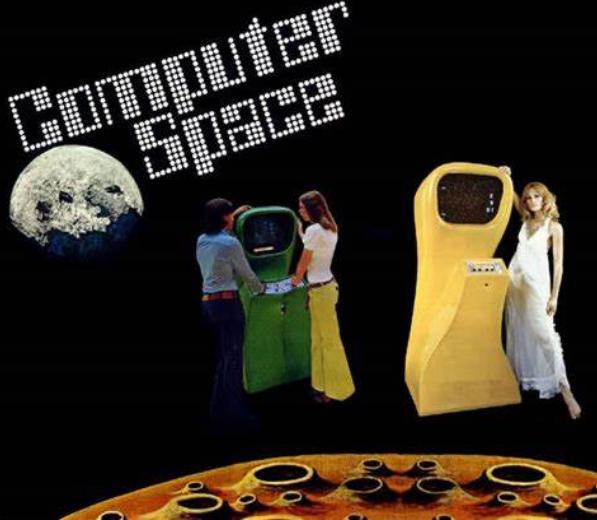
When it comes to notable games in personal collections or museums, Computer Space certainly ranks high due to its historical significance as the very first commercially produced video arcade game. Developed by Nolan Bushnell and Ted Dabney for Nutting Associates, it drew inspiration from the popular “Space War” game enjoyed by university students with access to campus supercomputers. During the 1970s, arcade developers and designers faced the challenge of creating games without any existing models to reference. As a result, they were pioneering new paths while grappling with technological limitations and budget constraints.
Computer Space was a straightforward game where players controlled a rocket ship represented by an outline of dots, aiming to shoot down moving UFOs. The game cabinet stood out with its colored fiberglass design and even made an appearance in the science fiction film Soylent Green, starring Charlton Heston. Additionally, a rare two-player edition of the game was also produced.
Approximately 1,500 units were manufactured, but Computer Space failed to capture the public’s attention, partly because it featured seven buttons—a somewhat daunting prospect for individuals unfamiliar with controlling objects on a television screen. Nonetheless, the duo of engineers would go on to establish a small company called Atari, where they would create a simpler game titled PONG, which would ultimately become a cultural phenomenon.

4. Pacland (1984)

Guess who did it first? That’s right, Pac-Man! The game Pacland actually beat Super Mario Bros. to the punch by a whole year when it came to popularizing side-scrolling platformers. Developed by Namco and released in 1984, Pacland had all the elements you would expect from a platformer: enemies patrolling the stages, power-ups, treacherous pitfalls, and thrilling side-scrolling action. The objective of the game was to escort a fairy, conveniently hidden beneath Pac-Man’s hat, to Fairyland and safely return to Pac-Man’s house. Along the way, players faced obstacles like enemy ghosts, quicksand, and spikes, among others.
Each stage consisted of four rounds, with Pac-Man delivering the fairy to the Fairy Queen at the end of the third round. In the fourth and final round of each stage, our hero had to make his way back home, aided by the magical boots bestowed upon him by the Fairy Queen for returning the fairy. This last round was played from right to left, and with the help of the magic boots, Pac-Man could perform multiple jumps in mid-air, adding an exciting twist and a unique challenge compared to the rest of the stage. Upon reaching home, Pac-Man would be welcomed by Ms. Pac-Man, Baby Pac-Man, as well as his faithful cat and dog, Sour Puss and Chomp-Chomp.
Subsequent levels followed a similar structure but with increasing difficulty to keep players engaged and challenged.
Funny story with this one, I have a long term friend who actually played this game religiously in a chip shop near Croydon, South London. He became so addicted to it that he got into debt as a teenager and used to steal 10p ‘s from his Mum’s purse just to fund his Pac-Land addiction. Sounds like a tragic story but if you knew the guy, it’s hilarious. Most people get addicted to substances or gambling and need rehab, he needed rehab for an addiction to Pac-Land – classic tale.

5. Sundance (1979)

This game is a rare gem from the era when vector graphics were all the rage. Sundance, developed in 1979 by Cinematronics, stands as a lost relic. Cinematronics, known for creating games like Tail Gunner, Star Castle, Armor Attack, and Rip Off, among others, crafted this elusive title. It is believed that only around 15 copies of Sundance were ever produced.
The gameplay itself was relatively straightforward. The game featured two grids stacked on top of each other, with suns and spherical objects bouncing continuously between them. Up to two players controlled holes that could be maneuvored along the bottom grid. The objective was to strategically position the holes beneath the bouncing objects, causing them to fall through and awarding the player points accordingly. Capturing the suns was especially crucial, as their bounce would gradually bring them closer to one another. The game would conclude when the grids fully converged. Players also had access to a limited number of “smart bombs” per run, which could be used to destroy the suns at any given time.
To grasp the rarity of this game, consider this intriguing story. In 2010, a functioning Sundance cabinet was discovered in an abandoned restaurant. The finding ignited a wave of excitement and discussion in the KLOV forums, a community where arcade gamers gather to discuss their favourite games and cabinets. The dedicated thread discussing the discovery spanned over 80 pages. Eventually, an anonymous individual arrived at the location and single-handedly removed the machine. The subsequent events remain unknown, but considering the game’s value, which can reach up to $12,000, it’s not surprising that someone would take the opportunity to claim the cabinet for themselves.

6. Asura Blade (1995)

In the 1990s, fighting games were a surefire hit, and it seemed almost impossible to go wrong with them. All you needed were captivating characters, visually appealing stages, and smooth combat mechanics, and you had a recipe for success. Asura Blade took this winning formula and added a unique twist by incorporating weapon-based gameplay for each character. This innovative approach introduced a wide range of combat styles, as each weapon endowed the characters with distinct and fascinating movesets. In many ways, Asura Blade can be considered a precursor to the popular Soul Calibur series, which also revolves around weapon-based combat. However, Asura Blade distinguished itself by offering a faster-paced experience compared to other titles in the same genre.
Despite its outstanding gameplay, Asura Blade never gained much traction in the West, primarily because it was never officially released in America. Its sequel, Asura Buster, built upon the strengths of the original game, introducing further improvements and refinements. Unfortunately, by the time Asura Buster reached the Western market in 1998, the fighting game craze had already begun to wane, resulting in the series slipping into obscurity.
Read our full game review here…..
7. Aztarac (1983)

Aztarac’s arcade cabinet is anything but ordinary. This machine features a distinctive design element—a large circular hole that extends toward the player, providing an intriguing and distorted viewing experience of the screen. This unique design element adds to its value and sets it apart from other arcade cabinets.
The gameplay of Aztarac revolves around an intergalactic theme, casting the player as the leader of a mutant race tasked with battling extraterrestrial enemies. Despite receiving a lukewarm response, the game boasts engaging mechanics and a captivating storyline. The characters in the game draw inspiration from the beloved Wizard of Oz, adding an interesting twist to the overall experience.

8. Cosmic Chasm (1983)

Cosmic Chasm, released by Cinematronics in 1983, stands as one of the company’s final games before they filed for bankruptcy. Due to its limited production run, there are only a few of these cabinets in existence, making it a highly sought-after collector’s item with significantly increased value. It has become a rare find for avid arcade enthusiasts.
The game itself is a colour vector game that takes place in the backdrop of an outer space battle. Players assume control of a spaceship that has successfully infiltrated the Cosmic Chasm space station and embarks on a mission to destroy it. What sets the cabinet apart is its unique design, with the center screen set deep within the cabinet, drawing players in and enhancing their engagement with the gameplay experience.

9. Blaster (Cockpit) (1983)

Williams Electronics was renowned for its innovative arcade cabinet designs, and one of their notable creations was the Blaster cabinet. These cabinets were designed to provide players with an immersive gaming experience by allowing them to sit down and fully engage with the game. These cabinets were massive in size and incredibly rare, with only five ever produced. As a result, enthusiasts actively keep track of the whereabouts of each machine around the world.
Blaster, released by Williams Electronics in 1983, is a first-person rail shooter video game developed by Eugene Jarvis and Larry DeMar. Serving as a loose sequel to Robotron: 2084, the game takes place in outer space and offers intense shoot ’em up gameplay. Players must destroy enemies, navigate through obstacles, and rescue astronauts across twenty levels in order to reach paradise.
Among the limited production of Blaster cabinets, only three sit-down cockpit machines were created. One of these machines is on display in Palo Alto, California, located in the home of Eugene Jarvis’s father. The second cabinet underwent a conversion to become a machine for Devastator, a prototype game that never saw a commercial release. According to Jarvis, there have been unconfirmed sightings of the third cabinet, adding to its elusive nature.

10. Sinistar – Duramold Arcade (1983)

During a time when arcades were facing a decline, Williams Electronics took a unique approach by introducing a series of machines known as Duramolds. These cylindrical cabinets were a departure from the traditional wooden cabinets commonly seen in arcades. Instead, they were made of plastic, marking a fresh and innovative design choice. One notable game released for these Duramold cabinets in 1982 was Sinistar.
In Sinistar, players assume the role of a spacecraft pilot and navigate planetoids to mine various crystals. Simultaneously, players must collect “Sinibombs” to confront and defeat the game’s main antagonist, Sinistar. The exact number of surviving Duramold cabinets is unknown, leading collectors to be extremely willing to pay a premium for these rare machines.

An that concludes our list of 10 Of the Rarest Arcade Machines – feel free to add to comments below.